On this page 19 sections
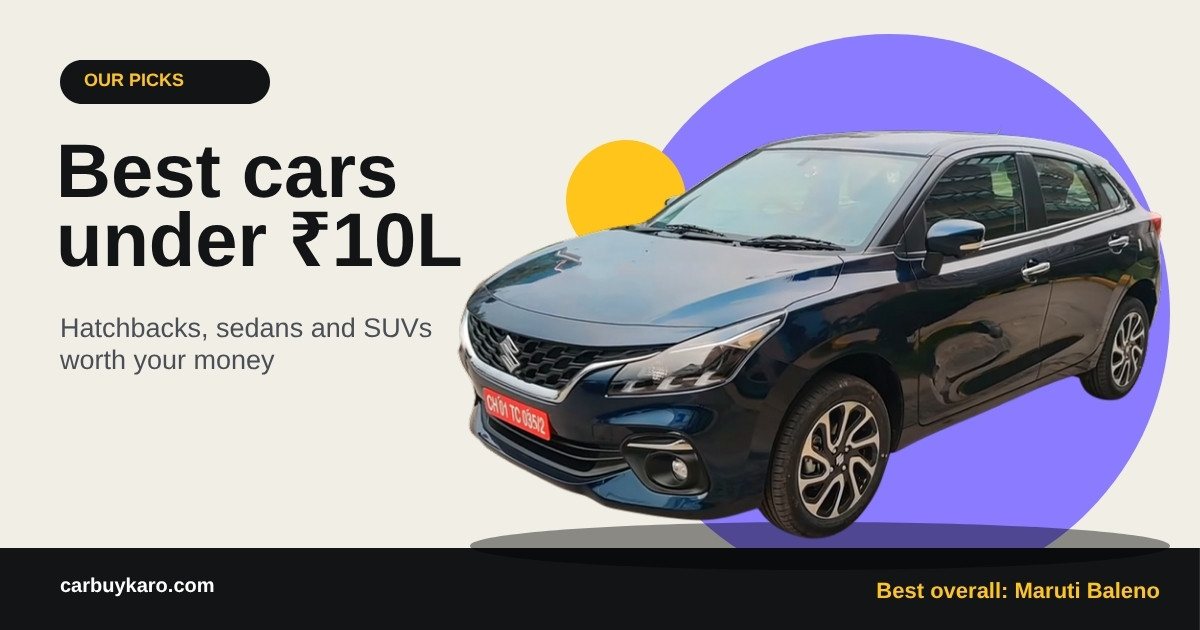
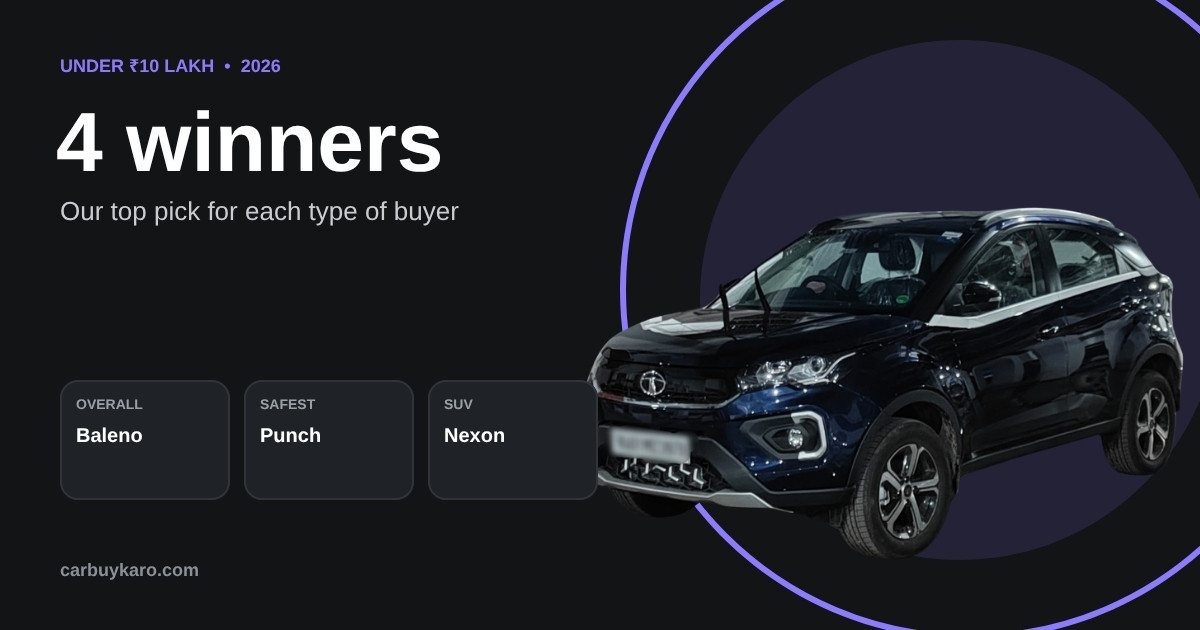
The best cars under 10 lakh in India in 2026 are the Maruti Baleno (best overall), Tata Punch (safest and best micro SUV), Tata Nexon (best compact SUV at this price), Maruti Dzire (best sedan), Maruti Swift (best to drive), Hyundai Exter (smoothest small SUV) and Hyundai i20 (most refined hatchback). Prices below are ex-showroom; add 10–15% for on-road costs.
Car prices in this segment fell in September 2025 when GST on small cars dropped to 18%. That means ₹10 lakh buys more car than it did two years ago. Here is how we ranked them and which variant we would buy.
How we chose
We looked at five things that matter most to Indian buyers at this budget:
- Safety: crash-test ratings and standard airbags.
- Running cost: real-world mileage, CNG options and service costs.
- Space: rear seat and boot for a family of four.
- Features: what you get at the variant you can actually afford.
- Ownership: service network, reliability and resale value.
We did not rank by top-variant features, because most people buy mid variants.
Quick list
| Car | Type | Price from (ex-showroom) | Best for |
|---|---|---|---|
| Maruti Baleno | Premium hatchback | ₹5.99 lakh | Best overall value |
| Tata Punch | Micro SUV | ₹5.59 lakh | Safety, bad roads |
| Tata Nexon | Compact SUV | about ₹7.4 lakh | SUV buyers, safety |
| Maruti Dzire | Compact sedan | about ₹6.8 lakh | Boot space, mileage |
| Maruti Swift | Hatchback | about ₹6.5 lakh | Fun, efficient |
| Hyundai Exter | Micro SUV | ₹5.81 lakh | Smooth city driving |
| Hyundai i20 | Premium hatchback | about ₹6 lakh | Refinement |
1. Maruti Baleno: best overall
The 2026 facelift made the Baleno even better value. It now uses the efficient Z12E three-cylinder engine (claimed 23.80–24.77 km/l), offers a CNG version (33.61 km/kg claimed), and adds ventilated seats and Level 2 ADAS on the top trim. Six airbags are standard. It is spacious, easy to drive and cheap to service.
Buy: Zeta AMT (about ₹8.5 lakh) for city buyers, or Zeta CNG (about ₹8.92 lakh) for high mileage. See our Baleno 2026 guide for the full price list.
2. Tata Punch: safest and best micro SUV
The 2026 Punch facelift carries a 5-star Bharat NCAP rating, a new 118 hp turbo-petrol option, a CNG AMT and a much better cabin with a 10.25-inch touchscreen and 360-degree camera on top trims. Its high ground clearance makes it great for broken roads.
Buy: a mid variant with the NA petrol AMT for city use, or the CNG AMT if you drive a lot. Our Tata Punch buyer’s guide breaks down every variant.
3. Tata Nexon: best compact SUV under ₹10 lakh
Lower and mid variants of the Nexon fall under ₹10 lakh after the GST cut. It offers a turbo-petrol, CNG and a strong safety record, plus plenty of features. For buyers who want a proper compact SUV rather than a micro SUV, it is the one to beat at this price.
Buy: a mid variant with the turbo-petrol manual or CNG. Compare it with its rival in our Nexon vs Brezza comparison.
4. Maruti Dzire: best sedan
The latest Dzire earned a 5-star Bharat NCAP rating, a first for a Maruti, with 29.46/32 for adult protection. It uses the Z12E engine with excellent mileage, has a big boot and a comfortable rear seat, and offers CNG.
Buy: a mid variant AMT or CNG. If you want a sedan, also wait for the new Tata Aeris, launching on 25 September.
5. Maruti Swift: best to drive
The Swift is light, agile and fun, with the same efficient Z12E engine. It is smaller than the Baleno inside, but more enjoyable on a twisty road. Service costs are among the lowest in India.
Buy: a mid variant AMT for city driving.
6. Hyundai Exter: smoothest micro SUV
The Exter’s four-cylinder engine is quieter and smoother than the three-cylinders in most rivals. It comes with six airbags as standard, a sunroof and a dual dashcam on higher variants, and a CNG option.
Buy: a mid variant AMT or CNG. See how it compares in Punch vs Exter.
7. Hyundai i20: most refined hatchback
The i20 has a smooth four-cylinder engine, a proper CVT and a premium-feeling cabin. It costs a little more to buy and run than the Baleno, but feels more upmarket.
Buy: a mid variant CVT. Read our Baleno vs i20 comparison.
Honourable mentions
- Hyundai Venue and Kia Sonet: lower variants fall under ₹10 lakh and offer strong features. The Venue has a strong Bharat NCAP score.
- Maruti Fronx: SUV styling with Baleno underpinnings; a facelift is due soon (see our Fronx facelift guide).
- Tata Tiago and Maruti Wagon R: for buyers with a budget closer to ₹5–7 lakh.
- Toyota Glanza: the Baleno’s twin, with a facelift launching in October.
Which body type suits you?
Hatchback (Baleno, Swift, i20): best efficiency, easiest to drive and park, most features for the money.
Compact sedan (Dzire, upcoming Aeris): biggest boot, comfortable rear seat, calm on highways.
Micro or compact SUV (Punch, Exter, Nexon): higher seating, better ground clearance, the look many buyers want. Usually a little less efficient.
How much can you really afford?
A car’s sticker price is only the start. A ₹9 lakh ex-showroom car costs about ₹10.3 lakh on-road, and then you pay for fuel, insurance and service every month. A sensible guide is to keep total monthly car costs under 10–15% of your take-home income.
For example, a ₹10.3 lakh on-road car with ₹2 lakh down and a ₹8.3 lakh loan at 9% for five years has an EMI of about ₹17,200. Add about ₹6,000 for fuel and ₹2,000 for insurance and service, and you are at ₹25,000 a month. Use our car affordability calculator to check your own situation, and the on-road price calculator to see real prices in your state.
Petrol, CNG or automatic?
- Under 1,000 km a month: petrol, manual or AMT.
- Over 1,200 km a month with good CNG availability: CNG. Tata offers CNG with an AMT.
- Heavy city traffic: an automatic makes life easier. Our AMT vs CVT vs DCT guide explains the types.
For the full break-even maths, see our petrol vs diesel vs CNG guide.
Common mistakes at this budget
- Buying the top variant of a small car when a mid variant of a bigger car costs the same.
- Choosing features over safety. A sunroof is nice; six airbags and a strong crash rating matter more.
- Ignoring the on-road price. Always compare on-road quotes, not ex-showroom prices.
- Skipping the base-variant check. Base variants often miss rear parking cameras and touchscreens, and they resell poorly. Our guide to choosing the right variant explains how to find the sweet spot.
- Taking dealer insurance blindly. Online quotes are often ₹5,000–10,000 cheaper.
Our top pick for each buyer
- First-time buyer, city: Maruti Baleno Zeta AMT.
- Safety-first family: Tata Punch mid variant.
- Rough roads: Tata Punch or Hyundai Exter.
- Long-distance, high mileage: Baleno or Dzire CNG.
- Enthusiast: Maruti Swift, or Punch turbo.
- Wants a proper SUV: Tata Nexon mid variant.
What changed in this segment recently
Three changes have made ₹10 lakh cars better than ever. First, the September 2025 GST cut to 18% for small cars lowered prices by roughly 7–9%. Our GST on cars guide explains the new rules. Second, six airbags have become standard on many models, and Bharat NCAP crash tests have pushed makers to build stronger bodies. Third, efficient engines like Maruti’s Z12E and factory CNG automatics have cut running costs.
Real ownership costs over five years
Buying price is only one part of what a car costs you. Here is a rough five-year picture for a typical buyer of a ₹9 lakh (ex-showroom) car who drives 1,200 km a month.
- Fuel: at 18 km/l and ₹95 per litre, about ₹6,300 a month, or ₹3.8 lakh over five years. A CNG version cuts this to about ₹2.4 lakh.
- Insurance: about ₹25,000–30,000 in year one, falling each year; roughly ₹1 lakh over five years with zero-depreciation cover.
- Service and tyres: about ₹50,000–70,000 over five years for a Maruti or Hyundai, a little more for some other brands.
- Depreciation: a car bought at ₹10.3 lakh on-road may be worth around ₹5–5.5 lakh after five years.
Add it up and a ₹9 lakh car costs roughly ₹10–11 lakh over five years beyond the loan interest. That is why running costs deserve as much attention as the sticker price. Our fuel cost calculator and resale value calculator help you compare options.
How to test drive a small car properly
A ten-minute spin around the dealership block tells you very little. Ask for a longer drive and cover these points:
- Traffic crawl. If you are buying an AMT, drive it in slow traffic and on a slope.
- Speed breakers. Take a few at normal speed with passengers. Listen for knocks and feel how the car settles.
- Highway run. Even 2–3 km at 80–90 km/h shows you engine noise and stability.
- Rear seat. Sit behind the driver’s seat set for the tallest family member.
- Parking. Reverse into a tight space and check the camera and sensors.
Summary
The best cars under 10 lakh in 2026 are the Maruti Baleno for overall value, the Tata Punch for safety, the Tata Nexon for SUV buyers, the Maruti Dzire for sedan buyers, the Swift for driving fun, the Hyundai Exter for smoothness and the i20 for refinement. Pick a mid variant, compare on-road prices and choose the fuel type that fits your monthly kilometres. For more guides, see our buying guides section.
Frequently asked questions
Which is the best car under 10 lakh in India?
For most buyers, the 2026 Maruti Baleno offers the best all-round value: efficient, spacious, well equipped and cheap to own. The Tata Punch is our pick for safety, and the Tata Nexon for buyers who want a compact SUV.
Which is the safest car under 10 lakh?
The Tata Punch and Maruti Dzire have 5-star Bharat NCAP ratings, and lower variants of the Tata Nexon and Hyundai Venue also fall under ₹10 lakh with strong crash-test records.
Which car under 10 lakh gives the best mileage?
The Maruti Baleno, Swift and Dzire with the Z12E engine claim around 24–25 km/l in petrol form, and their CNG versions claim well over 30 km/kg.
Should I buy a hatchback or compact SUV under 10 lakh?
A hatchback gives more features and efficiency for the money. A compact SUV gives higher seating and ground clearance. On good roads, the hatchback is smarter value; on rough roads, the SUV is less stressful.
Prices are ex-showroom unless we say otherwise, and makers change them often. Confirm the latest price, offers and variant details with an authorised dealer before you book.


