On this page 11 sections
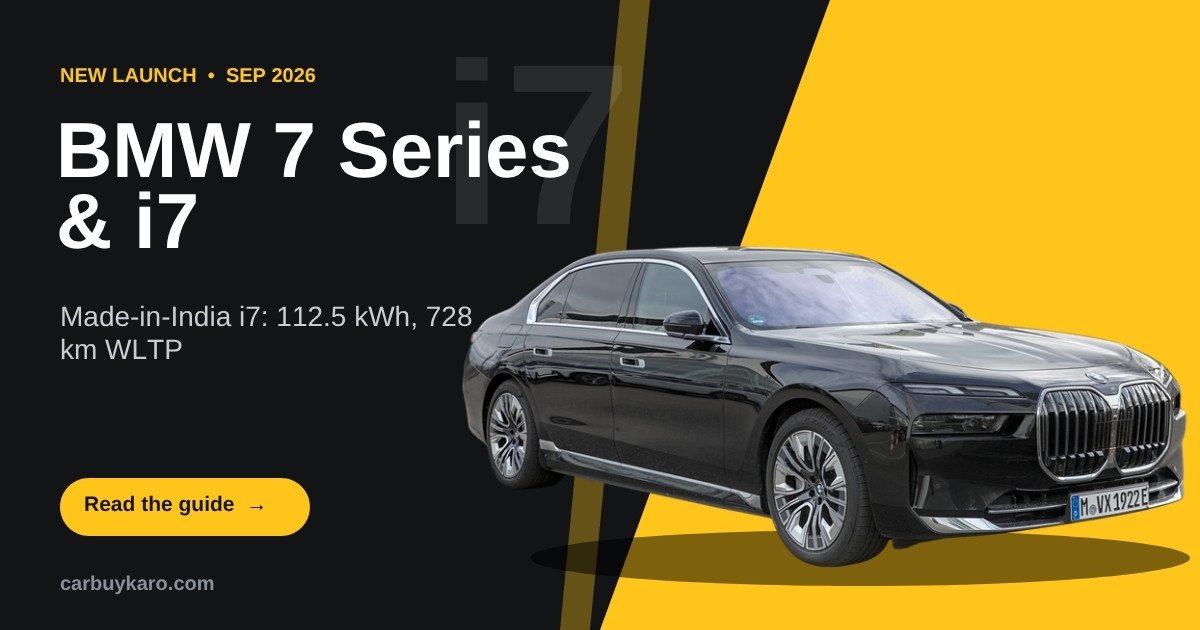
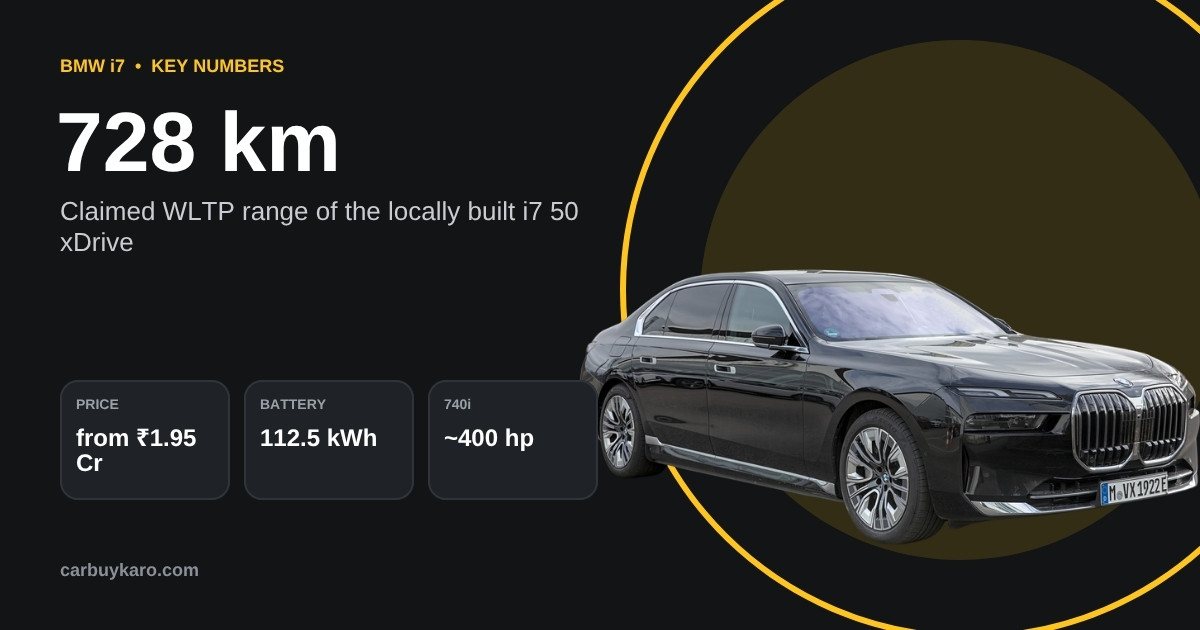
The BMW 7 Series and i7 facelift launched in India on 11 September 2026, with prices starting at ₹1.95 crore (ex-showroom) and going up to ₹2.65 crore for the i7 M70 xDrive. The facelift brings a reworked front end, a cabin inspired by BMW’s Neue Klasse design, a stronger 3.0-litre six-cylinder petrol with 48-volt mild hybrid, and a locally assembled i7 50 xDrive with a larger 112.5 kWh battery and a claimed 728 km WLTP range.
If you are shopping in this price band you already know what a 7 Series is. So we focus on what changed, which version makes sense for India, and how it compares with the Mercedes S-Class.
BMW 7 Series and i7 facelift prices
| Model | Powertrain | Ex-showroom (approx.) |
|---|---|---|
| 740i M Sport | 3.0 I6 turbo petrol, mild hybrid | from ₹1.95 crore |
| i7 50 xDrive | Dual motor, 112.5 kWh | around ₹1.95–2.1 crore |
| i7 M70 xDrive | Dual motor, high output | ₹2.65 crore |
BMW priced the locally assembled i7 very close to the petrol 740i. That is deliberate. Local assembly cuts import duty, and in many states EVs get lower or zero road tax. On-road, an i7 50 can end up cheaper than a 740i in a state such as Delhi or Maharashtra where EV road tax is waived or reduced. Read our EV road tax guide for your state, or run both through the on-road price calculator.
At this level, a ₹20–30 lakh difference in road tax is not unusual. It is worth ten minutes of maths.
What is new
Design
The front gets a new grille treatment and slimmer split headlamps, with revised bumpers front and rear. The illuminated grille stays. The design is still divisive, but the facelift looks a little calmer than the pre-update car.
Cabin
The biggest change is inside. BMW has brought in elements from its Neue Klasse concept: a wider, sleeker display layout, fewer physical buttons, a light strip across the dashboard and new materials. The rear is where most 7 Series owners in India actually sit, and it keeps the reclining executive seats with massage and the 31-inch theatre screen that folds down from the roof on higher trims.
Powertrains
- 740i: the 3.0-litre straight-six turbo-petrol now works with a 48-volt mild-hybrid system and makes up to about 400 hp and 540 Nm. The mild hybrid smooths out stop-start in traffic and adds a small torque boost off the line.
- i7 50 xDrive: new, larger 112.5 kWh battery with two motors and all-wheel drive. Claimed WLTP range is up to 728 km. Expect 550–600 km in real Indian use with the AC on full.
- i7 M70 xDrive: the performance flagship, with much higher output from its dual-motor setup.
There is no diesel. In this segment, diesel demand has faded, especially in Delhi-NCR where diesel cars have a 10-year limit.
740i or i7? How to choose
For most buyers in metro cities, the i7 is now the stronger choice:
- It is silent, which suits a chauffeur-driven car perfectly.
- Running costs are tiny. Even at a commercial tariff of ₹12 per unit, a full charge costs about ₹1,350 and covers 550+ km.
- In EV-friendly states, the on-road price can be lower than the 740i’s.
- Local assembly should mean better parts supply over time.
The 740i makes sense if you regularly drive long distances in regions with sparse fast charging, or if you simply prefer the character of a straight-six. It is also the easier car to resell to a buyer who is nervous about EVs, although that concern is fading quickly.
For home charging, BMW supplies a wallbox. At 11 kW AC, a full charge takes around 11 hours. Our home EV charger guide covers the electrical load you need to check before installation, which matters in older bungalows with a limited sanctioned load.
7 Series vs Mercedes S-Class vs EQS
| BMW 7 Series / i7 | Mercedes S-Class / EQS | |
|---|---|---|
| Positioning | Tech-forward, sportier to drive | Classic luxury, softer ride |
| EV option | i7, locally assembled | EQS |
| Rear seat | Theatre screen, executive seats | Executive seats, very quiet |
The S-Class has long been the default choice for Indian business families. The facelifted 7 Series, especially the locally built i7, is the most serious challenge BMW has mounted in years. Drive both from the back seat. That is where the decision should be made.
Ownership costs at this level
Luxury car ownership has costs beyond the EMI:
- Insurance: comprehensive cover with zero depreciation and return-to-invoice runs to several lakh rupees in year one. Our zero depreciation insurance guide explains what the add-ons actually cover.
- Service: BMW offers service packages; buy one at purchase, when discounts are easiest to negotiate.
- Depreciation: large luxury sedans lose value fast, often 40–50% in three years. Our resale value calculator gives a rough idea.
- Tyres: large-diameter run-flat tyres are expensive. Budget for them.
Worked example: 740i vs i7 in Mumbai over five years
- Assume both cost about ₹1.95 crore ex-showroom.
- In Maharashtra, petrol cars in this price band attract steep road tax, well above 10%, while EV road tax is waived. That alone can mean a gap of ₹25 lakh or more on-road.
- Running 1,500 km a month for five years is 90,000 km. The 740i at a real 8 km/l and ₹104 per litre spends about ₹11.7 lakh on fuel. The i7 at about 5 km per unit and ₹12 per unit spends about ₹2.2 lakh.
- Total five-year saving for the i7: well over ₹30 lakh, before resale is considered.
These numbers will vary by city and usage, but the direction is clear.
Things to check before booking
- Confirm the exact variant-wise price and what is standard versus optional; BMW’s option packs change the final price a lot.
- Ask about the waiting period for the locally built i7 versus imported versions.
- Check wallbox installation at both home and office.
- Ask for the battery warranty terms on the i7 in writing. Our EV battery warranty guide lists what to look for.
Living with an i7 in an Indian city
Most first-time EV owners at this level worry about the same three things: charging at home, long trips, and what happens during a power cut. Here is how it works in practice.
Home charging. The i7 comes with an AC wallbox. On an 11 kW connection it adds roughly 50–60 km of range per hour, so an overnight session refills even a nearly empty battery. The catch is load. Many homes in Indian cities have a sanctioned load of 5–7 kW for the whole house. Running an 11 kW charger alongside air conditioners will trip the main breaker or attract a penalty from the power company. Before delivery, ask your electrician to check the sanctioned load and apply for an increase if needed. In most cities this takes one to three weeks and costs a few thousand rupees in fees and deposit.
Long trips. Mumbai–Pune, Delhi–Jaipur and Bengaluru–Mysuru are well covered by 60 kW+ DC chargers. At a 150 kW charger, the i7 can add around 250–300 km in about 25 minutes. Trips into hill regions or smaller towns still need planning. Check a charging app the night before and have a backup charger on your route, because a single faulty unit can mean a long wait.
Power cuts. An EV does not need grid power to drive, only to charge. If your area has frequent outages, time charging for the night and keep the battery above 50% as a habit.
Chauffeur training. This matters more than people expect. Drivers used to petrol or diesel cars often brake late and accelerate hard, which wastes range and wears tyres faster. A 20-minute briefing on smooth driving and regenerative braking can add 10–15% to real-world range.
740i: who should still pick petrol?
There are sound reasons to choose the petrol car, and they are practical rather than emotional.
- You do frequent long trips to hill stations or smaller cities where fast chargers are rare or unreliable. A 740i refuels anywhere in five minutes.
- You keep cars for a very long time and want the most predictable repair costs after the warranty ends. Combustion drivetrains are well understood by independent workshops; high-voltage EV repairs still go back to the dealer.
- Your building will not allow a charger and you have no office charging. Relying on public DC chargers for a flagship EV is inconvenient.
For everyone else, especially owners who use the car within a city for meetings and family duties, the i7 is the more relaxing and cheaper car to run.
Negotiation tips at this price
At ₹2 crore, a 2–3% discount equals ₹4–6 lakh, so it is worth negotiating calmly.
- Ask for the full price breakdown, including options, before discussing discounts.
- Negotiate the service package, extended warranty and insurance as part of the deal rather than separately.
- If you are replacing an older BMW or Mercedes, get independent quotes for your old car before accepting the dealer’s exchange value.
- Ask whether any corporate or loyalty benefits apply. Many luxury brands run programmes for business owners and existing customers.
Summary
The BMW 7 Series and i7 facelift arrives in India from ₹1.95 crore with a fresh cabin, a stronger mild-hybrid six-cylinder and, most importantly, a locally assembled i7 with a 112.5 kWh battery and up to 728 km of WLTP range. For city-based, chauffeur-driven owners, the i7 now makes more sense than the petrol car in most states. See our other new car launches for this season’s arrivals.
Frequently asked questions
What is the price of the BMW 7 Series facelift in India?
The facelifted 7 Series and i7 range starts at ₹1.95 crore ex-showroom. The top i7 M70 xDrive costs ₹2.65 crore.
Is the BMW i7 made in India?
The i7 50 xDrive is now assembled at BMW's plant in Chennai. BMW says India is the only country outside Germany that builds its flagship electric sedan.
What is the range of the new BMW i7?
The i7 50 xDrive uses a 112.5 kWh battery and has a claimed WLTP range of up to 728 km. Real-world range in India is likely to be around 550–600 km.
What engine does the new BMW 740i have?
A 3.0-litre turbo-petrol straight-six with a 48-volt mild-hybrid system, making up to about 400 hp and 540 Nm.
Prices are ex-showroom unless we say otherwise, and makers change them often. Confirm the latest price, offers and variant details with an authorised dealer before you book.


