On this page 18 sections
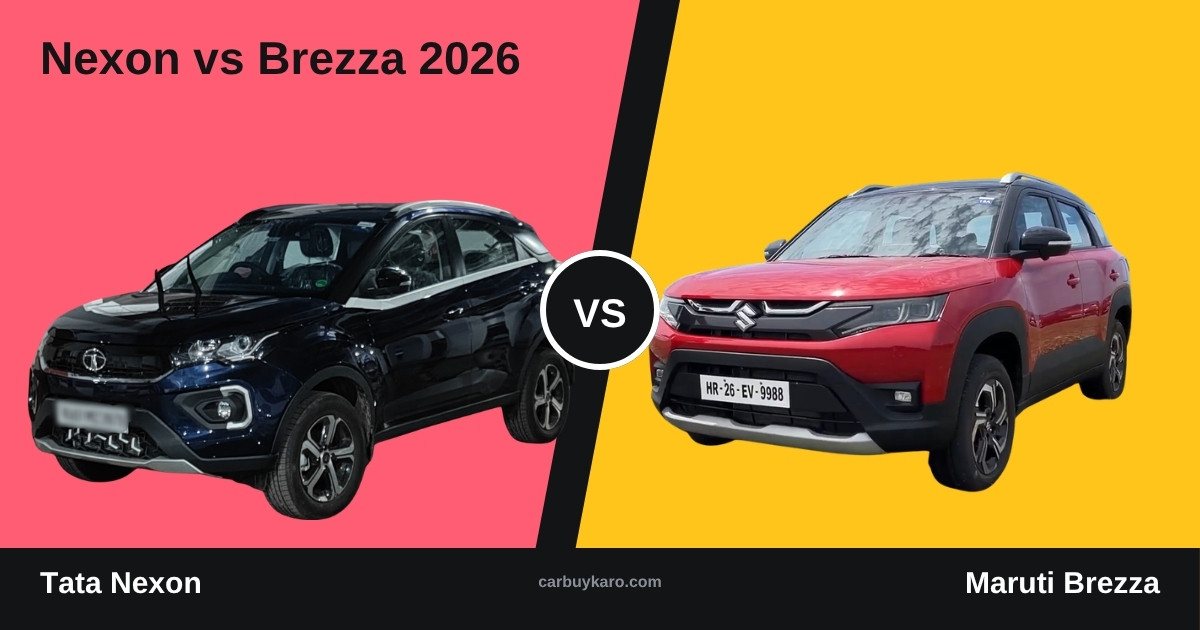
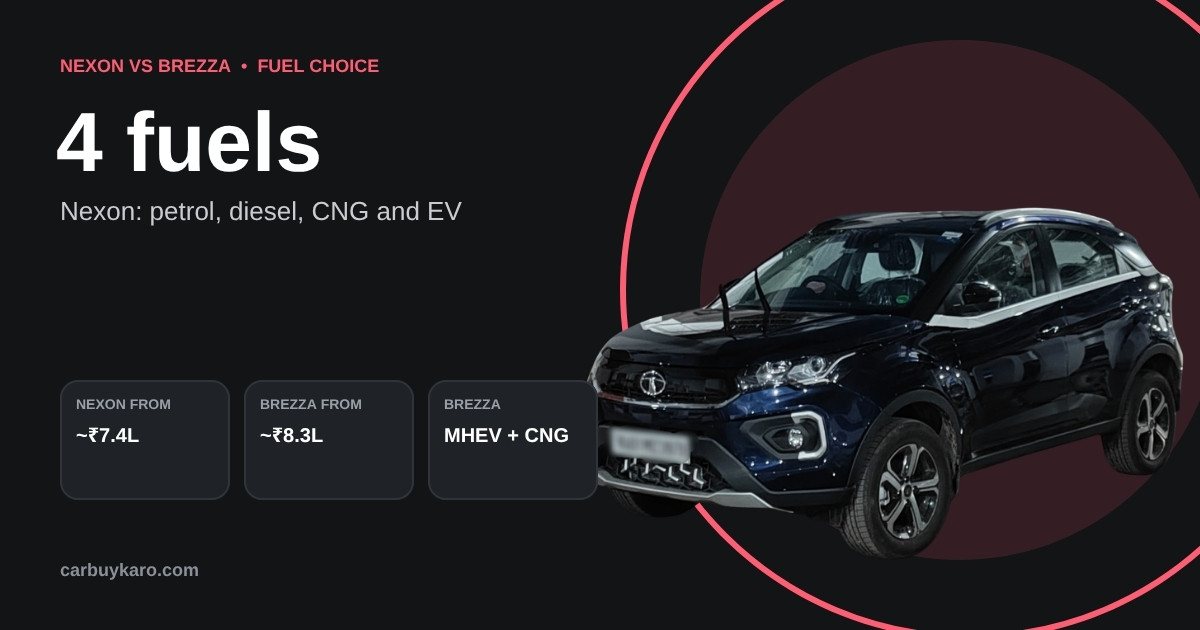
The Nexon vs Brezza comparison sets India’s safety-focused compact SUV against its most efficient and easiest-to-own rival. Short answer: the Tata Nexon (from about ₹7.4 lakh ex-showroom) offers more choice, with turbo-petrol, diesel, CNG and a separate EV, plus strong crash-test credentials and more features per rupee. The Maruti Brezza (from about ₹8.3 lakh) has a smoother 1.5-litre petrol mild-hybrid, better petrol mileage, lower service costs and the biggest service network in India. Pick the Nexon for safety, features and diesel; pick the Brezza for smoothness, efficiency and worry-free ownership.
Prices for both fell in late 2025 after GST on small cars was cut. Our guide to GST on cars explains how that works. Here is the detailed comparison.
Nexon vs Brezza: key specs
| Tata Nexon | Maruti Brezza | |
|---|---|---|
| Starting price (ex-showroom) | about ₹7.4 lakh | about ₹8.3 lakh |
| Petrol engine | 1.2 turbo, about 118 hp, 170 Nm | 1.5 NA mild hybrid, about 102 hp, 139 Nm |
| Diesel | 1.5, about 113 hp | Not offered |
| CNG | Yes (twin-cylinder) | Yes |
| Electric | Nexon EV (separate model) | No |
| Claimed petrol mileage | about 17.4 km/l | about 20.5 km/l |
Engines and driving
Nexon
The 1.2 turbo-petrol has more torque (170 Nm) than the Brezza’s engine, and it arrives low in the rev range. It feels punchy in the mid-range, good for overtaking. The trade-off is a three-cylinder’s characteristic sound and higher fuel use when driven hard.
The 1.5 diesel is the Nexon’s trump card. It offers strong pulling power and the best highway mileage in the segment. For buyers doing 2,000 km a month on highways, the diesel is excellent value.
The CNG version uses Tata’s twin-cylinder layout, which keeps much of the boot usable.
Brezza
The 1.5 petrol mild hybrid is a four-cylinder, naturally aspirated engine. It is smooth, quiet and very reliable, with a gentle power delivery that suits relaxed driving. It feels less punchy than the Nexon turbo on the highway, especially with a full load. The mild-hybrid system helps with start-stop and a small efficiency gain; it cannot drive the car on electric power alone.
The CNG Brezza is popular with high-mileage users, although it loses boot space and some performance.
Our take
For city drivers who value smoothness, the Brezza’s engine is nicer. For highway users who want punch or diesel economy, the Nexon wins.
Real-world fuel cost
| Version | Real-world economy | Monthly cost at 1,500 km |
|---|---|---|
| Nexon 1.2 turbo petrol | 13 km/l | about ₹11,000 (₹95/l) |
| Brezza 1.5 petrol | 15 km/l | about ₹9,500 (₹95/l) |
| Nexon diesel | 18 km/l | about ₹7,500 (₹90/l) |
| Brezza CNG | 22 km/kg | about ₹5,800 (₹85/kg) |
| Nexon CNG | 20 km/kg | about ₹6,400 (₹85/kg) |
Petrol to petrol, the Brezza saves around ₹1,500 a month at this usage. The Nexon diesel and both CNG versions are the cheapest to run. Calculate your own case with our fuel cost calculator.
Safety
The Nexon has earned 5-star adult occupant ratings in crash tests and is widely seen as one of the safest cars in its class. The Brezza is well built and offers six airbags on higher variants and ESC. If safety is your top priority, the Nexon’s record gives it an edge. Always check the latest Bharat NCAP results for the exact version you plan to buy; our safest cars guide tracks them.
Features
The Nexon is known for packing features into its price: large touchscreen, digital cluster, 360-degree camera, ventilated seats, sunroof and premium audio on upper trims. It often offers more features at a given price than the Brezza.
The Brezza covers the essentials well, with a touchscreen, head-up display, 360-degree camera and sunroof on the top trims. Its cabin is simpler and more functional.
Space and comfort
Both have similar rear-seat space and seat five. The Brezza’s boxy shape gives it a little more headroom and a more upright seating position. The Nexon’s rear seat is comfortable but its coupe-like roofline slightly reduces headroom for tall passengers.
Boot space is similar in petrol versions. In CNG form, the Nexon’s twin-cylinder setup preserves more usable boot space than a single-cylinder layout.
Service, reliability and resale
This is where the Brezza shines. Maruti’s service network covers almost every town in India, parts are cheap and quick to get, and service costs are among the lowest in the market. Resale values are strong, and Brezzas sell quickly in the used market.
The Nexon has improved a lot in reliability and is extremely popular, so resale is also good. Tata’s service experience varies by dealer. Check reviews for your nearest Tata workshop.
Nexon vs Brezza: which should you buy?
Buy the Nexon if:
- Safety is your top priority.
- You want a diesel for high highway mileage.
- You want more features for the money.
- You enjoy a punchier turbo-petrol.
Buy the Brezza if:
- You want a smooth, reliable petrol engine.
- Low service costs and easy service anywhere in India matter to you.
- You drive mostly in the city and want better petrol mileage.
- You want the most hassle-free ownership experience.
Which variant and fuel type?
- City, under 1,000 km a month: Brezza petrol automatic or Nexon petrol automatic.
- 1,500 km+ a month, highway: Nexon diesel.
- 1,500 km+ a month, city, CNG available: Brezza CNG or Nexon CNG.
- Home charging available, predictable commute: consider the Nexon EV. See our best electric cars guide.
Worked example: five-year cost, petrol automatic
Assume both cost about ₹12 lakh on-road for a mid-spec petrol automatic, and you drive 1,200 km a month for five years.
- Fuel: Nexon at 12.5 km/l city spends about ₹9,100 a month; Brezza at 14 km/l about ₹8,100. Five-year difference: about ₹60,000 in the Brezza’s favour.
- Service: Maruti’s service costs are typically lower. Allow a further ₹15,000–25,000 difference over five years.
- Resale: both hold value well; call it even.
Net, the Brezza is likely ₹75,000–85,000 cheaper to run over five years in petrol form, while the Nexon offers stronger safety credentials and more features. You decide which matters more. Check EMIs in our car EMI calculator.
Test drive tips
- Drive both on a highway stretch with four people to compare engine performance loaded.
- Try the automatics in stop-go traffic.
- Sit in the rear of both and check headroom.
- Compare the boot if you plan a CNG version.
- Ask both dealers for itemised on-road quotes.
Common mistakes
- Buying diesel for city use. The Nexon diesel shines on highways; in the city the petrol is fine.
- Assuming “mild hybrid” means big fuel savings. The Brezza’s mild-hybrid adds a small gain, not strong-hybrid numbers.
- Ignoring the Nexon EV. If you can charge at home, it can be cheaper to own over five years.
- Not comparing other rivals. The Hyundai Venue, Kia Sonet, Mahindra XUV 3XO and Maruti Fronx deserve a test drive too.
Other compact SUVs to consider
The segment is crowded. The Hyundai Venue and Kia Sonet offer strong feature lists and multiple engines. The Mahindra XUV 3XO is powerful and well equipped. The Maruti Fronx is more efficient and stylish, with a facelift due soon (see our Fronx facelift guide). The Skoda Kylaq offers a solid European feel. For a smaller budget, the Tata Punch is worth a look; we compare it in Punch vs Exter.
Understanding mild hybrid vs strong hybrid
The Brezza’s “Smart Hybrid” label causes confusion, so it is worth explaining. A mild hybrid uses a small battery and an integrated starter-generator. It shuts the engine off at stops, restarts it smoothly and gives a small boost during acceleration. It cannot drive the car on electric power alone. The fuel saving is modest, usually a few percent in city traffic.
A strong hybrid, like the one in the Maruti Grand Vitara or Toyota Hyryder, has a much larger battery and motor. It can drive the car on electric power at low speeds and can cut fuel use sharply in city traffic, often by 30–40%. These cost significantly more.
So the Brezza’s mild hybrid is a useful, low-cost efficiency aid, not a reason on its own to buy the car. Our hybrid vs electric guide explains all the types.
Automatic gearboxes compared
The Nexon offers an AMT and a dual-clutch automatic with the turbo-petrol (availability depends on variant), and an AMT with the diesel. The Brezza uses a six-speed torque-converter automatic with its petrol engine.
The Brezza’s torque converter is smooth and dependable in stop-go traffic, and it is the easier automatic to live with in heavy city use. The Nexon’s DCT is quicker and more efficient, but some buyers find DCTs less smooth at crawling speeds. The Nexon’s AMTs are affordable and efficient, with the typical AMT pause between shifts. Our AMT vs CVT vs DCT guide explains each type in detail.
Colours and waiting periods
Both cars sell in large numbers, so waiting periods are usually manageable for common colours. Automatic and CNG versions can take longer, especially around festivals. Ask for a written delivery estimate and be flexible on colour if you need the car quickly.
Warranty and extended warranty
Both brands offer standard warranties and sell extended warranty packages. Tata has been generous with warranty coverage on its newer models to build confidence, and Maruti’s extended warranty is inexpensive and widely honoured. If you plan to keep the car beyond five years, buy the extended warranty at purchase, when it is usually cheapest.
Summary
In the Nexon vs Brezza contest, the Nexon wins on safety, engine choice and features, while the Brezza wins on smoothness, petrol efficiency, service costs and ownership ease. Families that prioritise crash safety or need a diesel should pick the Nexon; buyers who want a reliable, efficient petrol SUV with easy service anywhere should pick the Brezza. For more head-to-heads, visit our comparisons section.
Frequently asked questions
Which is better, Nexon or Brezza?
The Nexon offers more engine choices including diesel, stronger crash-test credentials and more features for the money. The Brezza offers better real-world fuel efficiency in petrol form, a smoother engine, lower service costs and Maruti's huge service network.
Which has better mileage, Nexon or Brezza?
In petrol form, the Brezza is more efficient, with a claimed figure around 20.5 km/l against about 17.4 km/l for the Nexon turbo-petrol. The Nexon diesel is the most efficient option of all on the highway.
Is the Nexon safer than the Brezza?
The Nexon has earned 5-star crash-test ratings and is widely regarded as one of the safest cars in its segment. The Brezza is also well built, but check the latest Bharat NCAP results for both before deciding.
Does the Brezza have a diesel engine?
No. The Brezza is sold with a 1.5-litre petrol mild-hybrid engine and a factory CNG option. The Nexon offers petrol, diesel and CNG, plus a separate Nexon EV.
Prices are ex-showroom unless we say otherwise, and makers change them often. Confirm the latest price, offers and variant details with an authorised dealer before you book.


