On this page 19 sections
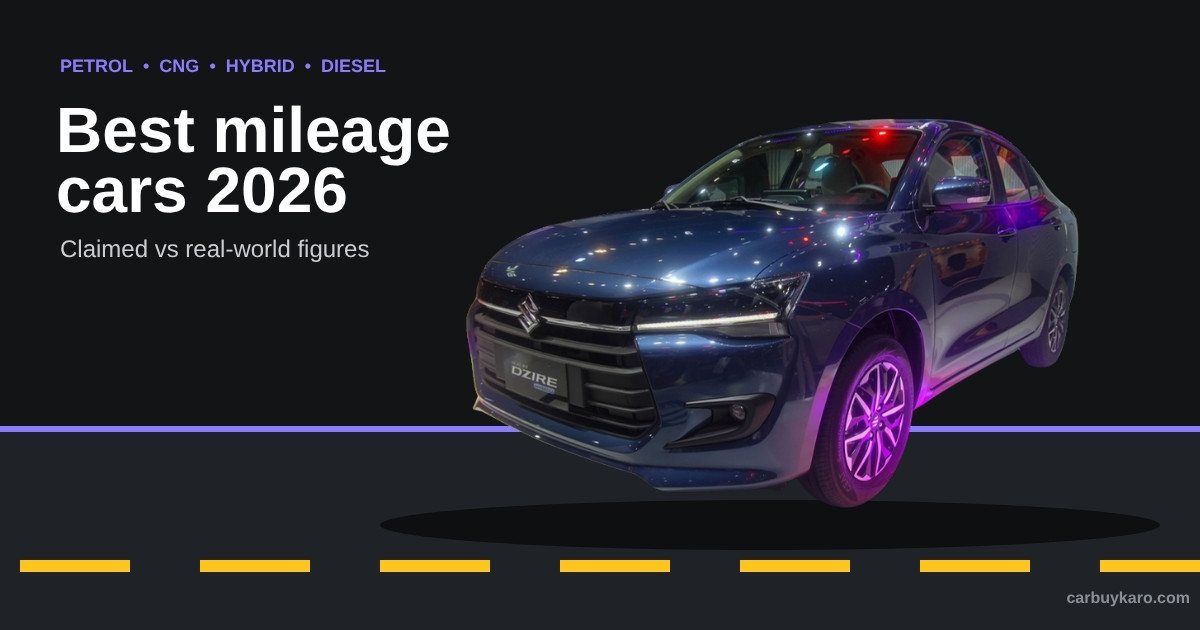
The best mileage cars in India in 2026 fall into four groups. Petrol: the Maruti Baleno, Swift and Dzire with the Z12E engine claim roughly 24–25 km/l. CNG: the Baleno CNG claims 33.61 km/kg, and small Maruti CNG cars are the cheapest to run per kilometre. Strong hybrid: the Maruti Grand Vitara, Toyota Hyryder and Honda City e:HEV claim around 27–28 km/l and often exceed 20 km/l in real city traffic. Diesel: compact SUVs like the Tata Nexon diesel are the most efficient on highways.
Here is our ranking by category, with real-world numbers and cost per kilometre.
Claimed vs real mileage
Claimed figures come from a standard lab test designed to compare cars fairly. They are not a promise of what you will get. In Indian conditions, expect:
- Petrol cars: 65–80% of claimed figures in mixed driving.
- CNG cars: 70–80% of claimed figures.
- Strong hybrids: 70–85% in city traffic; the gap is smaller in slow traffic because the hybrid system works best there.
- Diesel cars: 75–85%, better on highways.
We show both claimed and typical real-world figures below.
Best mileage petrol cars
| Car | Claimed | Typical real-world |
|---|---|---|
| Maruti Baleno (Z12E) AMT | 24.77 km/l | 17–20 km/l |
| Maruti Swift (Z12E) AMT | about 25 km/l | 17–21 km/l |
| Maruti Dzire (Z12E) | about 25 km/l | 17–20 km/l |
| Toyota Glanza (facelift, Z12E) | similar to Baleno | 17–20 km/l |
| Hyundai Exter AMT | about 19 km/l | 14–17 km/l |
Maruti’s Z12E three-cylinder is currently the petrol efficiency leader in its class. If you want a petrol car and care most about fuel bills, start here. Read our 2026 Baleno guide for details.
Best mileage CNG cars
| Car | Claimed | Typical real-world |
|---|---|---|
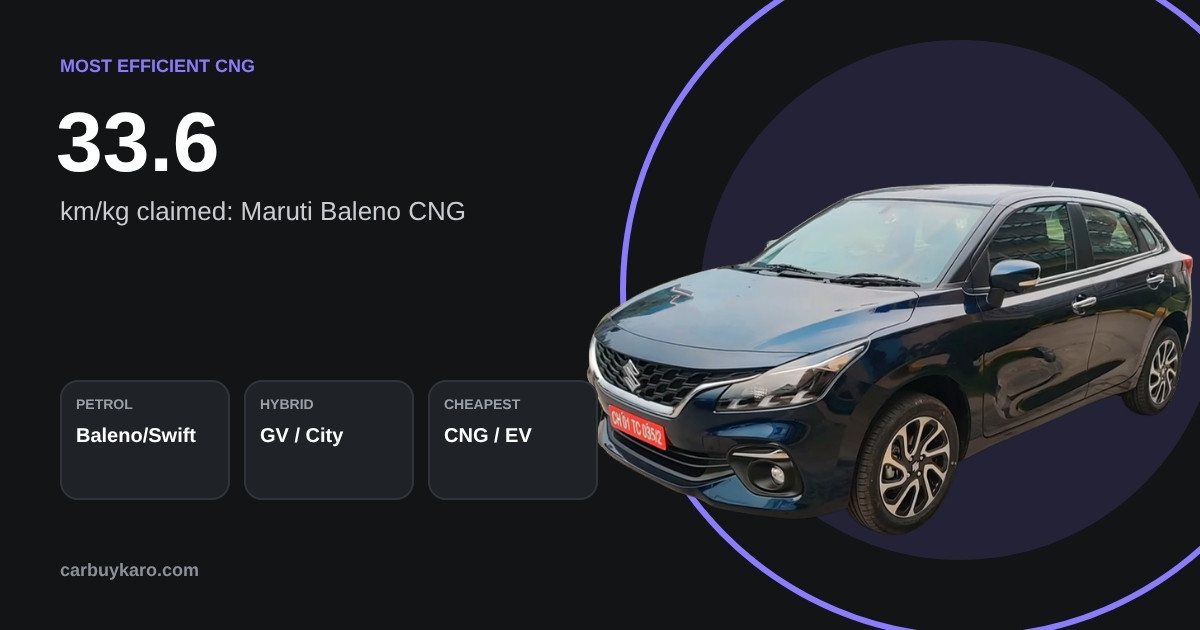
| Maruti Baleno CNG | 33.61 km/kg | 25–28 km/kg |
| Maruti Swift / Dzire CNG | over 32 km/kg | 25–28 km/kg |
| Maruti Wagon R / Celerio CNG | about 33–34 km/kg | 25–29 km/kg |
| Tata Punch CNG AMT | about 26 km/kg | 20–23 km/kg |
| Hyundai Exter CNG | about 27 km/kg | 21–24 km/kg |
At ₹85 per kg, a CNG car at 26 km/kg costs about ₹3.3 per km. That is the cheapest way to run a combustion car in India. See our best CNG cars guide for the full list.
Best mileage strong hybrids
| Car | Claimed | Typical real-world (city) |
|---|---|---|
| Maruti Grand Vitara strong hybrid | about 27.97 km/l | 20–24 km/l |
| Toyota Hyryder strong hybrid | about 27.97 km/l | 20–24 km/l |
| Honda City e:HEV | over 27 km/l | 20–25 km/l |
| Toyota Innova Hycross hybrid | about 23 km/l | 15–18 km/l |
Strong hybrids shine in city traffic, where they run on electric power at low speeds and recover energy when braking. On the highway, the gap with a petrol car narrows. Our hybrid vs electric guide explains how they work, and our City vs Verna comparison covers the City hybrid in detail.
Best mileage diesel cars
Diesel options have shrunk, but a few remain efficient choices for highway users. The Tata Nexon diesel, Mahindra XUV 3XO diesel and Kia Sonet/Seltos diesels typically return 16–20 km/l on highways. Diesel suits high-mileage drivers outside Delhi-NCR. Our petrol vs diesel vs CNG guide shows when it pays off.
Cost per kilometre compared
Using typical real-world figures and fuel at ₹95 per litre (petrol), ₹90 (diesel) and ₹85 per kg (CNG):
| Type | Example | Cost per km |
|---|---|---|
| CNG hatchback | Baleno CNG at 26 km/kg | about ₹3.3 |
| Strong hybrid SUV | Grand Vitara at 21 km/l | about ₹4.5 |
| Petrol hatchback | Baleno AMT at 18.5 km/l | about ₹5.1 |
| Diesel compact SUV | Nexon diesel at 18 km/l | about ₹5.0 |
| Petrol midsize SUV | at 12 km/l | about ₹7.9 |
| EV, home charging | at 6.5 km/unit, ₹8/unit | about ₹1.2 |
For someone driving 1,500 km a month, the gap between ₹3.3 and ₹7.9 per km is about ₹6,900 a month, or over ₹4 lakh in five years.
How to get better mileage from any car
Your driving habits can change real-world mileage by 15–25%.
- Keep tyres at the right pressure. Check every two weeks. Under-inflated tyres cost fuel.
- Drive smoothly. Gentle acceleration and early braking save fuel. Anticipate traffic.
- Keep a steady speed on highways. Around 80–90 km/h is usually the sweet spot. Fuel use rises sharply above 100 km/h.
- Use AC sensibly. In city traffic, AC adds noticeably to fuel use. On highways, AC is better than open windows.
- Remove extra weight. Unused luggage and roof carriers reduce mileage.
- Service on time. Clean filters, correct oil and good spark plugs matter.
- Avoid long idling. If you are stopped for more than a minute or two, switch off (if your car has no auto start-stop).
How to measure your own mileage
The trip computer is useful but often optimistic. For an accurate figure:
- Fill the tank to full and reset the trip meter.
- Drive normally.
- Fill to full again, and note the litres or kilograms added.
- Divide kilometres by fuel added.
Our mileage calculator does this for you and shows your cost per kilometre.
Which efficient car suits you?
- Budget buyer, city, under 1,000 km a month: Baleno or Swift petrol AMT.
- High mileage city driver: Baleno, Swift or Dzire CNG; or Punch CNG AMT for an automatic.
- Family SUV, lots of city driving: Grand Vitara or Hyryder strong hybrid.
- Sedan buyer, lots of city driving: Honda City e:HEV.
- Highway-heavy, outside Delhi-NCR: a diesel compact SUV.
- Predictable commute with home charging: an EV. See our best electric cars list.
Common mistakes
- Choosing on claimed figures alone. Compare real-world expectations instead.
- Buying CNG without checking local pumps. Long queues waste time and fuel.
- Paying for a hybrid when you drive mostly on highways. The benefit is largest in traffic.
- Ignoring purchase price. A more efficient car that costs ₹3 lakh more may take years to pay back. Use our fuel cost calculator to check.
Worked example: Baleno petrol vs Baleno CNG vs Grand Vitara hybrid
A buyer in Delhi drives 1,500 km a month.
- Baleno petrol AMT at 18.5 km/l: about ₹7,700 a month.
- Baleno CNG at 26 km/kg (CNG around ₹77/kg in Delhi): about ₹4,400 a month.
- Grand Vitara hybrid at 21 km/l: about ₹6,800 a month.
The Baleno CNG is cheapest to run, but the Grand Vitara is a much bigger, more powerful SUV. The comparison shows how different priorities lead to different “best mileage” answers.
Why mileage matters more than ever
Fuel is the largest running cost for most Indian car owners. A family driving 1,200 km a month in a car that returns 12 km/l spends around ₹9,500 a month on petrol. The same family in a car returning 20 km/l spends about ₹5,700. That ₹3,800 difference is ₹45,600 a year, or more than ₹2.25 lakh over five years. For many buyers, that is as much as the difference between a mid and top variant.
This is why efficient powertrains, like Maruti’s three-cylinder Z12E, factory CNG and strong hybrids, have become so popular. They let buyers enjoy bigger or better-equipped cars without a big jump in monthly costs.
Efficient cars by budget
Under ₹7 lakh: Maruti Swift and Wagon R petrol and CNG, Tata Tiago CNG, Hyundai Exter CNG. All are cheap to run and easy to service.
₹7–10 lakh: Maruti Baleno, Dzire and Swift AMT; Toyota Glanza; Tata Punch CNG AMT. This is the sweet spot for efficiency.
₹10–15 lakh: Maruti Brezza CNG, Tata Nexon diesel and CNG, lower variants of the Maruti Grand Vitara. Our best SUV under ₹15 lakh list covers these in detail.
₹15–25 lakh: Maruti Grand Vitara and Toyota Hyryder strong hybrids, Honda City e:HEV, Toyota Innova Hycross hybrid. These combine space and comfort with excellent efficiency.
Above ₹25 lakh: Kia Sorento hybrid and EVs like the BMW i7, where running costs are very low for the class.
Does AC really reduce mileage?
Yes, especially in city traffic. The AC compressor is driven by the engine, and at idle or low speeds it can account for a significant share of fuel use. In our experience, city mileage can drop by 10–15% with the AC running hard on a hot day. On the highway, the effect is smaller, and using the AC is more efficient than driving with windows open, which increases drag. Setting the AC to a sensible 24°C instead of the coldest setting helps.
Are mileage-boosting products worth it?
No. Fuel additives, magnets, special spark plugs and “fuel saver” gadgets make big promises but rarely deliver measurable results in independent tests. The reliable ways to improve mileage are proper tyre pressures, smooth driving, correct servicing and removing unnecessary weight.
Mileage in hilly areas and on highways
Mileage changes a lot with terrain. Climbing ghats and hill roads uses much more fuel, while the descent uses very little. Strong hybrids recover some energy on the way down, which helps. On flat highways at a steady 80–90 km/h, most petrol cars get close to or even beat their city figures, while CNG cars stay very economical.
If you live in a hilly city like Shimla, Shillong or Dehradun, expect lower real-world mileage from any car, and consider a slightly larger engine or a hybrid so the car is not working flat out on every climb.
Mileage myths
- “Diesel always gives better mileage.” Diesel is more efficient per litre, but small petrol and CNG cars can cost less per kilometre.
- “Higher-octane fuel improves mileage.” Only if your engine is designed for it. For most cars, regular petrol is fine.
- “Coasting in neutral saves fuel.” Modern fuel-injected cars use almost no fuel when coasting in gear. Neutral coasting is less safe and saves nothing.
Quick answer by budget
Under ₹10 lakh, a Maruti Z12E petrol or small Maruti CNG car. Between ₹10 and ₹20 lakh, a strong hybrid if you drive in the city, a diesel if you live on highways. Above that, look at EVs and premium hybrids.
Summary
The best mileage cars in India in 2026 are Maruti’s Z12E-engined petrol cars (Baleno, Swift, Dzire), small Maruti CNG models, and strong hybrids like the Grand Vitara, Hyryder and City e:HEV. CNG gives the lowest cost per kilometre among combustion cars; hybrids give excellent efficiency without CNG’s compromises; EVs are cheapest of all with home charging. Pick the type that fits your driving, then drive smoothly to get the most from it. See all our buying guides for more help.
Frequently asked questions
Which car gives the best mileage in India?
Among petrol cars, Maruti's models with the Z12E engine, such as the Baleno, Swift and Dzire, claim around 24–25 km/l. Strong hybrids like the Maruti Grand Vitara, Toyota Hyryder and Honda City e:HEV claim 27–28 km/l. CNG versions of small Marutis claim more than 33 km/kg.
What is the difference between claimed and real mileage?
Claimed mileage comes from a standard lab test cycle. Real-world mileage depends on traffic, driving style, AC use and load, and is usually 20–35% lower for petrol and CNG cars.
Which is the most fuel-efficient SUV in India?
The strong-hybrid Maruti Grand Vitara and Toyota Hyryder, with claimed figures around 27–28 km/l. In real city traffic they often deliver over 20 km/l.
Is CNG or hybrid better for mileage?
CNG is usually cheaper per kilometre. A strong hybrid avoids CNG's boot-space loss and refuelling queues, and gives more power, but costs more to buy.
Prices are ex-showroom unless we say otherwise, and makers change them often. Confirm the latest price, offers and variant details with an authorised dealer before you book.


