On this page 15 sections
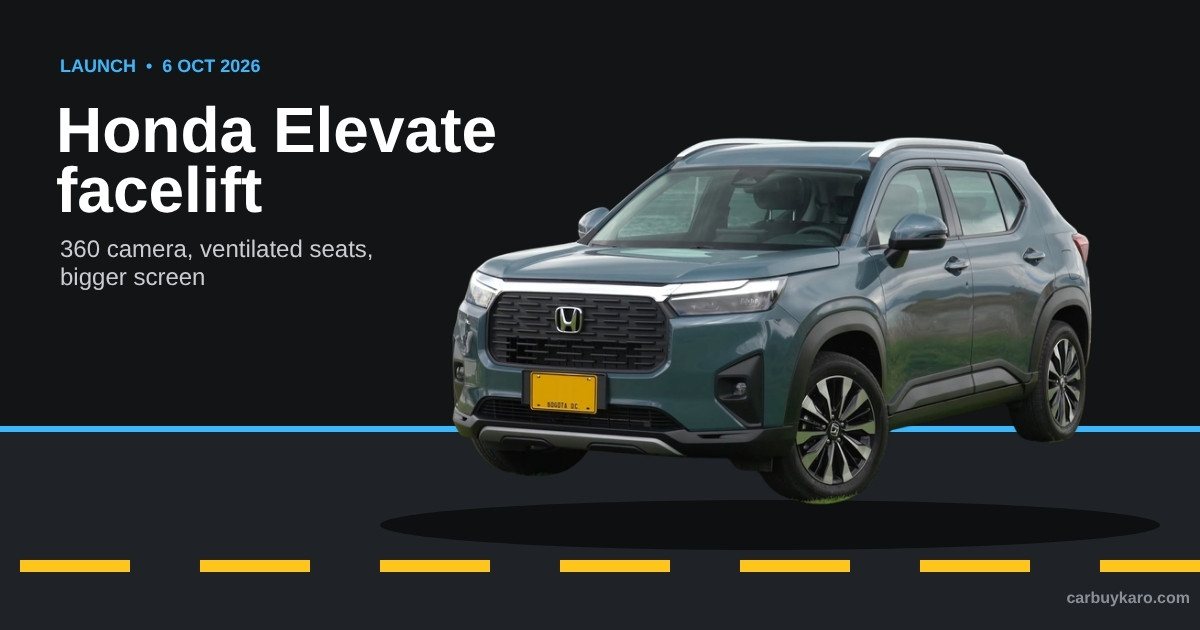
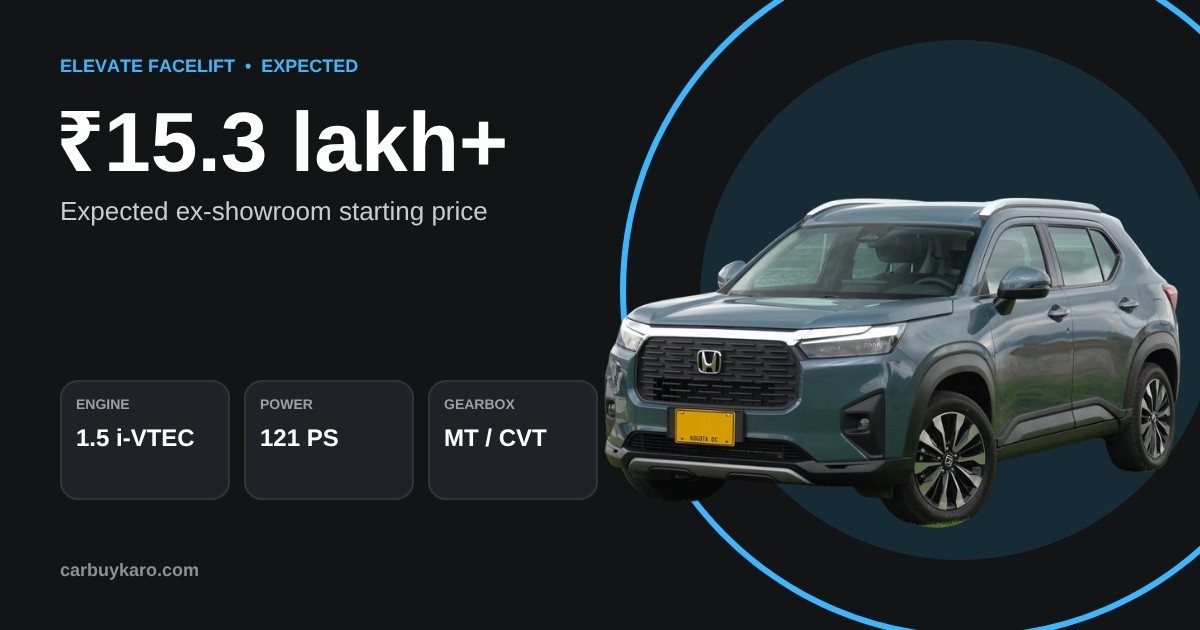
The Honda Elevate facelift 2026 is expected to launch on 6 October 2026. The expected price is ₹15.30–20.50 lakh (ex-showroom). The update brings a new front grille, revised bumpers, redesigned LED headlamps, new alloy wheels and slightly tweaked tail-lamps. Inside, Honda is expected to add a larger touchscreen, a 360-degree camera, ventilated front seats, fresh upholstery and an updated ADAS suite. The 1.5-litre i-VTEC petrol engine (121 PS, 145 Nm) with a 6-speed manual or CVT continues. Honda has not confirmed a hybrid.
The Elevate launched in 2023 as a well-built, spacious SUV that lacked a few features rivals had. This facelift aims to close that gap. Here is what to expect and whether it is worth waiting for.
What changes on the outside
The facelift follows Honda’s usual approach: a cleaner, more upright front end rather than a total redesign.
- New grille and bumpers: a sharper grille pattern and reworked front and rear bumpers.
- Redesigned LED headlamps: new internal graphics and daytime running light signature.
- New alloy wheels: fresh designs across the range.
- Tail-lamps: slightly tweaked LED graphics.
The Elevate’s boxy, upright shape already suits Indian tastes. Expect the facelift to look a bit more premium without losing that character.
What changes on the inside
This is where the facelift matters most. The pre-facelift Elevate was criticised for missing a 360-degree camera, ventilated seats and a panoramic sunroof at a time when Hyundai, Kia and Maruti offered them.
Expected additions:
- A larger touchscreen, likely around 10.25 inches, with wireless Android Auto and Apple CarPlay.
- A 360-degree camera, very useful for tight city parking.
- Ventilated front seats, a must-have for many buyers in hot parts of India.
- New upholstery and interior colour themes.
- An updated Honda Sensing ADAS suite with better lane-keeping and adaptive cruise behaviour.
A panoramic sunroof has not been confirmed. Honda has so far stuck with a single-pane sunroof on the Elevate.
Engine and gearboxes
The 1.5-litre four-cylinder i-VTEC petrol makes 121 PS and 145 Nm. It is paired with a 6-speed manual or a 7-step CVT. This engine is one of the smoothest in the segment, and the CVT is well suited to city traffic.
The Elevate has no turbo-petrol, diesel or hybrid option. That is its biggest weakness against the Hyundai Creta and Kia Seltos, which offer turbo-petrol and diesel choices. Enthusiasts wanting quicker acceleration, and high-mileage users wanting diesel, will still look elsewhere.
Will a hybrid come?
The Elevate shares a lot with the Honda City, which offers Honda’s e:HEV strong hybrid. A hybrid Elevate would make a lot of sense as rivals like the Maruti Grand Vitara and Toyota Hyryder sell well with strong hybrids. Honda has not confirmed it for this facelift. If a hybrid matters to you, read our hybrid vs electric car guide to see whether a hybrid SUV from another brand fits your needs better.
Expected price and variants
| Expected price (ex-showroom) | |
|---|---|
| Entry variants, manual | from about ₹15.3 lakh |
| Mid variants, CVT | ₹17–19 lakh |
| Top variants with ADAS | up to about ₹20.5 lakh |
Honda may raise prices slightly given the extra features. On-road, expect to add ₹2.3–3.5 lakh depending on your state. Our road tax by state guide explains why the same car can cost very different amounts in Karnataka and Delhi.
Elevate facelift vs rivals
| Honda Elevate | Hyundai Creta | Kia Seltos | Maruti Grand Vitara | |
|---|---|---|---|---|
| Petrol NA | Yes | Yes | Yes | Yes |
| Turbo petrol | No | Yes | Yes | No |
| Diesel | No | Yes | Yes | No |
| Strong hybrid | Not yet | Coming later | Coming later | Yes |
The Elevate’s selling points are refinement, build quality, a spacious rear seat and a big boot. It is not the most feature-packed or the fastest. For a full comparison of the segment’s two best-sellers, see our Creta vs Seltos guide. For more choices at this budget, read our list of the best SUVs under ₹15 lakh.
Who should buy the Elevate facelift?
- Buyers who value smoothness and reliability over maximum features.
- City drivers who want a proven CVT automatic.
- Families who want a spacious rear seat and a large boot.
- Honda loyalists upgrading from an older City or Jazz.
Look elsewhere if you want a diesel, a turbo-petrol with strong acceleration, or a strong hybrid today.
Should you wait?
With the launch only weeks away, yes. Buying the outgoing Elevate at full price now does not make sense. The facelift will almost certainly be better equipped for a similar price, and cars bought just before a facelift lose resale value faster.
The exception is a very large discount on remaining pre-facelift stock. If a dealer offers ₹1.5 lakh or more off and you do not care about the new features, it can be a good deal. Just confirm the manufacturing date of the car; a car built many months ago is technically older at resale.
Worked example: EMI for an Elevate facelift CVT
Assume a mid-spec CVT costs about ₹17.5 lakh ex-showroom and around ₹20.5 lakh on-road in Mumbai.
- Down payment: ₹4.5 lakh.
- Loan: ₹16 lakh at 9% for five years.
- EMI: about ₹33,200 a month.
- Fuel at 1,200 km a month, 13 km/l city mileage and petrol at ₹104: about ₹9,600 a month.
That is roughly ₹43,000 a month before insurance and service. Check different down payments and tenures in our car EMI calculator.
Test drive checklist
- Drive the CVT in city traffic and on a flyover to feel how it responds to sudden acceleration.
- Try the 360-degree camera in a tight parking spot, especially at night.
- Check the ventilated seats on a hot day. Some systems are much more effective than others.
- Test the ADAS on a highway with clear lane markings, and learn how to turn features off.
- Sit in the rear. The Elevate’s rear seat has been a strength; make sure that has not changed.
Common mistakes
- Paying for ADAS you will never use. Adaptive cruise is useful on expressways but less so in city traffic.
- Buying the top trim for one feature. If you only want a 360 camera, check whether a mid trim gets it.
- Skipping the extended warranty. Honda’s extended warranty is reasonably priced and worth it if you keep cars for long.
- Accepting the first exchange offer. Get independent quotes for your old car.
What Honda owners say about the current Elevate
Owners of the pre-facelift Elevate tend to praise three things: the smooth engine, the easy-going CVT, and a cabin that feels solidly put together. The rear seat is roomy and the 458-litre boot is among the biggest in the class. Common complaints are about missing features rather than faults: no 360-degree camera, no ventilated seats, and a touchscreen that felt small next to rivals. The facelift targets exactly those complaints.
Real-world mileage for the CVT typically lands at 11–13 km/l in heavy city traffic and 15–17 km/l on the highway. Expect similar figures from the facelift.
Pre-facelift Elevate discounts: are they worth it?
Dealers clearing old stock before a facelift often offer cash discounts, free accessories, exchange bonuses or insurance deals. Here is how to judge whether a pre-facelift Elevate deal is worth taking.
- Add up the real discount. Accessories are often priced high. Count only cash, insurance and exchange value as real savings.
- Compare with the feature gap. The facelift is expected to add a 360 camera, ventilated seats and a bigger screen. If those matter to you, a discount under ₹1 lakh is not worth giving them up.
- Check the manufacturing month. Used-car buyers look at manufacturing dates as well as registration. A car built early in 2026 and sold in October is a little older than it looks on paper.
- Think about resale. Once the facelift arrives, used pre-facelift cars look older. Expect resale value a few percent lower than a facelifted car of the same age.
Our view: a discount of ₹1.5 lakh or more on a top-spec manual or CVT is a good deal for buyers who do not care about the new features. Anything less, wait.
Elevate CVT or manual?
Most Elevate buyers in big cities pick the CVT, and for good reason. Honda’s CVT is smooth, predictable in traffic and well matched to the engine. The manual is lighter to use than many rivals and costs noticeably less, and it suits buyers who drive mostly on highways or in smaller towns. If you are unsure, our AMT vs CVT vs DCT guide explains how each type of automatic feels in Indian traffic.
Real ownership costs for an Elevate
Honda cars have a reputation for low running costs, and the Elevate fits that pattern. Scheduled services in the first few years typically cost ₹5,000–9,000 each at authorised workshops, depending on what is due. The 1.5 i-VTEC is a naturally aspirated engine without a turbocharger, which means fewer expensive parts to worry about as the car ages. The CVT needs its fluid changed on schedule; skipping this is the most common cause of CVT trouble in any brand.
Insurance for a mid-spec Elevate with zero depreciation cover usually costs ₹35,000–45,000 in the first year, falling in later years. Tyres in the Elevate’s size cost roughly ₹6,000–8,000 each. Put together, a typical owner driving 1,200 km a month spends about ₹12,000–14,000 a month on fuel, insurance and maintenance combined, before any EMI.
Honda’s resale values are generally strong because used-car buyers trust the brand’s engines and gearboxes. Keep every service record, and the Elevate should sell quickly when it is time to upgrade.
Summary
The Honda Elevate facelift 2026 launches on 6 October with a fresher design and the features buyers wanted: a bigger screen, 360-degree camera, ventilated seats and updated ADAS. The smooth 1.5 petrol with manual or CVT stays, with no hybrid confirmed yet. Expected prices are ₹15.3–20.5 lakh. For more upcoming models, see our October 2026 upcoming cars list.
Frequently asked questions
When is the Honda Elevate facelift launching?
Honda is expected to launch the facelifted Elevate on 6 October 2026, ahead of the festive season.
Will the Honda Elevate facelift get a hybrid engine?
Honda has not confirmed a hybrid Elevate. The City sedan offers Honda's e:HEV strong hybrid, so it is technically possible, but for now expect the 1.5-litre petrol with manual and CVT only.
What are the new features in the Elevate facelift?
Expected additions include a larger touchscreen, a 360-degree camera, ventilated front seats, new upholstery and an updated ADAS suite, along with new bumpers, grille, LED headlamps and alloy wheels.
Should I buy the current Elevate or wait for the facelift?
With the launch only weeks away, wait unless your dealer offers a large discount on current stock. The facelift adds features buyers in this segment expect, and it will hold value better.
Prices are ex-showroom unless we say otherwise, and makers change them often. Confirm the latest price, offers and variant details with an authorised dealer before you book.


