
On this page 16 sections
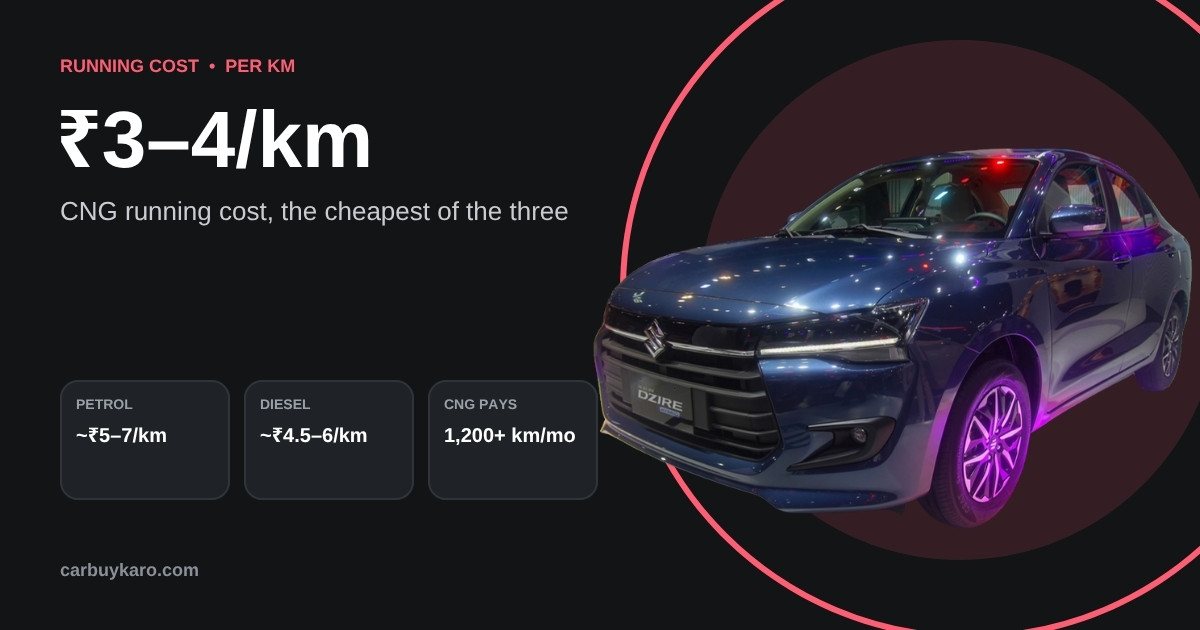
Choosing between a petrol vs diesel vs CNG car is really a question of how many kilometres you drive and where. Short answer: CNG is the cheapest to run (roughly ₹3–4 per km) and pays back its extra cost at around 1,200–1,500 km a month. Diesel suits high-mileage highway drivers of bigger SUVs outside Delhi-NCR. Petrol is the simplest, cheapest to buy and best for people who drive under about 1,000 km a month. If you can charge at home, an EV beats all three on running cost.
Below we do the maths properly, including the costs most people forget.
Running cost per kilometre
Fuel prices vary by city. We use typical 2026 figures: petrol at ₹95 per litre, diesel at ₹90 per litre and CNG at ₹85 per kg. The real-world economy figures below are realistic mixed-use numbers, not claimed test figures.
| Car type | Petrol | Diesel | CNG |
|---|---|---|---|
| Small car / hatchback | 17 km/l → ₹5.6/km | not common now | 25 km/kg → ₹3.4/km |
| Compact SUV | 14 km/l → ₹6.8/km | 18 km/l → ₹5.0/km | 21 km/kg → ₹4.0/km |
| Midsize SUV | 12 km/l → ₹7.9/km | 15 km/l → ₹6.0/km | rare |
CNG is the clear running-cost winner where available. Diesel wins against petrol on bigger, heavier vehicles.
The upfront cost difference
Running costs are only half the story. The fuel you choose changes the price of the car.
- CNG versions typically cost ₹75,000–95,000 more than the equivalent petrol manual. The new Baleno’s CNG premium is ₹92,000, for example.
- Diesel versions typically cost ₹1–2 lakh more than petrol versions of the same SUV.
The question is how long it takes to recover that extra cost.
Break-even maths: CNG vs petrol
Take a hatchback where CNG costs ₹90,000 more.
- Petrol cost per km: ₹5.6
- CNG cost per km: ₹3.4
- Saving per km: ₹2.2
Break-even distance = ₹90,000 ÷ ₹2.2 = about 41,000 km.
| Monthly driving | Months to break even |
|---|---|
| 800 km | about 51 months (over 4 years) |
| 1,200 km | about 34 months |
| 1,500 km | about 27 months |
| 2,000 km | about 20 months |
So CNG makes sense if you drive at least 1,200 km a month and plan to keep the car for four years or more. Run your own numbers in our fuel cost calculator.
Break-even maths: diesel vs petrol (SUV)
Take a compact SUV where the diesel costs ₹1.5 lakh more.
- Petrol cost per km: ₹6.8
- Diesel cost per km: ₹5.0
- Saving per km: ₹1.8
Break-even distance = ₹1,50,000 ÷ ₹1.8 = about 83,000 km. At 1,500 km a month, that is about 4.6 years. At 2,500 km a month, about 2.8 years.
Diesel only pays off for genuinely high-mileage users. For average drivers, a petrol automatic is often the better overall buy.
The costs people forget
Maintenance
- Petrol: simplest and usually cheapest to service.
- Diesel: modern diesels have diesel particulate filters (DPF), and some have AdBlue systems. Short city trips can clog the DPF, leading to costly repairs. Diesel injectors and turbochargers are also expensive to replace.
- CNG: needs periodic cylinder hydro-testing (legally required), and spark plugs and some engine parts may wear slightly faster. Service costs are a little higher than petrol, but still low.
Boot space
A CNG cylinder takes up boot space. Twin-cylinder layouts from Tata and Hyundai reduce the problem. Check the boot of the exact CNG car you plan to buy.
Refuelling convenience
CNG availability varies widely. It is easy in Delhi-NCR, Mumbai, Pune, Gujarat and many northern cities, harder in parts of the south and east. Queues at CNG pumps can be long at peak hours. Check pumps near your home and on your regular routes.
Performance
CNG versions produce less power than petrol. In small cars, this is noticeable on highways with a full load. Diesel engines have strong low-end torque, which helps heavy SUVs.
Resale and the Delhi-NCR rule
In Delhi-NCR, diesel vehicles must be deregistered after 10 years and petrol vehicles after 15 years. This severely affects diesel resale in the region. Buyers there should think carefully before choosing diesel.
Elsewhere, diesel SUVs hold value well because of demand from high-mileage buyers. CNG cars sell well in cities with good CNG networks, especially to taxi and commercial buyers.
Which fuel should you choose?
| Your situation | Best choice |
|---|---|
| Under 1,000 km a month, mostly city | Petrol (automatic if you like) |
| 1,200–2,500 km a month, city, CNG available | CNG |
| 2,000 km+ a month, highway, SUV, outside Delhi-NCR | Diesel |
| Predictable commute, home charging available | Electric |
| Heavy city traffic, want low cost without CNG hassles | Strong hybrid |
What about hybrids and EVs?
Two other options have changed the maths:
- Strong hybrids like the Maruti Grand Vitara, Toyota Hyryder and Honda City e:HEV can match or beat diesel running costs in city traffic without diesel’s downsides. They cost more upfront.
- EVs charged at home cost roughly ₹1–1.5 per km, far lower than any fuel. They need home charging to make sense.
Our hybrid vs electric guide and EV charging cost guide explain these in detail.
Worked example: a family’s choice
A family in Pune drives 1,600 km a month, mostly city, and is choosing a compact SUV.
- Petrol automatic: 13 km/l real-world, about ₹11,700 a month on fuel.
- Diesel automatic: 16 km/l, about ₹9,000 a month; costs ₹1.5 lakh more.
- CNG manual: 20 km/kg, about ₹6,800 a month; costs ₹90,000 more than petrol manual.
Over five years:
- Diesel saves about ₹1.6 lakh in fuel versus petrol, which barely covers its ₹1.5 lakh premium.
- CNG saves about ₹2.9 lakh in fuel versus petrol, well above its ₹90,000 premium.
If the family is comfortable with a manual and CNG availability is good, CNG wins easily. If they want an automatic, look at a CNG AMT (Tata offers these) or a strong hybrid. Our best CNG cars guide lists the options.
Common mistakes
- Buying diesel “for mileage” while driving 800 km a month. The premium never pays back.
- Buying CNG without checking pump availability. Long queues can wipe out the convenience.
- Choosing aftermarket CNG kits. Factory-fitted CNG is safer, covered by warranty and easier to insure.
- Ignoring resale in Delhi-NCR. The 10-year diesel rule makes diesel a poor long-term buy there.
- Forgetting insurance. CNG kits must be declared to the insurer; factory CNG is included automatically.
Fuel prices change, but the ranking rarely does
Fuel prices in India move with global crude prices, taxes and state levies. Petrol and diesel prices differ from state to state by several rupees per litre, and CNG prices differ by city. Even so, the ranking by running cost has stayed remarkably stable: CNG is cheapest, then diesel, then petrol. The gaps shift a little, which moves the break-even point by a few months either way, but they rarely flip.
That means you can make a confident choice based on your driving pattern today, and revisit the maths only if something dramatic changes, like a big CNG price hike in your city.
How to track your real running cost
Claimed mileage figures from test cycles are optimistic. To know your true cost per kilometre:
- Fill the tank completely and reset the trip meter.
- Drive normally until the next fill-up.
- Fill the tank completely again and note the litres (or kilograms) added.
- Divide the distance by the fuel added to get your real mileage.
- Divide the fuel price by that mileage to get your cost per kilometre.
Repeat it two or three times for an accurate average. Our mileage calculator does the maths for you.
CNG safety: what you should know
Many first-time buyers worry about CNG safety. Factory-fitted CNG systems are designed, tested and certified by the carmaker and meet safety standards. The cylinders are strong and fitted with safety valves. A few sensible habits help:
- Get the cylinder hydro-tested on schedule, as required by law.
- Do not use unauthorised workshops for CNG repairs.
- If you smell gas, switch to petrol, park in the open and get the car checked.
- Keep the fitment certificate and test certificate in the car.
Aftermarket kits fitted by unauthorised installers carry more risk and can complicate insurance claims. If you want CNG, buy it from the factory.
Diesel in 2026: who should still buy one?
Diesel sales have fallen as carmakers dropped diesel engines from small cars. But diesel remains the right choice for some buyers: owners of heavy seven-seat SUVs who drive long distances on highways, people who tow trailers or regularly carry full loads in hilly areas, and high-mileage users outside Delhi-NCR who keep cars for many years. For these buyers, diesel’s torque and highway efficiency are hard to beat, and resale for diesel SUVs remains strong outside the capital region.
Quick decision checklist
Answer these five questions honestly:
- How many kilometres do you drive in a typical month? Check your fuel receipts or the odometer.
- Is there a CNG pump within 3 km of your home or office, without long queues?
- Do you live or plan to register the car in Delhi-NCR?
- How long will you keep the car?
- Do you need an automatic?
Under 1,000 km a month, pick petrol. Above 1,200 km with easy CNG access and no need for an automatic, pick CNG. If you need an automatic and drive a lot, look at a CNG AMT or a strong hybrid. Choose diesel only for heavy, high-mileage highway use outside Delhi-NCR.
Summary
In the petrol vs diesel vs CNG car decision, let your monthly kilometres decide. Under 1,000 km, petrol is simplest. Above 1,200 km in cities with good CNG supply, CNG saves the most. Diesel makes sense only for high-mileage highway users of SUVs outside Delhi-NCR. And if you can charge at home, look seriously at an EV. For more cost guides, see our ownership and money section.
Frequently asked questions
Which is cheapest to run: petrol, diesel or CNG?
CNG is usually the cheapest per kilometre, at roughly ₹3–4 per km for small and midsize cars. Diesel comes next, then petrol. EVs charged at home are cheaper still.
When does a CNG car pay for itself?
A factory CNG car usually costs ₹75,000–95,000 more than the petrol version. At 1,200–1,500 km a month, the fuel savings recover that in about two to three years.
Is diesel still worth buying in 2026?
For high-mileage highway users outside Delhi-NCR who drive SUVs, yes. Diesel cars are more expensive to buy, and in Delhi-NCR they must be deregistered after 10 years, which hurts resale.
Does CNG damage the engine?
Factory-fitted CNG systems are designed for the engine and do not damage it when serviced correctly. CNG runs slightly hotter and can wear valves faster over very long periods, which is why regular servicing matters.
Prices are ex-showroom unless we say otherwise, and makers change them often. Confirm the latest price, offers and variant details with an authorised dealer before you book.


