On this page 21 sections
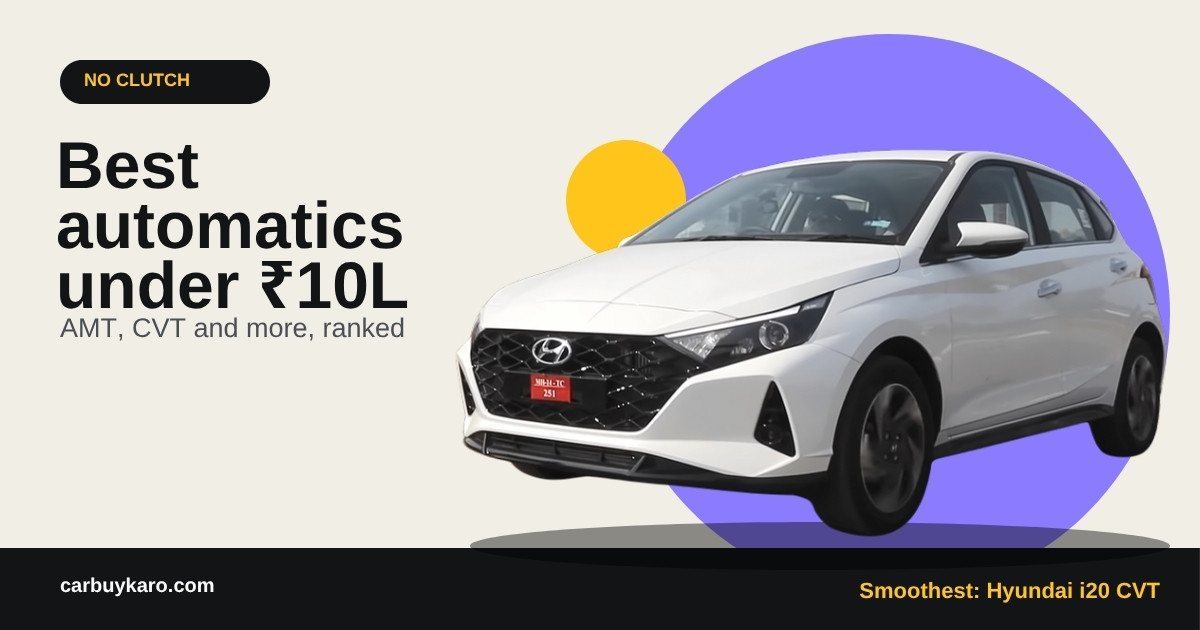
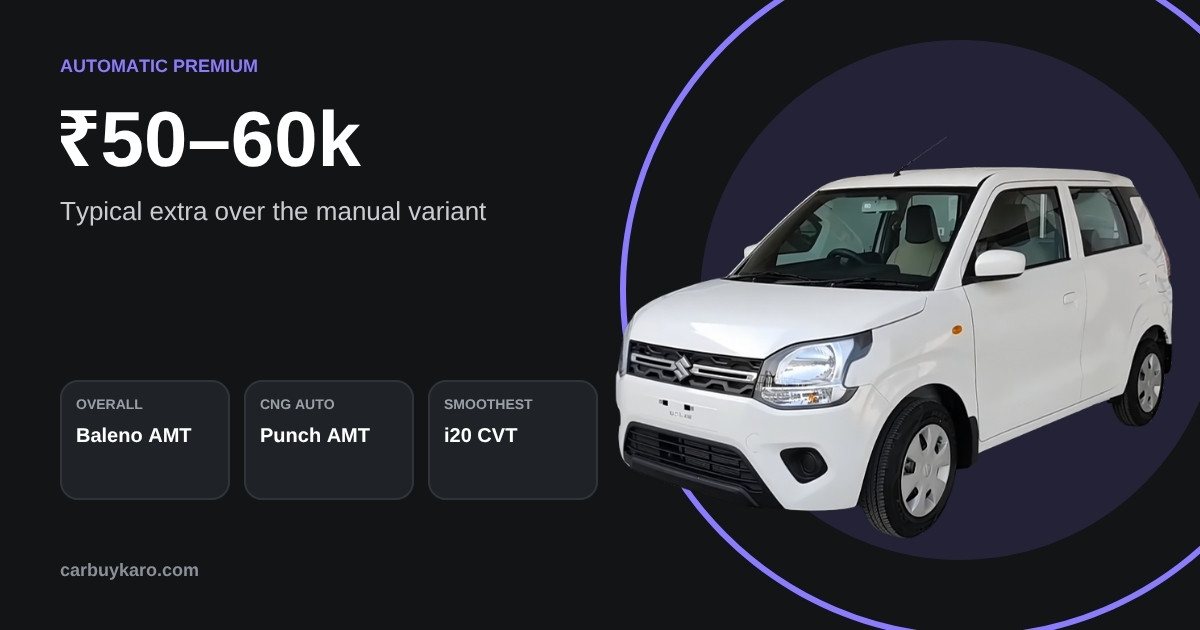
The best automatic cars under 10 lakh in India in 2026 are the Maruti Baleno AMT (best overall), Maruti Swift AMT (most fun), Maruti Dzire AMT (best sedan), Tata Punch AMT and Punch CNG AMT (safest and cheapest to run without a clutch), Hyundai Exter AMT (smoothest small SUV) and the Hyundai i20 CVT (smoothest gearbox). Most automatics under ₹10 lakh use AMTs, which add only ₹50,000–60,000 to the price.
Here is the full list, what each gearbox is like in traffic, and how to pick.
Why most budget automatics are AMTs
An AMT (automated manual transmission) is a normal manual gearbox with a computer operating the clutch and gear changes. It is cheap to build, efficient and reliable. The trade-off is a short pause during each gear change. CVTs and torque-converter automatics are smoother but cost more, which is why they appear mostly on pricier cars. Our AMT vs CVT vs DCT guide explains each type.
Our picks
| Car | Gearbox | Approx. automatic price (ex-showroom) | Best for |
|---|---|---|---|
| Maruti Baleno | AMT | ₹7.50–9.99 lakh | Best overall |
| Maruti Swift | AMT | about ₹7.5–9.5 lakh | Fun, efficient |
| Maruti Dzire | AMT | about ₹7.8–9.9 lakh | Sedan buyers |
| Tata Punch | AMT, CNG AMT | about ₹7–10 lakh | Safety, bad roads |
| Hyundai Exter | AMT | about ₹7.5–9.6 lakh | Smooth engine |
| Hyundai i20 | CVT | about ₹9–10.6 lakh | Smoothest gearbox |
| Toyota Glanza | AMT | facelift from 14 Oct | Toyota warranty |
1. Maruti Baleno AMT: best overall
The 2026 Baleno AMT claims 24.77 km/l, the best in the range, and offers a spacious cabin, six airbags and a long feature list. The Zeta AMT at ₹8.50 lakh is our pick.
Why: efficient, roomy, cheap to run and service. See our Baleno 2026 guide.
2. Maruti Swift AMT: most fun
The Swift is lighter and more agile than the Baleno, with the same efficient engine. The AMT suits city driving well.
Why: fun to drive, very efficient, low service costs.
3. Maruti Dzire AMT: best automatic sedan
The Dzire has a 5-star Bharat NCAP rating, a big boot and the same efficient engine. The AMT makes it an easy, economical family sedan.
Why: safety, boot space, efficiency. Also consider the new Tata Aeris launching 25 September.
4. Tata Punch AMT and CNG AMT: safest and cheapest to run
The 2026 Punch facelift has a 5-star Bharat NCAP rating and offers an AMT with both the petrol and CNG engines. The CNG AMT combines clutch-free driving with CNG running costs, around ₹3.5–4 per km.
Why: safety, ground clearance, CNG automatic. See our Punch buyer’s guide.
5. Hyundai Exter AMT: smoothest small SUV
The Exter’s four-cylinder engine is smoother than most three-cylinder rivals, and six airbags come as standard.
Why: refinement and easy ownership. Compare it in Punch vs Exter.
6. Hyundai i20 CVT: smoothest gearbox
The i20 CVT has no gear-change pause at all, making it the most relaxing automatic here in heavy traffic. It costs more and is a little less efficient.
Why: if smoothness matters most, this is the one. See Baleno vs i20.
AMT tips: how to drive one smoothly
Many people who dislike AMTs simply drive them like a torque-converter automatic. A few habits make a big difference:
- Ease off the accelerator slightly during upshifts, as you would when changing gear in a manual. The shift becomes much smoother.
- Use manual mode on ghats to hold a gear and use engine braking.
- Hold the car on slopes with the brake, not the accelerator. Many AMTs now have hill-hold assist.
- Anticipate overtakes. Press the accelerator firmly and early so the AMT downshifts before you need the power.
After a week or two, most owners stop noticing the gearbox.
How much more does an automatic cost to own?
Purchase: an AMT adds ₹50,000–60,000; a CVT adds about ₹1–1.3 lakh.
Fuel: modern AMTs are as efficient as manuals, sometimes more. CVTs are close.
Maintenance: AMTs are cheap to maintain. The clutch still wears, like a manual. CVTs need fluid changes on schedule.
Resale: automatics are in high demand in big cities, so they often sell faster and hold value well.
Worked example: AMT vs manual EMI
Take a Baleno Zeta at ₹8 lakh (manual) and ₹8.5 lakh (AMT) ex-showroom, and on-road prices of about ₹9.1 lakh and ₹9.6 lakh.
- Down payment ₹2 lakh for both.
- Loans of ₹7.1 lakh and ₹7.6 lakh at 9% for five years.
- EMIs: about ₹14,700 (manual) and ₹15,800 (AMT).
The AMT costs about ₹1,000 more a month. For most city drivers, that is money well spent on a much more relaxed commute. Try it in our car EMI calculator.
Who should buy which automatic?
- Budget-conscious city commuter: Baleno or Swift AMT.
- Safety-first family: Punch AMT or Dzire AMT.
- High mileage, city: Punch CNG AMT.
- Smoothness above all: i20 CVT.
- Rough roads: Punch or Exter AMT.
Common mistakes
- Rejecting AMTs without a proper test drive. Drive one in real traffic.
- Buying a CVT just for highway use. Its advantage is in traffic.
- Paying for a top variant to get an automatic. Many cars offer AMTs on mid variants.
- Forgetting to check for hill-hold. Useful in hilly cities and multi-level parking.
Test drive checklist for automatics
- Drive in stop-go traffic for at least ten minutes.
- Try pulling away on a slope.
- Test a quick overtake at 50–70 km/h.
- Reverse into a parking spot using the creep function.
- Try manual mode if offered.
Automatic vs manual: the case for going clutch-free
Indian cities have some of the worst traffic in the world, and the clutch pedal is the part of a manual car that makes it tiring. In a typical 45-minute commute through heavy traffic, a manual driver may press the clutch hundreds of times. Over years, that adds up to real fatigue and, for some drivers, knee pain.
An automatic removes that entirely. For a price premium of ₹50,000–60,000 on most cars under ₹10 lakh, you get a much calmer daily drive. For families where more than one person drives, an automatic also makes it easier for less confident drivers to handle traffic.
There are still reasons to choose a manual. It is a little cheaper, it gives complete control on ghats and in tricky situations, and some enthusiasts simply enjoy it. If most of your driving is on open roads or in smaller towns, a manual remains a perfectly sensible choice.
Automatic cars just over ₹10 lakh
If you can stretch your budget slightly, a few smoother automatics come into range:
- Hyundai Venue and Kia Sonet with torque-converter or DCT options on higher variants.
- Maruti Brezza with a smooth six-speed torque-converter automatic.
- Tata Nexon with AMT and DCT options.
- Maruti Fronx with an AMT on the 1.2 and a torque-converter automatic on the turbo; a facelift is due soon (see our Fronx facelift guide).
These give you an SUV body and, in some cases, smoother gearboxes. Compare on-road prices carefully, because a ₹10.5 lakh ex-showroom car can cost ₹12 lakh or more on the road.
Real-world mileage of budget automatics
Modern AMTs are as efficient as manuals, and sometimes more, because the computer shifts at the most efficient points. In city traffic, expect around 16–19 km/l from Maruti’s Z12E AMT cars, around 14–17 km/l from the Exter and Punch AMTs, and around 14–16 km/l from the i20 CVT. For a driver covering 1,200 km a month, the difference between 18 and 15 km/l is about ₹1,300 a month at ₹95 per litre. Our fuel cost calculator lets you compare exact figures.
Maintenance of budget automatics
AMTs share most parts with manual gearboxes. The clutch plate still wears and will eventually need replacement, typically after 60,000–100,000 km depending on driving style. The actuator unit is reliable but can occasionally need servicing. CVTs have no clutch to wear, but their fluid must be changed on schedule; skipping this is the most common cause of problems. With either, follow the service schedule and buy extended warranty if you plan to keep the car beyond five years.
Best automatic for new drivers
For people who have just learned to drive, an automatic removes a major source of stress: stalling in traffic or on a slope. We recommend a compact car with a light steering, good visibility and parking sensors or a camera. The Baleno AMT, Swift AMT and Exter AMT are all excellent first automatics. Our best first car guide covers more options for new drivers.
Resale of budget automatics
Automatic hatchbacks and compact SUVs are in strong demand in the used market, especially in metros where traffic pushes buyers towards clutch-free cars. Well-maintained AMT Marutis and Hyundais usually sell quickly and hold value at least as well as their manual versions. Keep service records, replace the clutch only when needed, and mention the automatic gearbox clearly when you list the car for sale.
If you are torn between two cars, take both on the same traffic-heavy route on the same day. The gearbox you forget about first is usually the right one for you.
Summary
The best automatic cars under 10 lakh in 2026 are the Maruti Baleno AMT, Swift AMT and Dzire AMT for value and efficiency, the Tata Punch AMT and CNG AMT for safety and low running costs, the Hyundai Exter AMT for smoothness and the Hyundai i20 CVT for the most relaxing gearbox. AMTs add only about ₹50,000 and are well worth it in city traffic. For more options, see our best cars under ₹10 lakh.
Frequently asked questions
Which is the best automatic car under 10 lakh?
The Maruti Baleno Zeta AMT is our top pick for value, efficiency and features. The Hyundai i20 CVT is the smoothest, and the Tata Punch CNG AMT is the best choice if you want low running costs without a clutch.
How much more does an automatic cost?
An AMT typically costs ₹50,000–60,000 more than the equivalent manual. A CVT or torque-converter automatic usually costs ₹1–1.3 lakh more.
Is there a CNG automatic car under 10 lakh?
Yes. Tata offers CNG with an AMT on models like the Punch and Tiago, and the upcoming Tata Aeris is expected to offer it too.
Are AMT cars reliable?
Yes. AMTs are based on manual gearboxes and are simple, reliable and cheap to repair. The main downside is a pause during gear changes.
Prices are ex-showroom unless we say otherwise, and makers change them often. Confirm the latest price, offers and variant details with an authorised dealer before you book.


