On this page 18 sections
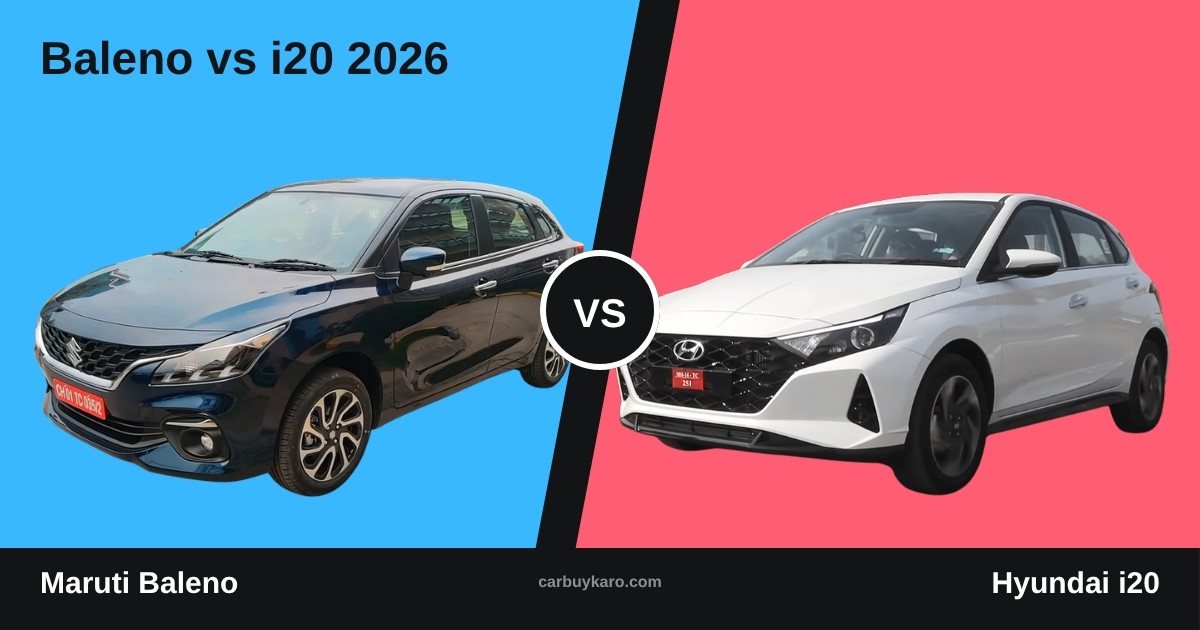
The Baleno vs i20 comparison is the classic premium hatchback choice in India. Short answer: the facelifted 2026 Maruti Baleno (₹5.99–9.99 lakh ex-showroom) is cheaper, more fuel-efficient, offers factory CNG and now has Level 2 ADAS and ventilated seats on the top trim. The Hyundai i20 (about ₹6–10.6 lakh) has a smoother four-cylinder engine, a more premium-feeling cabin and a proper CVT automatic. For value, efficiency and low running costs, pick the Baleno. For refinement and a nicer automatic, pick the i20.
Both are excellent cars, and choosing the “wrong” one is not a disaster. But the differences matter depending on how you drive and what you value. Let us go through them.
Baleno vs i20: key specs
| Maruti Baleno (2026) | Hyundai i20 | |
|---|---|---|
| Price (ex-showroom) | ₹5.99–9.99 lakh | about ₹6–10.6 lakh |
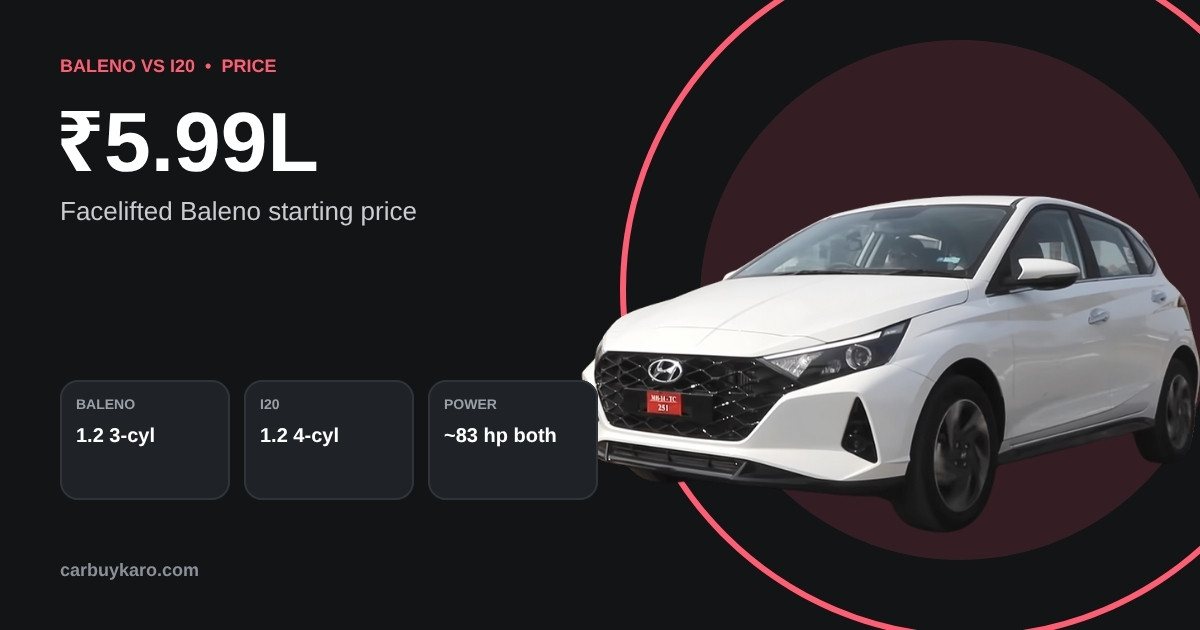
| Engine | 1.2 three-cylinder Z12E, 83 hp, 112 Nm | 1.2 four-cylinder, about 83 hp, 115 Nm |
| Gearboxes | 5MT, 5-speed AMT | 5MT, CVT |
| CNG | Yes, 33.61 km/kg claimed | No |
| Claimed petrol mileage | 23.80 km/l (MT), 24.77 km/l (AMT) | lower than Baleno |
| ADAS | Level 2 on top trim | Check current variant list |
Engines and refinement
The biggest difference between these two cars in 2026 is under the bonnet.
The Baleno switched to Maruti’s Z12E three-cylinder engine with its September facelift. It is efficient and has good low-end pull, which helps in traffic. But three-cylinder engines have a natural thrum and a little more vibration at idle than a four-cylinder. Most people get used to it quickly; some never do.
The i20 keeps a four-cylinder 1.2. It is quieter and smoother at idle and revs more sweetly. If you are sensitive to engine noise and vibration, or you are moving from an older four-cylinder car, the i20 will feel more refined.
On paper, power is almost identical. On the road, both are adequate for city driving and relaxed highway cruising, and neither is quick. Hyundai has previously offered a turbo-petrol in the i20 N Line for enthusiasts.
Automatic gearboxes: AMT vs CVT
This matters a lot for city buyers.
The Baleno AMT is a manual gearbox with a computer operating the clutch. It is cheap, reliable and efficient; the Baleno AMT actually has the best claimed mileage in the range. The downside is a noticeable pause during gear changes, especially when you accelerate hard. In slow city traffic, it works well once you learn to ease off the throttle during shifts.
The i20 CVT has no fixed gears. It feels smooth and even in traffic, with no jerks or pauses. Under hard acceleration it can make the engine drone, which some drivers dislike. CVTs are more expensive to buy and to repair out of warranty, but they are generally reliable when their fluid is changed on time.
If you drive mostly in heavy traffic and smoothness matters, the i20 CVT is nicer to live with. If budget and mileage matter more, the Baleno AMT is the sensible pick. Our AMT vs CVT vs DCT guide goes deeper.
Fuel efficiency and running costs
The Baleno wins clearly here. Here is a real-world estimate for a buyer driving 1,200 km a month, with petrol at ₹95 per litre and CNG at ₹85 per kg:
| Version | Real-world economy | Monthly fuel cost |
|---|---|---|
| Baleno petrol AMT | 18.5 km/l | about ₹6,200 |
| Baleno CNG | 26 km/kg | about ₹3,900 |
| i20 petrol CVT | 15 km/l | about ₹7,600 |
The Baleno AMT saves around ₹1,400 a month over the i20 CVT at this usage, or about ₹84,000 over five years. The Baleno CNG saves far more, but only makes sense for high-mileage users. Try your own numbers with our fuel cost calculator.
Features
With its 2026 facelift, the Baleno added ventilated front seats, a wireless charger and Level 2 ADAS to its already long feature list, which includes a 360-degree camera and head-up display on the top trims. Six airbags are standard.
The i20 offers a well-designed cabin with a large touchscreen, digital cluster, sunroof and connected-car tech. Hyundai updates features often, so compare current variant lists at your budget.
For features per rupee, the new Baleno has pulled ahead, especially at the top of the range.
Cabin quality and design
The i20 has long been praised for its cabin design and material quality. It feels a notch more upmarket than most rivals, and its exterior design is sharper and more European in style.
The Baleno cabin is well laid out and practical but uses more hard plastics. The facelift freshened the design, but if cabin ambience matters to you, sit in both.
Space and comfort
Both are among the roomiest hatchbacks in India. The Baleno has generous rear legroom and a large boot for its class. The i20 is also spacious, with good rear-seat comfort. Ride quality is comfortable in both; the i20 feels a little more planted on the highway, the Baleno a touch softer over city bumps.
Safety
Both offer six airbags as standard. Check the latest Bharat NCAP results for both when choosing; our safest cars guide tracks the current ratings. The Baleno’s new ADAS adds automatic emergency braking and lane-keep assist on the top trim.
Service, reliability and resale
The Baleno benefits from Maruti’s service network, which reaches almost every town in India, and from very low parts prices. Resale is excellent because used-car demand is huge.
The i20 also has a large service network through Hyundai, reasonable service costs and good resale value. Hyundai’s parts are a little pricier than Maruti’s on average.
For buyers in smaller towns or those who drive long distances across India, Maruti’s reach is a genuine advantage.
Baleno vs i20: which should you buy?
Buy the Baleno if:
- You want the best value for money and lowest running costs.
- You need CNG.
- You want ADAS and ventilated seats under ₹10 lakh.
- You live in a smaller town or travel widely.
Buy the i20 if:
- Engine smoothness matters to you.
- You want a smooth CVT automatic for heavy traffic.
- You value a more upmarket cabin and sharper design.
- You do not mind paying a little more to buy and run it.
Best variants
- Baleno: the Zeta AMT offers the best balance of price and features for city buyers. The Zeta CNG suits high-mileage users. See our Baleno 2026 guide for the full price list.
- i20: a mid-spec CVT typically offers the best balance for city buyers. Avoid the base variant; it misses too much.
Our guide to choosing a car variant explains how to find the sweet spot.
Worked example: five-year cost of ownership
Assume a Baleno Zeta AMT at about ₹9.6 lakh on-road and an i20 mid-spec CVT at about ₹10.8 lakh on-road in Delhi. Both are financed with ₹2 lakh down at 9% for five years, and driven 1,200 km a month.
- EMI: Baleno about ₹15,800; i20 about ₹18,300. Difference: ₹2,500 a month.
- Fuel: Baleno about ₹6,200; i20 about ₹7,600. Difference: ₹1,400 a month.
- Service and insurance: roughly ₹300–500 a month cheaper for the Baleno.
- Resale after five years: similar percentages, but the i20 starts from a higher price, so it may be worth ₹40,000–60,000 more.
Net, over five years, the Baleno costs roughly ₹2 lakh less to own. That is the price of the i20’s refinement and CVT. Model it yourself in the car EMI calculator.
Test drive checklist
- Drive both automatics in stop-go traffic. Notice the AMT pause and the CVT drone.
- Listen to both engines at idle with the AC on.
- Sit in the rear seats and check knee room and headroom.
- Open both boots and check the loading lip and space.
- Test the Baleno’s ADAS on a highway if possible.
- Ask both dealers for itemised on-road quotes.
Common mistakes
- Choosing on looks alone. Both look good; running costs and gearbox feel matter more day to day.
- Assuming AMT is bad. Modern AMTs are much better than early versions. Drive one before dismissing it.
- Buying CNG for low mileage. CNG pays back only if you drive a lot.
- Ignoring the Glanza. Toyota’s twin of the Baleno offers a different warranty. See our Glanza facelift guide.
- Forgetting the Altroz. Tata’s hatchback offers diesel and strong safety credentials.
Other premium hatchbacks worth considering
The Tata Altroz stands out with a diesel option and strong crash-test performance. The Toyota Glanza is the Baleno’s twin with Toyota’s warranty. If you want more space and a bigger boot, a compact sedan like the upcoming Tata Aeris is worth a look.
Highway manners
On a long highway drive, the i20 feels a little more settled at 100–110 km/h, with less wind and engine noise in the cabin. The Baleno is comfortable too, and its softer suspension absorbs bumps well, but the three-cylinder engine is more audible when you accelerate hard to overtake. For families who drive between cities every month, the i20’s refinement is worth considering. For city-focused buyers, the Baleno’s efficiency matters more.
Colours and waiting periods
Both cars come in a wide range of colours, including dual-tone options on upper variants. White, silver and grey hold resale value best. The Baleno’s facelift has high demand, so popular AMT and CNG variants may have a waiting period of a few weeks. Ask both dealers for a written delivery date before you pay a booking amount.
Summary
In the Baleno vs i20 contest, the 2026 Baleno wins on price, mileage, CNG availability, features and running costs, while the i20 wins on engine refinement, the CVT and cabin feel. Value-focused and high-mileage buyers should pick the Baleno; buyers who prize smoothness and a premium feel should pick the i20. Browse our best cars under ₹10 lakh for more options at this budget.
Frequently asked questions
Which is better, Baleno or i20?
The 2026 Baleno is cheaper, more fuel-efficient, has ADAS and ventilated seats on top trims, and costs less to service. The i20 has a smoother four-cylinder engine, a more upmarket cabin feel and a CVT option. Most value-focused buyers will prefer the Baleno; buyers who prioritise refinement may prefer the i20.
Which has better mileage, Baleno or i20?
The Baleno. Its claimed figures are 23.80 km/l for the manual and 24.77 km/l for the AMT, plus a CNG option at 33.61 km/kg. The i20's claimed figures are lower and it has no factory CNG.
Does the i20 have an automatic?
Yes, the i20 offers a CVT automatic, which is smoother than the Baleno's AMT in stop-go traffic.
Which is cheaper to maintain, Baleno or i20?
The Baleno is usually slightly cheaper to service and repair, thanks to Maruti's low parts prices and huge service network. The i20 is also reasonable to maintain.
Prices are ex-showroom unless we say otherwise, and makers change them often. Confirm the latest price, offers and variant details with an authorised dealer before you book.


