On this page 13 sections
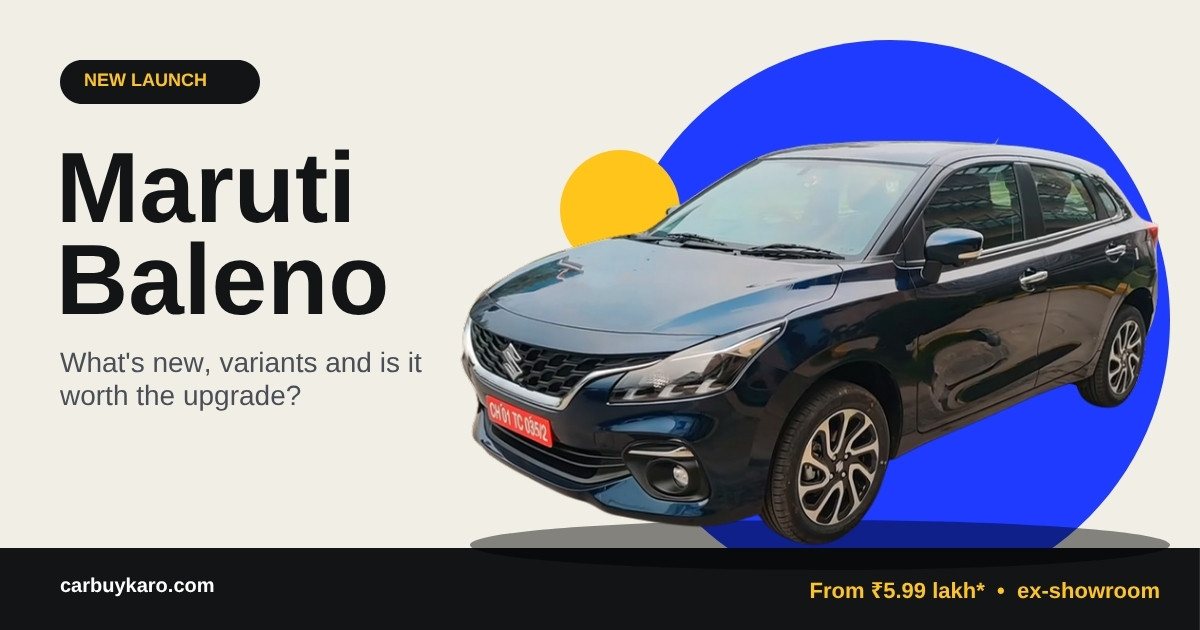
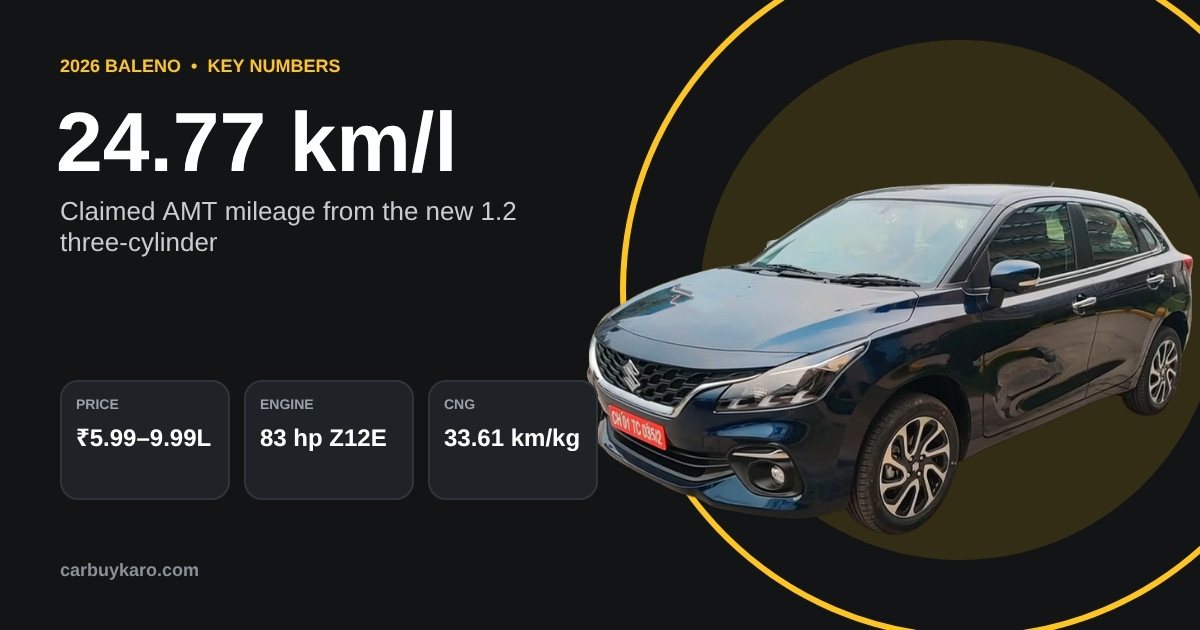
The 2026 Maruti Baleno facelift went on sale on 5 September with prices from ₹5.99 lakh to ₹9.99 lakh (ex-showroom). The big change is under the bonnet: the old four-cylinder engine has been replaced by the Z12E 1.2-litre three-cylinder already used in the Swift and Dzire. Claimed mileage goes up to 24.77 km/l for the AMT. Maruti has also added features that were missing on a premium hatchback, including ventilated front seats, wireless charging and Level 2 ADAS on the top trim.
Let us look at the full price list, what the new engine is like, what else is new, and which variant is the best value.
2026 Maruti Baleno facelift price list
Five trims are on offer: Sigma, Delta, Zeta, Alpha and Alpha (O). The table below shows ex-showroom prices.
| Variant | Petrol MT | Petrol AMT | CNG MT |
|---|---|---|---|
| Sigma | ₹5.99 lakh | – | – |
| Delta | ₹7.00 lakh | ₹7.50 lakh | ₹7.92 lakh |
| Zeta | ₹8.00 lakh | ₹8.50 lakh | ₹8.92 lakh |
| Alpha | ₹9.10 lakh | ₹9.60 lakh | – |
| Alpha (O) | ₹9.50 lakh | ₹9.99 lakh | – |
A few patterns stand out. The AMT costs ₹50,000 more than the manual on every trim. CNG costs ₹92,000 more than the petrol manual. And the jump from Sigma to Delta is a hefty ₹1.01 lakh. That gap tells you Maruti wants most people to skip the Sigma, and for once we agree.
The Baleno was launched at ₹6.10 lakh and the base price was trimmed to ₹5.99 lakh within days. That puts it just under the psychological ₹6 lakh mark and well below the Hyundai i20.
The new three-cylinder engine
The Z12E is a 1.2-litre three-cylinder with 83 hp and 112 Nm. On paper that is a small drop from the old four-cylinder’s 90 hp and 113 Nm. Maruti says it has tuned the engine for better low-end torque, and that is what you notice in traffic. It pulls cleanly from 1,500 rpm in third gear, which means fewer downshifts in stop-go driving.
The trade-off is refinement. Three-cylinder engines have a natural off-beat thrum, and you feel a little more vibration at idle than you did in the old Baleno. It is well controlled, similar to the current Swift, and most owners stop noticing after a week. If you are coming from an older four-cylinder Maruti, do a proper test drive with the AC on and listen at a traffic light.
The CNG version is detuned to 70 hp and 102 Nm, which is normal for factory CNG. It is fine in the city but you will need to plan overtakes on the highway.
Mileage: the real reason for the switch
| Version | Claimed mileage | Change vs old |
|---|---|---|
| Petrol MT | 23.80 km/l | +1.45 km/l |
| Petrol AMT | 24.77 km/l | +1.83 km/l |
| CNG MT | 33.61 km/kg | +3 km/kg |
Claimed figures are measured on a fixed test cycle, so treat them as a ceiling. Our experience with the Z12E in the Swift suggests 17–19 km/l in city traffic and 21–23 km/l on an easy highway run. That is still excellent for a car of this size.
Here is what the gain means in rupees. Someone driving 1,200 km a month with petrol at ₹95 a litre spends about ₹5,700 on fuel at 20 km/l, against ₹6,300 at 18 km/l for the older engine. That is roughly ₹7,000 a year saved. You can plug your own numbers into the fuel cost calculator.
What else is new on the Baleno
Design
The changes are mild. A reworked front bumper and grille, new LED lighting signatures, fresh alloy wheel designs and updated tail-lamp graphics. From the side it is clearly still a Baleno. That is not a bad thing; the shape has aged well and the car remains roomy for its footprint.
Features
The list of new features on the upper trims is long for a car under ₹10 lakh:
- Ventilated front seats (a first for the Baleno)
- Wireless phone charger
- Level 2 ADAS with adaptive cruise and lane-keep on the top trim
- A larger touchscreen and connected-car features
- 360-degree camera and head-up display carried over on the top trims
Six airbags are standard across the range, which matters because the Sigma is the version fleet buyers and budget buyers pick.
Which 2026 Baleno variant should you buy?
Our pick: Zeta petrol AMT at ₹8.50 lakh. You get the new engine, an automatic that makes city traffic painless, alloy wheels, a good touchscreen and six airbags. The jump to Alpha adds about ₹1.1 lakh for LED projector lamps, 360 camera, HUD and the bigger feature list. Nice to have, not must-have.
If you drive a lot, 2,000 km a month or more, the Zeta CNG is the sensible choice at ₹8.92 lakh. The CNG premium of ₹92,000 pays back in about two years at that usage. Our petrol vs diesel vs CNG guide walks through the break-even maths.
Buy the Alpha (O) only if you want ADAS and ventilated seats. On Indian city roads, adaptive cruise is useful on expressways; lane-keep works best where lane markings are clear.
Skip the Sigma unless the budget is fixed at ₹6 lakh. It misses the touchscreen, rear parking camera and several comfort features, and resale for base variants is weaker. Our guide on how to choose the right car variant explains why the second-from-base trim is so often the best value.
Baleno vs its rivals
The Baleno competes with the Hyundai i20, Tata Altroz and its own twin, the Toyota Glanza (which gets its own facelift in October; see our Glanza facelift preview). Against the i20, the Baleno is cheaper, has an AMT option at a lower price and better claimed mileage. The i20 has a slightly more upmarket cabin and a smoother four-cylinder engine. We compare them properly in Baleno vs i20.
Worked example: EMI and running cost of a Baleno Zeta AMT
- Ex-showroom: ₹8.50 lakh. On-road in Delhi comes to about ₹9.6 lakh with road tax, insurance and registration.
- Down payment of ₹2 lakh, loan of ₹7.6 lakh at 9% for 5 years: EMI about ₹15,800.
- Fuel at 1,200 km a month, 18 km/l, ₹95 per litre: about ₹6,300 a month.
- Service and insurance averaged over the year: about ₹2,000 a month.
Total monthly cost is close to ₹24,000 for the first five years. Check your own figures in our car EMI calculator.
Things to check before you book
- Test the AMT in traffic. Maruti’s AMT is smooth for its type, but there is a pause between gears. Some buyers love the price and mileage, others hate the shift. Try it in a real traffic crawl.
- Listen to the three-cylinder at idle. If vibration bothers you, compare it back-to-back with an i20.
- Ask about stock. Early facelift stock goes to the popular trims first. Ask for a written delivery date.
- Check old-model discounts. Some dealers still have the pre-facelift Baleno with discounts. The old four-cylinder is smoother, but you lose ADAS, ventilated seats and some mileage.
Common mistakes
- Paying extra for a CNG you will rarely use. CNG only makes sense above roughly 1,200–1,500 km a month.
- Taking the dealer’s insurance without comparing quotes. It is often ₹5,000–10,000 more than buying online.
- Forgetting that ADAS needs clean windscreens and calibrated cameras. Any windscreen replacement must be done at an authorised workshop.
Petrol, AMT or CNG: picking your powertrain
Petrol manual. The cheapest way into a Baleno and the most efficient petrol version per rupee spent. Good for drivers who enjoy a manual and mostly drive on open roads or in smaller towns with light traffic.
Petrol AMT. An AMT is a manual gearbox with a computer doing the clutch work. It is cheap, reliable and efficient, which is why the Baleno AMT claims the best mileage in the range. The downside is a noticeable pause during gear changes, especially under hard acceleration. In city traffic at low speeds it works well. Our AMT vs CVT vs DCT guide explains the differences between automatic types in detail.
CNG manual. The running cost champion. At around ₹80–90 per kg in most cities and a real-world figure of about 26–28 km/kg, CNG costs roughly ₹3–3.5 per km, against about ₹5 per km for petrol. The costs are a smaller boot (the cylinder sits in the boot), a bit less power, and the need to find CNG pumps, which can have long queues in some cities.
Baleno ownership: what to expect
Maruti’s biggest strength is its service network. There is an authorised workshop in almost every district in India, parts are cheap and widely available, and independent mechanics know Maruti cars well. For first-time buyers or families in smaller towns, this peace of mind is worth a lot.
A few ownership tips:
- Stick to the service schedule during warranty. Missing services can complicate warranty claims.
- Extend the warranty. Maruti’s extended warranty is inexpensive and covers the car for more years and kilometres. For a car you plan to keep for six to eight years, it is worth buying.
- Watch tyre pressure. Correct tyre pressure alone can change real-world mileage by 1–2 km/l. Check it every two weeks.
- CNG kit checks. Factory CNG cars need periodic cylinder inspection and testing. Your service centre will remind you; do not ignore it.
Resale value
The Baleno has been one of India’s best-selling cars for years, which means used-car demand is strong and resale values are among the best in the segment. A well-maintained, mid-variant Baleno typically holds 60–65% of its value after three years. Automatic and CNG versions tend to sell faster in big cities. Our car resale value tips cover the simple habits that add ₹30,000–50,000 at selling time.
Who should not buy the Baleno
To be fair, it is not the right car for everyone.
- If you regularly carry five adults on highway trips, a compact sedan or small SUV will be more comfortable and have more boot space.
- If you want a strong highway performer, the three-cylinder engine is adequate but not quick when fully loaded.
- If you want a higher seating position and more ground clearance for bad roads, consider a compact SUV like the Fronx, which is built on the same platform.
Summary
The 2026 Maruti Baleno facelift trades a little refinement for a lot more efficiency, and adds features like ventilated seats, wireless charging and ADAS that make it feel current again. At ₹5.99–9.99 lakh it undercuts most rivals. Our pick is the Zeta AMT for city buyers and the Zeta CNG for high-mileage users. If you want more choices at this budget, see our list of the best cars under ₹10 lakh.
Frequently asked questions
What is the starting price of the 2026 Maruti Baleno?
The facelifted Baleno starts at ₹5.99 lakh ex-showroom for the Sigma manual. The top Alpha (O) AMT costs ₹9.99 lakh. Maruti first announced ₹6.10 lakh at launch on 5 September and then revised the base price.
Does the new Baleno have a three-cylinder engine?
Yes. The 2026 Baleno uses the Z12E 1.2-litre three-cylinder petrol from the Swift and Dzire, rated at 83 hp and 112 Nm. The older four-cylinder K12N is gone.
What is the mileage of the 2026 Baleno?
Claimed figures are 23.80 km/l for the manual, 24.77 km/l for the AMT and 33.61 km/kg for the CNG. In mixed city and highway use, expect roughly 17–20 km/l from the petrol.
Is the Baleno CNG available with an automatic?
No. The CNG version is offered only with the 5-speed manual, in Delta and Zeta trims.
Prices are ex-showroom unless we say otherwise, and makers change them often. Confirm the latest price, offers and variant details with an authorised dealer before you book.


