On this page 14 sections
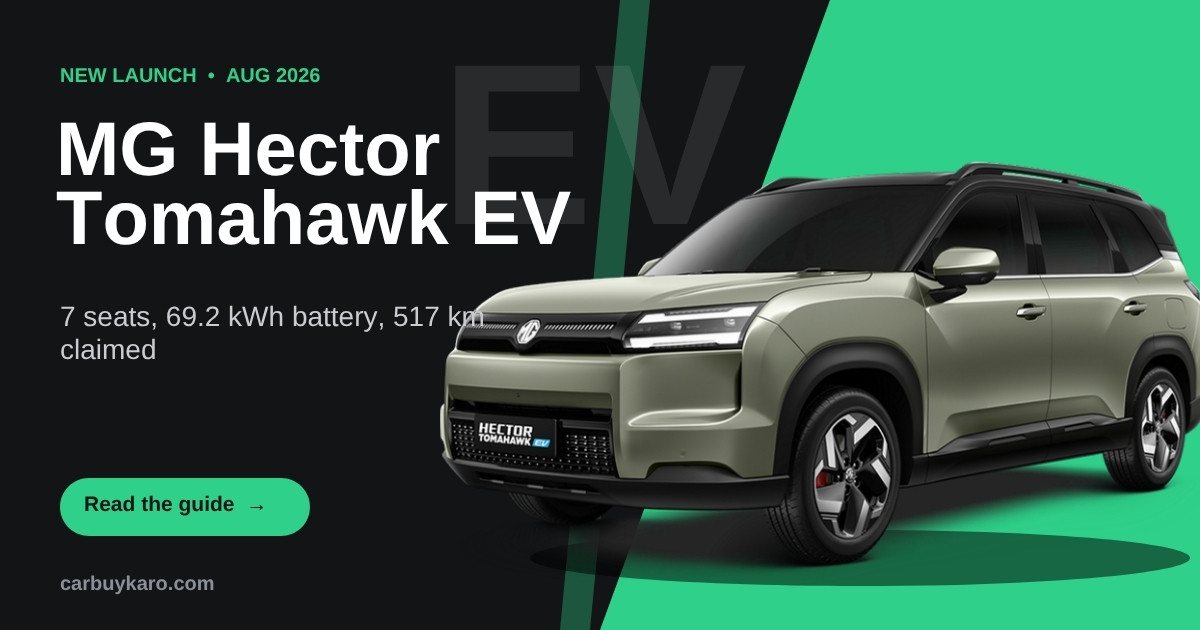
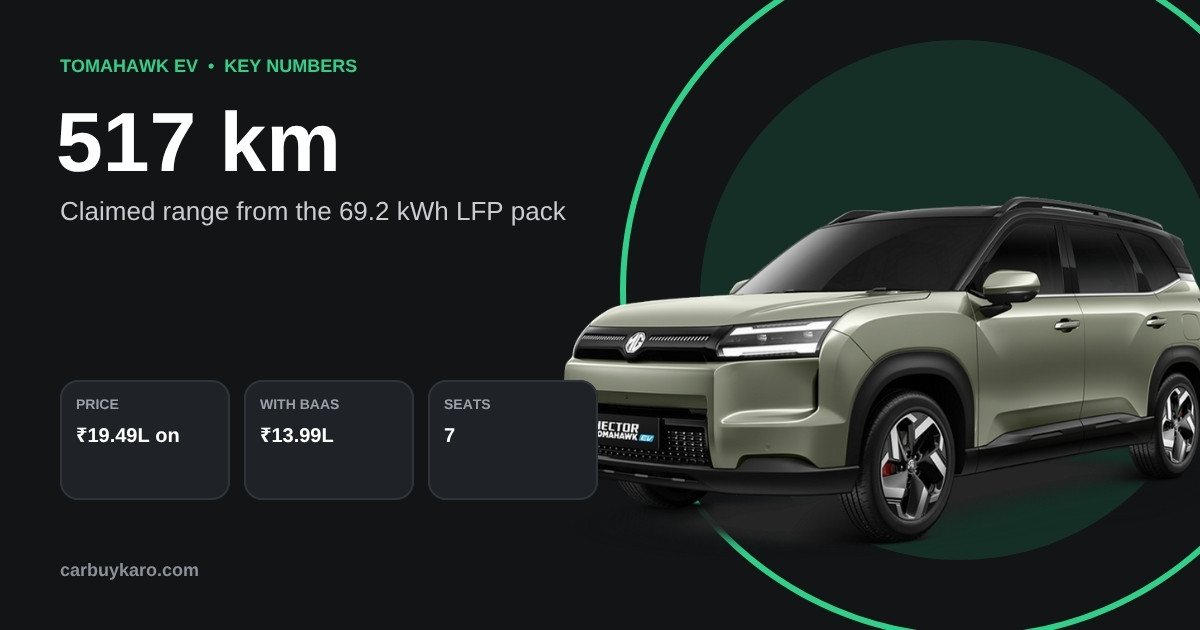
The MG Hector Tomahawk EV is a seven-seat electric SUV launched on 26 August 2026, priced from ₹19.49 lakh to ₹23.49 lakh (ex-showroom). It uses a 69.2 kWh LFP battery with a claimed 517 km MIDC range and a 204 hp motor. Alongside it, MG launched the Tomahawk PHEV, a plug-in hybrid at ₹25.69 lakh with more than 115 km of electric-only range. Both can also be bought with MG’s Battery-as-a-Service (BaaS) plan, which cuts the upfront price but adds a per-kilometre charge.
This guide breaks down the prices, the real range you can expect, whether BaaS is worth it, and whether the EV or the PHEV is the better buy for you.
MG Hector Tomahawk EV price list
| Variant | Seats | Ex-showroom | With BaaS |
|---|---|---|---|
| Excite | 7 | ₹19.49 lakh | from ₹13.99 lakh + ₹4.90/km |
| Exclusive | 7 | ₹21.99 lakh | – |
| Essence | 5 | ₹22.99 lakh | – |
| Essence | 7 | ₹23.49 lakh | – |
The PHEV comes in one seven-seat version at ₹25.69 lakh, or ₹21.79 lakh plus ₹3.20 per km with BaaS. Some listing sites show a lower “starting from” figure; that is the BaaS price, not the full price. Always compare full prices when you are cross-shopping.
Many states waive or cut road tax on EVs, so the on-road gap between an EV and a petrol SUV is often smaller than the ex-showroom gap. Check your state in our EV road tax and subsidy guide.
Battery, range and charging
The EV uses a 69.2 kWh lithium iron phosphate (LFP) battery. LFP cells hold up well to daily charging to 100% and cope better with Indian heat than some other chemistries. They are slightly heavier for the same energy, which is why the range is good rather than class-leading.
Range. MG claims 517 km on the MIDC cycle. In our experience, real-world range for Indian EVs lands at 75–80% of MIDC in mixed use with the AC running. For the Tomahawk that means roughly 380–420 km. On a highway at a steady 100–110 km/h, expect around 330–360 km.
Charging.
- DC fast charging up to 90 kW: 30% to 80% in about 35 minutes.
- 7.4 kW AC wallbox at home: 10% to 100% in about 12.5 hours.
- Vehicle-to-load (V2L), vehicle-to-vehicle and vehicle-to-home support, so the car can power appliances during a power cut.
If you charge at home overnight, a full charge costs roughly ₹560–700 at ₹8–10 per unit. That is about ₹1.4–1.8 per km. Public DC chargers cost ₹18–25 per unit, which triples the per-km cost. Our EV charging cost guide has the full numbers, and our home EV charger guide explains what installation involves.
Performance and practicality
The motor makes 150 kW (204 hp) and 310 Nm, and MG quotes 0–100 km/h in 8.2 seconds. That is quicker than most diesel seven-seaters. Ground clearance is 230 mm, and the body measures 4,745 mm long with a 2,810 mm wheelbase.
Boot space depends on seats: 610 litres in the five-seater, and 192 litres behind the third row in the seven-seater (528 litres with it folded). The third row is best for kids or short trips.
Features include a 15.6-inch touchscreen, 8.8-inch digital cluster, wireless Apple CarPlay and Android Auto, panoramic sunroof, ventilated front seats, 10-speaker Infinity audio and 256-colour ambient lighting.
The PHEV: who is it for?
The Tomahawk PHEV pairs a 1.5-litre petrol engine with a 20.5 kWh battery. Charged fully, it can cover more than 115 km on electricity, which covers most people’s daily commute. For longer trips the engine takes over, and MG claims more than 1,100 km of combined range with a full tank and full battery.
The PHEV makes sense if you want electric running on weekdays but do frequent long highway trips to places where fast chargers are scarce. It does not make sense if you cannot charge at home. An uncharged PHEV is just a heavy petrol SUV carrying a big battery around.
Is BaaS worth it? The maths
BaaS on the EV cuts the upfront price by ₹5.5 lakh (₹19.49 lakh to ₹13.99 lakh) and charges ₹4.90 per km.
| Monthly driving | Five-year BaaS cost | Ahead with BaaS? |
|---|---|---|
| 800 km | ₹2.35 lakh | Yes, by ₹3.15 lakh |
| 1,100 km | ₹3.23 lakh | Yes, by ₹2.27 lakh |
| 1,500 km | ₹4.41 lakh | Yes, by ₹1.09 lakh |
| 2,000 km | ₹5.88 lakh | No, behind by ₹0.38 lakh |
On pure rental, BaaS stays cheaper up to about 1,870 km a month over five years. But you also lose the interest you would have paid on the extra ₹5.5 lakh (in BaaS’s favour) and you may face resale questions when you sell a car whose battery you do not own (against BaaS). After those adjustments, our rule is simple: under about 1,100 km a month, BaaS is attractive. Above 1,500 km, buy the battery.
Try your own numbers with our EV vs petrol cost calculator.
Tomahawk EV vs the competition
The obvious rivals are the Mahindra XEV 9e and XUV700 on price, the Tata Harrier EV, and MG’s own Windsor EV lower down. The Tomahawk’s big selling point is seven seats in an EV at under ₹25 lakh. Among combustion seven-seaters, see our XUV700 vs Safari comparison to understand what you give up and gain by going electric.
Which one should you buy?
- You drive under 1,200 km a month and can charge at home: Tomahawk EV Exclusive with BaaS, or outright if you plan to keep it for 8+ years.
- You drive 1,500–2,500 km a month: Tomahawk EV bought outright. Running costs are about a fifth of a diesel SUV.
- You do frequent long trips to places without fast chargers: the PHEV, but only if you will charge it most nights.
- You cannot charge at home: stay with a petrol or diesel SUV for now, or look at a strong hybrid.
Common mistakes EV buyers make
- Judging range by the MIDC number instead of real-world figures.
- Relying only on public fast charging, which can cost more per km than CNG.
- Not checking the housing society’s rules for installing a wallbox. Get written permission first.
- Ignoring battery warranty terms. Read our EV battery life and warranty guide.
What real-world range looks like on a typical week
Numbers on a spec sheet mean little until you map them to your own life. Here is a realistic week for a Bengaluru family using a Tomahawk EV with the 69.2 kWh battery.
- Monday to Friday: 45 km each day of office commute through heavy traffic, AC on. Heavy traffic is actually kind to EVs, because regenerative braking recovers energy. Total: 225 km.
- Saturday: school activities and shopping, about 40 km.
- Sunday: a 150 km round trip to a relative’s place on the highway.
That is about 415 km in a week. Starting the week full and charging only once on Wednesday night, the family never goes below 30%. Charging at home at ₹8 per unit, the week’s energy costs roughly ₹600–650. A diesel SUV of similar size would spend about ₹3,000 on fuel for the same week.
The seven-seat question
The Tomahawk’s biggest draw is seven seats in an EV at this price. Be realistic about the third row. It is best for children, or for adults on short city trips. With the third row up, boot space drops to 192 litres, enough for a few soft bags but not for a family’s holiday luggage. Families who regularly travel with seven people and luggage will need a roof carrier or a bigger vehicle.
If you need five seats and a big boot most of the time, and seven seats only occasionally, the seven-seat version still makes sense; the third row folds flat.
Safety and features to check on the test drive
- ADAS behaviour: if your trim has driver-assist features, test them on a highway and learn how to turn off lane-keep quickly on narrow city roads.
- Brake feel: EVs blend regenerative braking with the normal brakes. Make sure the pedal feels consistent at low speeds.
- Rear visibility with seven occupants: check the rear camera and the view out of the back when the third row is in use.
- V2L: ask the dealer to demonstrate the vehicle-to-load feature. It can power a small appliance or laptop during a power cut, which is handy in many Indian cities.
Battery safety and heat
Buyers often ask whether EV batteries are safe in Indian summers. LFP chemistry, which the Tomahawk uses, is known for being more stable at high temperatures than some other lithium-ion types, and it tolerates frequent full charges well. The car’s battery management system also cools the pack during fast charging and on hot days.
Simple habits help battery life: park in shade when you can, avoid leaving the car at 100% for days in extreme heat, and prefer AC charging at home over daily fast charging.
Insurance and resale
EV insurance premiums are linked to the car’s value, and the battery is the costliest single part. Zero-depreciation cover and a battery protection add-on are worth considering. Our zero depreciation insurance guide explains how these add-ons work.
Resale for EVs in India is still settling. Early evidence suggests EVs with LFP batteries and good warranties are holding value better than first-generation EVs did. A transferable battery warranty makes selling easier, so keep all your service and charging records.
Summary
The MG Hector Tomahawk EV brings a spacious, seven-seat electric SUV with a 517 km claimed range to the ₹19.49–23.49 lakh bracket, and the PHEV adds a plug-in option for long-distance drivers. With home charging, running costs are tiny. BaaS is smart for lighter users but costs heavy users more. For more options, see our list of the best electric cars in India.
Frequently asked questions
What is the price of the MG Hector Tomahawk EV?
The Tomahawk EV costs ₹19.49 lakh to ₹23.49 lakh ex-showroom. With MG's Battery-as-a-Service plan it starts at ₹13.99 lakh plus ₹4.90 per km of battery rental.
What is the range of the Hector Tomahawk EV?
MG claims 517 km on the MIDC test cycle from the 69.2 kWh LFP battery. Expect around 380–420 km in real-world mixed driving with the AC on.
Is the Tomahawk PHEV a hybrid I need to charge?
Yes. The PHEV is a plug-in hybrid with a 20.5 kWh battery and a 1.5-litre petrol engine. Charge it daily and you can do more than 115 km on electricity alone. If you never charge it, it behaves like a heavy petrol car.
Is BaaS a good idea for the Tomahawk EV?
BaaS lowers the upfront price by ₹5.5 lakh but adds ₹4.90 per km. It works out cheaper only if you drive less than about 1,100 km a month over five years. Heavy users are better off buying the battery outright.
Prices are ex-showroom unless we say otherwise, and makers change them often. Confirm the latest price, offers and variant details with an authorised dealer before you book.


