On this page 13 sections
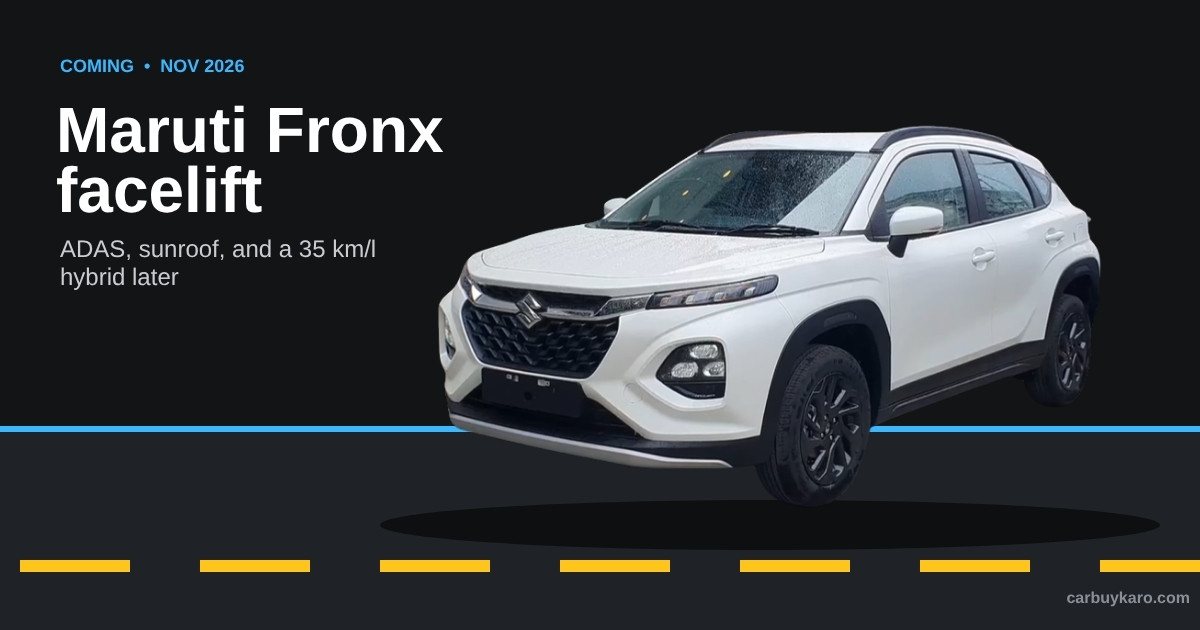
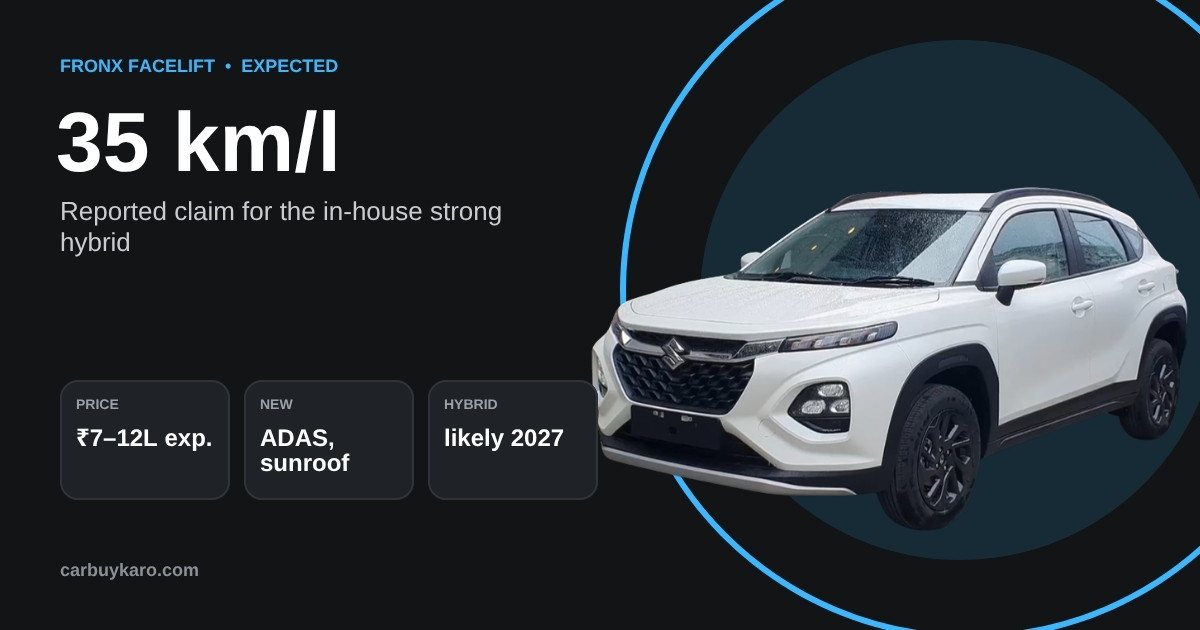
The Maruti Fronx facelift 2026 is expected in November 2026, with prices around ₹7–12 lakh (ex-showroom). The update is expected to bring Level 2 ADAS, a sunroof, ventilated front seats and a refreshed front end with a new grille, bumper and headlamps. The bigger news is Maruti’s in-house strong hybrid, a series hybrid system that reports say could deliver more than 35 km/l. It is likely to debut on the Fronx, but may arrive a few months after the standard facelift, possibly in early 2027.
The Fronx has been one of India’s best-selling crossovers since its 2023 launch. It combines Baleno underpinnings with SUV styling and more ground clearance. Here is what the facelift should bring and whether you should wait.
What we expect from the Fronx facelift
Design
The changes should be evolutionary. Spy shots suggest a redesigned grille, a new front bumper and revised headlamps. The coupe-like roofline and chunky wheel arches that make the Fronx stand out will stay. Expect new alloy wheel designs and perhaps a new colour or two.
Features
The Fronx has been well equipped but missed three things rivals offered: ADAS, a sunroof and ventilated seats. The facelift is expected to add all three.
- Level 2 ADAS: adaptive cruise, lane-keep assist and automatic emergency braking on the top trim. The facelifted Baleno already has it, so the technology is ready.
- Sunroof: a single-pane sunroof, a feature many buyers in this segment look for.
- Ventilated front seats: very useful in most of India.
Engines
The current Fronx offers a 1.2-litre naturally aspirated petrol, a 1.0-litre turbo-petrol and a factory CNG. It is possible the 1.2 will switch to the new Z12E three-cylinder already used in the Baleno, Swift and Dzire, which would raise claimed mileage. The 1.0 turbo should continue for buyers who want more punch.
The strong hybrid: what is a series hybrid?
Maruti’s upcoming hybrid is reported to be a series hybrid, which works differently from the Toyota-sourced hybrid in the Grand Vitara.
- In a series hybrid, the wheels are always driven by an electric motor. The petrol engine never drives the wheels directly. It acts as a generator that charges the battery or feeds the motor.
- In a series-parallel hybrid (like Toyota’s system in the Grand Vitara and Hyryder), the engine can drive the wheels directly at highway speeds and the motor helps at lower speeds.
Series hybrids are simpler and cheaper to build, and they feel like an EV to drive: smooth, silent and punchy from standstill. They are most efficient in stop-go city traffic. At steady highway speeds, they can be slightly less efficient than a series-parallel system because energy is converted twice.
The reported 35 km/l figure would make the Fronx hybrid one of the most efficient cars in India. Remember it is a claimed figure. Real-world mileage in city traffic might be in the mid-to-high 20s, which would still be remarkable. Our hybrid vs electric guide explains how the different hybrid types compare.
Expected price
| Version | Expected price (ex-showroom) |
|---|---|
| 1.2 petrol MT / AMT | ₹7–10 lakh |
| 1.0 turbo-petrol MT / AT | ₹9.5–12 lakh |
| CNG | ₹8.5–9.5 lakh |
| Strong hybrid (later) | likely ₹11–13 lakh |
These are estimates. Maruti tends to price aggressively, and the facelift may cost only slightly more than the current car despite the extra features.
Fronx facelift vs rivals
The Fronx competes with the Tata Nexon, Hyundai Venue, Kia Sonet, Mahindra XUV 3XO, Kia Syros, Skoda Kylaq and its twin, the Toyota Urban Cruiser Taisor. It also faces the upcoming Hyundai Bayon, which is longer and positioned slightly higher.
The Fronx’s strengths are efficiency, Maruti’s service network and a comfortable ride. Its weaknesses have been rear headroom (due to the sloping roof) and a lack of premium features. The facelift should address the feature gap. The roofline stays.
For a head-to-head in this segment, see our Nexon vs Brezza comparison, which covers the other big Maruti and Tata compact SUVs.
Should you wait for the Fronx facelift?
Wait if:
- You want ADAS, a sunroof or ventilated seats.
- You are interested in the hybrid and can wait until 2027.
- You can hold off for two months without inconvenience.
Buy the current Fronx if:
- Your dealer offers a big discount on outgoing stock (₹75,000 or more is a good benchmark).
- You do not care about the new features.
- You need a car right away.
Wait for the hybrid if:
- You drive 1,500 km or more a month, mostly in city traffic.
- You want the lowest running cost without going fully electric.
Worked example: current Fronx CNG vs expected hybrid
For a buyer driving 1,800 km a month in city traffic:
- Fronx CNG: real-world 24 km/kg, CNG at ₹85 per kg. Monthly cost about ₹6,400.
- Fronx 1.2 petrol: real-world 17 km/l, petrol at ₹95. Monthly cost about ₹10,000.
- Fronx hybrid (estimated): real-world 26 km/l in city traffic, petrol at ₹95. Monthly cost about ₹6,600.
If these estimates hold, the hybrid would match CNG running costs without CNG’s downsides: no boot space lost to a cylinder, no queues at CNG pumps and full engine power. The trade-off will be a higher purchase price. Try your numbers in our fuel cost calculator.
How to decide between turbo, NA petrol and CNG
1.2 NA petrol: best for relaxed city driving and efficiency. The AMT version is easy in traffic.
1.0 turbo-petrol: noticeably quicker, better for highways and overtaking. The torque-converter automatic is smoother than the AMT. It costs more to buy and returns lower mileage.
CNG: cheapest to run for high-mileage users. Loses boot space and some performance.
If you drive under 1,000 km a month, the 1.2 petrol is the sensible choice. If you do regular highway trips with family, the turbo is worth the premium. Above 1,500 km a month, CNG or the future hybrid will save serious money. Our petrol vs diesel vs CNG guide explains the break-even maths.
Test drive checklist for the facelift
- Sit in the rear seat and check headroom, especially if family members are tall.
- Drive the AMT or automatic in real traffic.
- Test the ADAS on a highway and learn to switch off lane-keep on narrow roads.
- Check the sunroof size and whether it lets in too much heat.
- Try the ventilated seats. Their effectiveness varies a lot between cars.
- Ask about waiting periods for your preferred variant and colour.
Common mistakes
- Waiting forever for the “perfect” version. If the hybrid slips to late 2027, you may have waited a year for a saving you could have partly had with CNG.
- Choosing the turbo for city-only use. The turbo’s extra power is wasted in traffic and costs more in fuel.
- Ignoring the Toyota Taisor. It is the Fronx’s twin with Toyota’s warranty. Compare both.
- Skipping the extended warranty. Maruti’s extended warranty is inexpensive and worth buying.
The Fronx’s place in Maruti’s line-up
The Fronx sits between the Baleno hatchback and the Brezza compact SUV. It shares its platform with the Baleno but has more ground clearance and SUV styling. The Brezza is more upright, with more rear headroom and a bigger engine, but costs more. Many buyers choose the Fronx as a stylish middle ground.
After the facelift, the Fronx may overlap more with the Brezza on features. Compare both before deciding, especially if rear-seat space matters. A family with teenagers who are already tall will likely be happier in the Brezza’s boxier cabin.
Fronx ownership: what current owners report
Owners of the current Fronx tend to praise its ride comfort, light controls and low running costs. The 1.2 petrol AMT is popular in big cities, and owners typically see 15–17 km/l in heavy traffic and 19–21 km/l on highways. The 1.0 turbo-petrol with the six-speed automatic is quicker and smoother but usually returns 12–14 km/l in the city.
The most common complaints are rear headroom for tall passengers, a boot that is adequate rather than generous, and cabin plastics that feel budget in places. None of these are reliability problems. Maruti’s service costs remain among the lowest in India, with routine services commonly costing ₹3,500–6,500.
Expect the facelift to keep these strengths and fix the feature gaps. It will not change the roofline, so if rear headroom bothered you in the current car, it will in the new one too.
A note on waiting for new technology
The first year of any new powertrain can bring small software updates and teething issues. Maruti has a strong record of reliable engineering, but the series hybrid will be its first in-house strong hybrid. Some buyers prefer to wait six months after launch to let early owners find any issues. If you drive a lot and want the savings as soon as possible, buying early is reasonable; just make sure the extended warranty covers the hybrid system.
Summary
The Maruti Fronx facelift 2026 is expected in November with ADAS, a sunroof, ventilated seats and a refreshed design, at around ₹7–12 lakh. The in-house series hybrid, promising over 35 km/l, may follow in early 2027. Wait if you want the new features, and consider holding out for the hybrid if you drive a lot in the city. See our upcoming cars in October 2026 for other launches coming sooner.
Frequently asked questions
When will the Maruti Fronx facelift launch?
Industry reports point to November 2026 for the facelifted petrol versions. The strong hybrid is expected later, possibly in early 2027.
Will the Fronx facelift get a hybrid engine?
Maruti is developing its own series hybrid system and the Fronx is expected to be the first car to use it. Reports suggest mileage above 35 km/l, but the hybrid may arrive after the standard facelift.
What new features will the Fronx facelift get?
Expected additions include Level 2 ADAS, a sunroof, ventilated front seats and subtle design changes to the grille, bumper and headlamps.
What is the expected price of the Fronx facelift?
Around ₹7 lakh to ₹12 lakh ex-showroom for the petrol versions. The strong hybrid will cost more.
Prices are ex-showroom unless we say otherwise, and makers change them often. Confirm the latest price, offers and variant details with an authorised dealer before you book.


