
On this page 10 sections
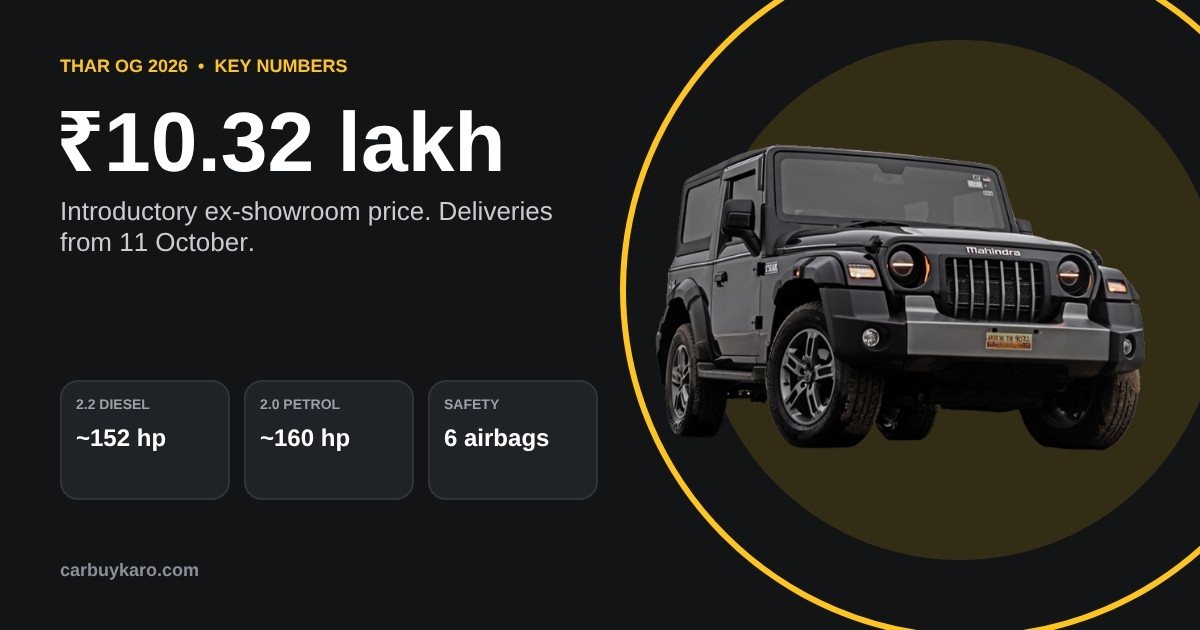
The Mahindra Thar OG 2026 is the updated three-door Thar, launched on 22 September 2026 at an introductory price of ₹10.32 lakh (ex-showroom). The top version costs ₹18.99 lakh. The short answer on what changed: more power from the petrol and 2.2 diesel engines, six airbags, disc brakes on all four wheels, a new rear suspension that rides better, and electric power steering. Deliveries start on 11 October.
Mahindra has kept the starting price exactly where it was, which is the headline most buyers care about. Below we go through the full price list, the engines, what is new, what the old Thar did better, and which variant we would actually buy.
Mahindra Thar OG 2026 price list
Three trim levels are on sale: AXT, LXT and ZXT. The AXT is a single entry version with the small 1.5-litre diesel and a manual gearbox, meant to hold the ₹10 lakh price point. LXT and ZXT get the choice of engines, gearboxes and 4x4.
| Variant | Price range (ex-showroom) | Notes |
|---|---|---|
| AXT | ₹10.32 lakh | 1.5 diesel, manual, RWD only |
| LXT | ₹12.99–18.00 lakh | All engines, MT/AT, RWD/4WD |
| ZXT | ₹13.99–18.99 lakh | Top trim, all engines, full safety kit |
The prices are introductory and apply to deliveries until 30 November 2026. Mahindra has a habit of raising Thar prices once the first wave of bookings is in, so if you are sure you want one, booking before the festive rush makes sense.
On-road, expect to add 12–20% depending on your state. A ₹15 lakh LXT diesel in Maharashtra or Karnataka will land close to ₹18.5 lakh once road tax, registration and insurance are added. You can run your own city’s numbers in our on-road price calculator, and our on-road price explainer shows where every rupee goes.
Engines: more power across the board
All three engines stay, but two of them get a proper bump.
- 2.0-litre turbo-petrol (mStallion): 119 kW, which is about 160 hp, with 330 Nm. That is roughly 8 hp and 10–30 Nm more than before, depending on the gearbox.
- 2.2-litre diesel (mHawk): 111.9 kW, about 152 hp, and 330 Nm. This is the biggest jump. The old engine made 132 hp, so you get about 20 hp more.
- 1.5-litre diesel (D117 CRDe): 87.2 kW, about 117 hp, with 300 Nm. Same as before. RWD with a manual gearbox only.
Manual and six-speed automatic gearboxes are offered on the bigger engines. The notable addition is a 2.2 diesel automatic with rear-wheel drive. Earlier, if you wanted a diesel auto you had to pay for 4x4 too. Plenty of city buyers wanted the diesel torque and the automatic without the extra weight and cost of a transfer case. They now get exactly that.
Which engine suits you?
Here is our quick rule of thumb. If you drive under 1,000 km a month, mostly in town, the petrol automatic is the nicest to live with. It is smoother and quieter at idle. If you do long highway trips or cover 1,500 km plus a month, the 2.2 diesel is the one; it pulls cleanly from low revs and returns noticeably better real-world mileage. The 1.5 diesel is fine for people who want the Thar look and lifestyle on a budget, but it feels a little stretched with four people and luggage on a ghat road.
Want to see the running-cost difference in rupees? Put your monthly kilometres into our fuel cost calculator. With diesel at about ₹90 and petrol at about ₹95 a litre, a 1,500 km month works out roughly ₹10,000 for the diesel against ₹14,000 for the petrol.
What is new on the Thar OG
Ride and handling
This is the change you will feel most. The Thar OG sits on what Mahindra calls the M_Glyde 4G platform, with a new five-link rear setup (Mahindra’s name is PENTALINK) plus a Watts link, and frequency-dependent dampers that Mahindra badges DAVINCI. In plain words, the rear axle is located more precisely and the shock absorbers react differently to small, sharp bumps and big, slow ones. The old Thar was bouncy and fidgety on broken city roads. Early drives suggest the new one is calmer without losing its off-road articulation.
Electric power steering replaces the old hydraulic unit. It is lighter at parking speeds, which matters a lot in a car with a big turning circle, and it lets Mahindra add driver-assist features later.
Safety
The top ZXT gets six airbags, including side and curtain airbags for the front occupants. Disc brakes now come on all four wheels. ESP, tyre-pressure monitoring and front parking sensors are also part of the kit. For a car that many families buy as a second, “fun” car, the extra airbags matter. The previous Thar only had two.
Off-road hardware
The 4x4 versions keep the electronic locking rear differential and add terrain modes. Mahindra has also fitted more sound insulation, so the cabin should be quieter at 80–100 km/h. That has long been a complaint from owners who use the Thar for highway trips.
What we like and what we don’t
Likes
- Same ₹10.32 lakh starting price with more equipment.
- Rear-wheel-drive diesel automatic finally exists.
- Six airbags and four disc brakes on the top trim.
- Still the most capable off-roader under ₹20 lakh.
Dislikes
- It is still a three-door. Rear-seat access is a squeeze, and the boot is small with all seats up.
- The best safety kit is limited to the ZXT.
- Introductory prices usually do not last long.
Thar OG vs Thar Roxx vs Jimny
If you are cross-shopping, the choice usually comes down to three cars. The Thar Roxx is the five-door Thar with a proper rear bench and bigger boot, but it costs more and is harder to park. The Maruti Jimny is lighter, narrower and easier in the city, but it only has a 1.5 petrol engine and feels slow on the highway. We have a full Thar vs Jimny comparison if you are stuck between the two.
Our quick verdict: a couple or a small family with a separate main car should get the Thar OG. A family that wants the Thar as its only car should stretch for the Roxx. Someone who lives in a hill town with narrow roads will be happier in a Jimny.
Which Thar OG variant should you buy?
We would pick the LXT with the 2.2 diesel, rear-wheel drive and the automatic gearbox. It gets the new, stronger engine, the convenience of an automatic, and it skips the cost and weight of 4x4 that many owners never use. If you actually go off-road, even a couple of times a year to a trail or a beach, get the 4x4. Mahindra’s system with the locking differential is genuinely good, and resale for 4x4 Thars is strong.
The AXT at ₹10.32 lakh is a price-leader. It is worth it only if your budget is tight and you want a Thar above everything else. Remember that insurance for a Thar is not cheap; see our guide to zero depreciation car insurance before you accept the dealer’s first quote.
A worked example: real cost of a Thar OG LXT diesel AT
Let us put numbers on it for a buyer in Pune.
- Assume an ex-showroom price of about ₹16.5 lakh for the LXT 2.2 diesel AT RWD.
- Maharashtra road tax on a diesel car in this price band is roughly 13%, which adds about ₹2.15 lakh.
- Insurance for the first year, with zero-dep and engine protect, comes to around ₹75,000.
- Registration, FASTag, TCS and handling add another ₹25,000–40,000.
That puts the on-road price near ₹19.7 lakh. With a ₹4 lakh down payment and a ₹15.7 lakh loan at 9% for five years, the EMI is about ₹32,600 a month. You can play with the down payment and tenure in our car EMI calculator. If that EMI makes you nervous, check our car affordability calculator first. The 20/4/10 rule it uses is a good sanity check for a lifestyle purchase like a Thar.
Common mistakes Thar buyers make
- Buying 4x4 “just in case”. It adds cost, weight and slightly worse mileage. Be honest about whether you will use it.
- Ignoring the waiting period. Popular Thar versions have had long waits before. Ask the dealer for a written delivery date.
- Skipping the test drive on a bad road. Drive it over speed breakers and broken patches, not just the smooth stretch outside the showroom. That is where the new suspension should prove itself.
- Forgetting the rear seat. Sit in the back yourself. If parents or kids will use it daily, look hard at the Roxx.
- Accepting accessories bundles. Dealers love to add ₹40,000–60,000 of accessories. Buy only what you need.
Is the Thar OG worth waiting for?
If you were already set on a three-door Thar, there is no reason to wait. This update fixes the three big complaints about the old car: ride, safety and diesel automatic choice. If you are on the fence between a Thar and a regular SUV, remember that a Thar is still a body-on-frame off-roader. It will never ride like a monocoque SUV such as the Creta. For more family-friendly options, see our list of the best SUVs under ₹15 lakh.
Summary
The Mahindra Thar OG 2026 keeps the ₹10.32 lakh starting price but adds real substance: a stronger 2.2 diesel with about 152 hp, a punchier 160 hp petrol, a rear-drive diesel automatic, six airbags, all-disc brakes and a more settled ride. Our pick is the LXT diesel automatic RWD, or the 4x4 if you will actually leave the tarmac. Book before 30 November to lock in the introductory price, and check the latest new car launches if you want to see what else is on sale this festive season.
Frequently asked questions
What is the price of the Mahindra Thar OG 2026?
The Thar OG starts at ₹10.32 lakh ex-showroom for the AXT diesel manual and goes up to ₹18.99 lakh for the top ZXT 4x4 automatic. These are introductory prices valid for deliveries until 30 November 2026.
Is the Thar OG different from the Thar Roxx?
Yes. The Thar OG is the three-door Thar, updated for 2026. The Thar Roxx is the longer five-door model with more rear space and a bigger boot. The OG is the better pick for off-road use and city parking, the Roxx for families.
When do Thar OG deliveries start?
Mahindra says deliveries begin on 11 October 2026, just before the festive season.
Which Thar OG variant should I buy?
For most buyers the LXT diesel is the sweet spot. Pick the 2.2 diesel automatic 4x4 only if you really go off-road, and the petrol automatic if you drive mostly in the city and cover less than 1,000 km a month.
Prices are ex-showroom unless we say otherwise, and makers change them often. Confirm the latest price, offers and variant details with an authorised dealer before you book.


