On this page 19 sections
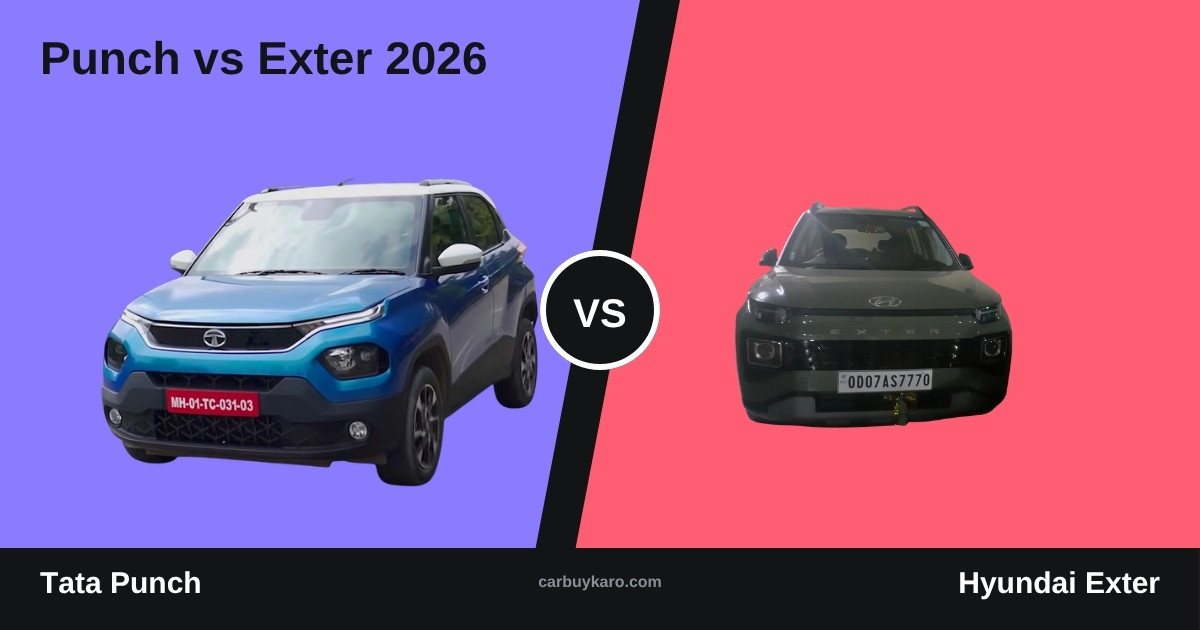
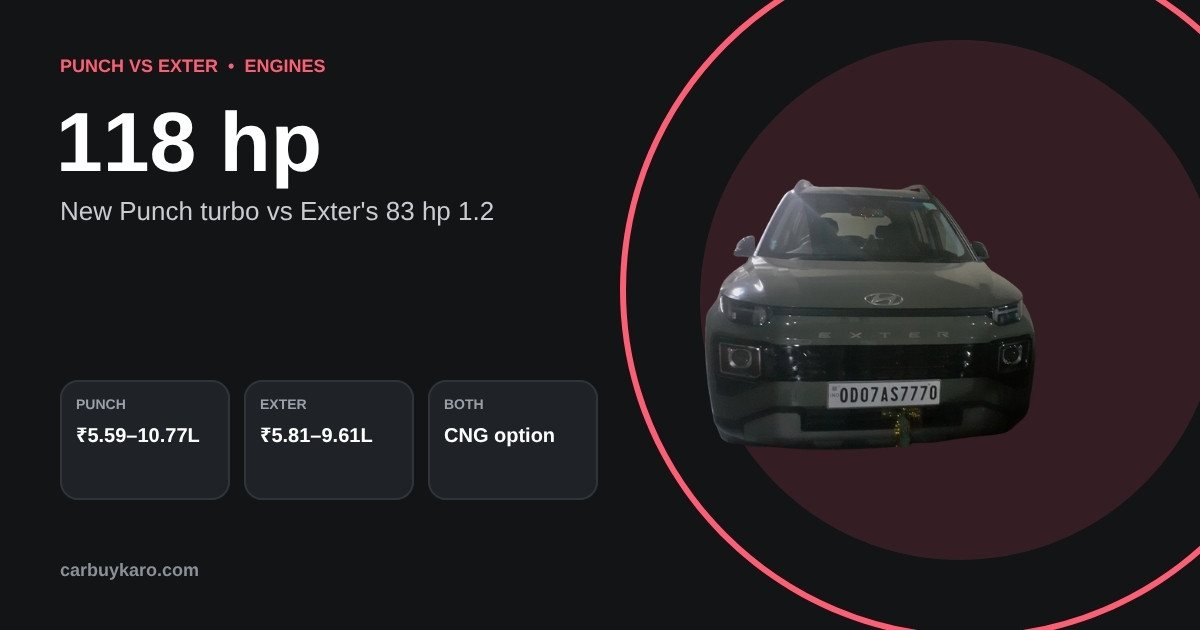
The Punch vs Exter comparison is the key choice for buyers who want an SUV-style car for the price of a hatchback. Short answer: the 2026 Tata Punch facelift (₹5.59–10.77 lakh ex-showroom) now offers a 118 hp 1.2 turbo-petrol, a 5-star Bharat NCAP rating, a CNG AMT and upmarket features such as ventilated seats and a 360-degree camera. The Hyundai Exter (₹5.81–9.61 lakh) has a smoother four-cylinder engine, good efficiency, a CNG option and Hyundai’s easy ownership. Choose the Punch for safety, performance and features; choose the Exter for refinement and value in the lower variants.
Let us go through each area in detail.
Punch vs Exter: key specs
| Tata Punch (2026 facelift) | Hyundai Exter | |
|---|---|---|
| Price (ex-showroom) | ₹5.59–10.77 lakh | ₹5.81–9.61 lakh |
| Petrol | 1.2 three-cylinder NA | 1.2 four-cylinder, 83 hp, 114 Nm |
| Turbo-petrol | 1.2 iTurbo, 118 hp, 170 Nm | Not offered |
| CNG | Yes, including AMT | Yes, manual |
| Gearboxes | MT, AMT | 5MT, 5-speed AMT |
| Crash rating | 5-star Bharat NCAP | Check latest |
What changed on the 2026 Punch
Tata launched the Punch facelift earlier in 2026. The headline change is a new 1.2-litre iTurbo turbo-petrol making 118 hp and 170 Nm. That transforms the Punch on highways, where the naturally aspirated version felt strained with a full load.
Other changes include slimmer LED daytime running lights, a new grille, connected LED tail-lamps, new alloy wheels, a 10.25-inch touchscreen with a matching digital driver’s display, ventilated seats, a 360-degree camera and an updated steering wheel. It also carries a 5-star Bharat NCAP rating.
Engines and driving
Punch
The naturally aspirated 1.2 three-cylinder is fine for city use but feels slow on highways. The new 1.2 turbo changes that, with strong mid-range pull and easy overtaking. It is the most powerful car in this price segment. The trade-off is higher fuel use, especially when driven hard.
Exter
The Exter’s 1.2 four-cylinder is smooth, quiet and refined at idle. It has similar power to the Punch’s non-turbo engine but feels more polished. It is adequate in the city and on relaxed highway drives, but it is not quick.
Our take
If you drive on highways often, the Punch turbo is the clear winner. For city-only use, the Exter’s smoother engine is the nicer daily companion.
Safety
The Punch’s 5-star Bharat NCAP rating is a strong selling point. Tata has built a reputation for safe cars across its range.
The Exter comes with six airbags as standard, which is excellent at this price, along with ESC on many variants. For the latest ratings of both, check our safest cars guide.
Features
The Punch facelift has moved upmarket: 10.25-inch touchscreen, digital cluster, ventilated seats, 360-degree camera and connected LED tail-lamps. For a car starting under ₹6 lakh, the top trims are impressively equipped.
The Exter is well equipped too, with a sunroof, dashcam with dual cameras, touchscreen and six airbags. It offers strong value in its mid variants.
At the top end, the Punch now offers more premium features. In the middle, the two are close.
Space and practicality
Both are compact, with seats for four adults comfortably and five for short trips. The Punch has higher ground clearance and a more upright SUV stance, which helps on broken roads and big speed breakers. The Exter is also tall and boxy, with good headroom.
Boot space is modest in both. CNG versions lose some boot space; Tata’s twin-cylinder layout and Hyundai’s dual-cylinder setup help, but check with your own luggage.
Running costs
For a buyer driving 1,200 km a month, with petrol at ₹95 and CNG at ₹85 per kg:
| Version | Real-world economy | Monthly fuel cost |
|---|---|---|
| Punch 1.2 NA petrol AMT | 15 km/l | about ₹7,600 |
| Punch 1.2 turbo petrol | 13.5 km/l | about ₹8,400 |
| Punch CNG AMT | 22 km/kg | about ₹4,600 |
| Exter 1.2 petrol AMT | 16 km/l | about ₹7,100 |
| Exter CNG MT | 24 km/kg | about ₹4,300 |
The Exter is slightly cheaper to run in petrol and CNG form. The Punch turbo costs the most but offers far more performance. Calculate your own case in our fuel cost calculator.
CNG: automatic or manual?
The Punch CNG AMT is a big advantage for city drivers who want low running costs without a clutch. Driving a CNG manual in heavy traffic is tiring; an AMT makes it much easier.
The Exter CNG is manual-only (check the latest list). If you want CNG and an automatic, the Punch is the obvious choice. Our best CNG cars guide lists all the CNG automatics available today.
Service, reliability and resale
Hyundai has a large service network, reasonable parts prices and a reputation for reliable engines. Resale values are good.
Tata has grown its network quickly, and the Punch has become one of India’s best-selling cars, which supports resale. Service experience varies by dealer, so check reviews locally.
Punch vs Exter: which should you buy?
Buy the Punch if:
- Safety is your top priority.
- You want the turbo for highway performance.
- You want a CNG automatic.
- You want premium features such as ventilated seats and a 360 camera.
Buy the Exter if:
- You want a smooth, refined four-cylinder engine.
- You drive mostly in the city.
- You want slightly lower running costs.
- You value Hyundai’s service network and ownership experience.
Best variants
- Punch: a mid variant with the NA engine and AMT is the best city value. The turbo on an upper variant is the choice for highway users. The CNG AMT suits high-mileage city drivers. Read our Tata Punch buyer’s guide for a full variant breakdown.
- Exter: mid variants with the AMT or CNG offer the best value.
Worked example: EMI on a mid-spec automatic
Assume a mid-spec Punch AMT at ₹8.2 lakh on-road and a mid-spec Exter AMT at ₹8 lakh on-road in Bengaluru.
- Down payment: ₹1.8 lakh for both.
- Loans: ₹6.4 lakh and ₹6.2 lakh at 9.25% for five years.
- EMIs: about ₹13,400 for the Punch and ₹12,900 for the Exter.
- Fuel at 1,200 km a month: about ₹7,600 for the Punch and ₹7,100 for the Exter.
The monthly difference is about ₹1,000. Model your own case in the car EMI calculator.
Test drive checklist
- Drive the Punch turbo and the Exter on a highway with passengers to feel the power difference.
- Try both AMTs in city traffic.
- Drive over speed breakers to compare ground clearance and ride.
- Sit in the rear and check knee room and headroom.
- Open the CNG boots if you plan to buy CNG.
- Ask for itemised on-road quotes from both dealers.
Common mistakes
- Choosing the turbo for city-only driving. You will pay more for fuel and rarely use the power.
- Buying the base variant. Base versions miss key comfort and safety features and resell poorly.
- Assuming CNG always saves money. It pays off only above about 1,000–1,200 km a month.
- Ignoring the rear seat. These are compact cars; check if your family fits.
Micro SUV or hatchback?
Some buyers consider a hatchback like the Maruti Swift or Baleno instead. Hatchbacks are usually more efficient and better to drive on smooth roads. Micro SUVs like the Punch and Exter offer higher ground clearance, a taller driving position and better visibility, which many Indian drivers prefer. If your daily routes are rough, the micro SUV is worth the small compromise in efficiency. See our Baleno vs i20 comparison for the hatchback side.
Who each car suits best
The young professional in a metro. Drives 30–40 km a day in traffic, occasionally heads out of town on weekends. The Exter AMT is easy, smooth and cheap to run. If weekend trips are frequent, the Punch turbo adds a lot of highway confidence.
The family with young kids. Wants maximum safety and a car that can handle bad roads near home. The Punch’s 5-star rating and ground clearance make it the stronger choice. A mid-spec Punch AMT covers daily needs well.
The high-mileage driver. Covers 2,000 km a month in the city, perhaps for work. The Punch CNG AMT is the obvious pick: automatic convenience with CNG running costs.
The first-time buyer in a smaller town. Values easy service, low running costs and good resale. Both work, but check which brand has the better-rated service centre nearby. That often decides it.
Ownership costs beyond fuel
Service costs for both are among the lowest in the market. Expect routine services to cost roughly ₹3,000–6,000 in the first few years. Insurance with zero-depreciation cover typically costs ₹20,000–30,000 in the first year for mid variants. Tyres are small and inexpensive to replace.
Both brands sell extended warranty packages. Tata has been offering long warranties on its newer models, and Hyundai’s extended warranty is well regarded. For a car you plan to keep for six years or more, it is worth buying. Our zero depreciation insurance guide explains which insurance add-ons are worth paying for.
Resale after five years
Micro SUVs sell well in the used market because they suit first-time buyers. A well-maintained mid-variant Punch or Exter should retain around 55–60% of its value after three years and around 45–50% after five years. AMT and CNG versions often sell faster in big cities. Keep all service records and avoid aftermarket modifications if you want the best price.
Summary
In the Punch vs Exter contest, the 2026 Punch facelift wins on safety, turbo performance, CNG automatic and premium features, while the Exter wins on engine refinement, slightly lower running costs and easy ownership. Pick the Punch if safety and highway performance matter most; pick the Exter for relaxed, smooth city driving. See our best cars under ₹10 lakh for other options.
Frequently asked questions
Which is better, Punch or Exter?
The 2026 Punch facelift is more powerful with its new turbo-petrol, has a 5-star Bharat NCAP rating and more premium features on top trims. The Exter has a smoother four-cylinder engine, good CNG efficiency and easy ownership. Pick the Punch for safety and performance, the Exter for smoothness and value.
Is the Tata Punch safer than the Hyundai Exter?
The Punch facelift has a 5-star Bharat NCAP rating. The Exter offers six airbags as standard. Check the latest crash test results for both before buying.
Which has better mileage, Punch or Exter?
In petrol and CNG form the Exter's four-cylinder is usually slightly more efficient in real-world use than the Punch's naturally aspirated three-cylinder. The Punch turbo uses more fuel than either.
Do both have CNG with an automatic?
The Punch offers a CNG AMT. The Exter's CNG is offered with a manual gearbox. Check current variant lists, as makers update these often.
Prices are ex-showroom unless we say otherwise, and makers change them often. Confirm the latest price, offers and variant details with an authorised dealer before you book.


