
On this page 18 sections
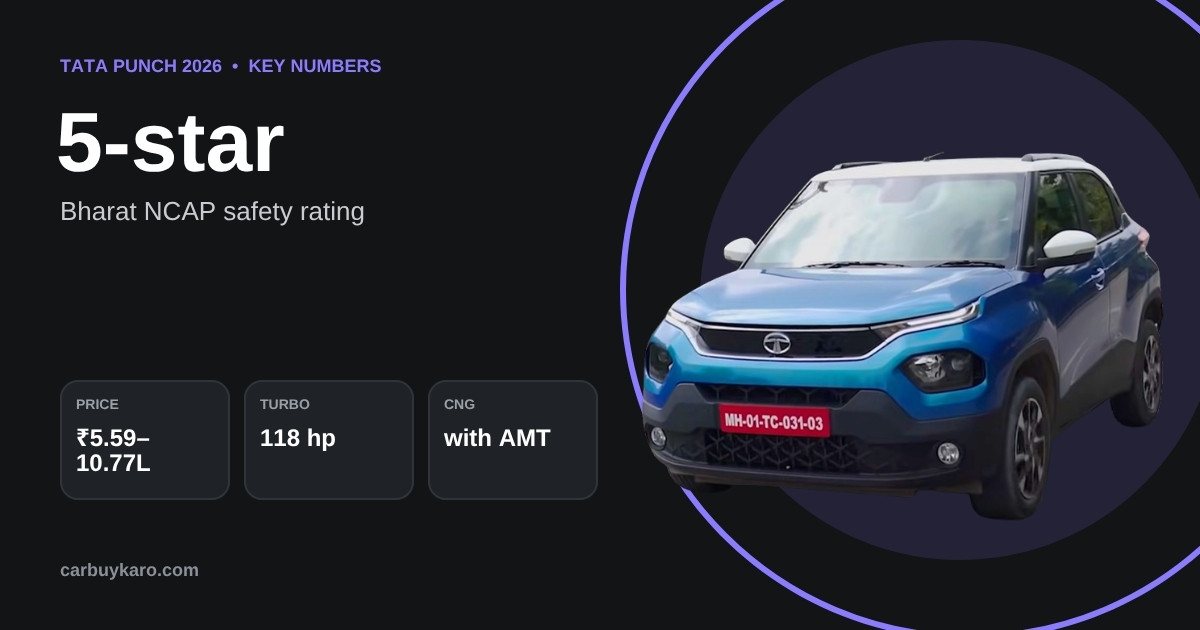
The Tata Punch 2026 facelift costs ₹5.59–10.77 lakh (ex-showroom) and is one of the safest cars you can buy at the price, with a 5-star Bharat NCAP rating. The update brought a new 118 hp 1.2 turbo-petrol, a refreshed design with slimmer LED lights and connected tail-lamps, and a much better cabin with a 10.25-inch touchscreen, digital cluster, ventilated seats and a 360-degree camera on top variants. It also offers a CNG version with an AMT, which is rare at this price.
This guide walks you through the engines, variants, real-world costs and ownership, then tells you exactly which Punch we would buy.
What changed in the 2026 facelift
Think of the facelift as a fix for the two complaints owners had most often. The first was highway performance: the old Punch only had a small naturally aspirated engine, so overtaking a truck with a full car needed planning. Tata answered with a new 1.2 iTurbo unit. The second was the cabin, which felt plain next to rivals. Now the dashboard carries a 10.25-inch touchscreen paired with a digital instrument screen, and the upper trims get cooled front seats and a surround-view camera.
Outside, the nose is slimmer and cleaner, the rear lamps are joined by a light strip, and the wheels are new. The crash rating is five stars from Bharat NCAP.
Engines explained
1.2 naturally aspirated petrol
The standard engine is a three-cylinder with modest power. It is fine in the city and returns decent mileage, but feels strained on highways with four people on board. Available with a manual or AMT.
1.2 iTurbo turbo-petrol
The new turbo transforms the Punch. With 118 hp and 170 Nm, overtaking on highways becomes easy and ghat roads are no longer a struggle. It uses more fuel, especially when driven hard. It is the engine to choose if you do regular highway trips.
CNG
The CNG version uses Tata’s twin-cylinder layout, which keeps some of the boot usable. The option of an AMT with CNG makes it one of the cheapest clutch-free cars to run in India.
Which engine should you choose?
| Your driving | Best engine |
|---|---|
| City only, under 1,000 km a month | 1.2 petrol, AMT |
| Regular highway trips | 1.2 turbo-petrol |
| City, over 1,200 km a month | CNG AMT |
| Tight budget | 1.2 petrol manual |
Real-world running costs
For a driver covering 1,200 km a month, with petrol at ₹95 and CNG at ₹85 per kg:
| Version | Real-world economy | Monthly fuel cost |
|---|---|---|
| 1.2 petrol AMT | 15 km/l | about ₹7,600 |
| 1.2 turbo petrol | 13.5 km/l | about ₹8,400 |
| CNG AMT | 22 km/kg | about ₹4,600 |
The CNG AMT saves about ₹3,000 a month over the petrol AMT at this usage. Calculate your exact numbers with our fuel cost calculator.
Variants: how to pick
Tata offers the Punch in several trims, from a basic entry version to a fully loaded top variant. Rather than listing every trim name (they change often), here is how to think about them:
- Base trims: the cheapest way into a 5-star car, but they skip the touchscreen, rear camera and several comfort features. Resale is weaker.
- Mid trims: the sweet spot for most buyers. You get the touchscreen, rear camera, more airbags and the AMT or CNG options at a sensible price.
- Top trims: add ventilated seats, the 360-degree camera, larger alloys and premium touches. Worth it if these features matter to you.
Our guide on how to choose the right car variant explains why mid trims are usually the best value.
Space and practicality
The Punch is compact outside but tall and boxy, with good headroom and a high seating position. Four adults fit comfortably; five is tight for long trips. Ground clearance is generous, which makes it well suited to broken roads and big speed breakers. Boot space is adequate in petrol versions and reduced in CNG versions.
Safety
The Punch’s 5-star Bharat NCAP rating is its biggest strength. It offers airbags, ESC and ISOFIX child seat mounts, depending on variant. For a family on a budget, few cars offer this level of crash protection. See our safest cars guide for how it compares.
Punch vs rivals
The Punch’s main rival is the Hyundai Exter, which has a smoother four-cylinder engine and slightly lower running costs, but no turbo option and no CNG automatic. We compare them in detail in Punch vs Exter. If you can stretch your budget, the Tata Nexon offers more space and power. If you prefer a hatchback, the Maruti Baleno and Swift are more efficient. See our best cars under ₹10 lakh.
Our pick
For most buyers: a mid variant with the 1.2 petrol AMT. It is easy to drive in the city, well equipped, safe and affordable.
For high-mileage city drivers: the CNG AMT in a mid variant.
For highway users: the turbo-petrol in an upper variant.
Worked example: EMI and total monthly cost
A mid variant Punch AMT costs about ₹8.2 lakh on-road in Pune.
- Down payment: ₹1.8 lakh.
- Loan: ₹6.4 lakh at 9% for five years.
- EMI: about ₹13,300.
- Fuel at 1,200 km a month: about ₹7,600.
- Insurance and service averaged: about ₹2,000.
Total: about ₹22,900 a month. Try other options in our car EMI calculator.
Ownership tips
- Service on schedule. Tata’s service experience varies by dealer, so pick a well-reviewed workshop.
- Buy the extended warranty. Tata’s extended warranty is reasonably priced and worth it if you keep the car beyond five years.
- Check tyre pressures every two weeks, especially on the CNG version, which carries extra weight.
- Get CNG cylinders tested as required by law.
- Keep all service records for better resale.
Common mistakes Punch buyers make
- Buying the turbo for city-only use. You will pay more for fuel and rarely use the extra power.
- Choosing the base variant for safety alone. The rating applies to the tested configuration; confirm what safety kit your variant has.
- Buying CNG without checking pumps. Make sure CNG is easily available near you.
- Skipping a test drive on a bad road. The Punch’s suspension is one of its strengths; make sure you like it.
A week with a Punch AMT in the city
Here is what ownership looks like for a typical buyer in Pune who commutes 30 km a day through traffic and heads out of town once a month.
Weekdays: the AMT handles the crawl without fuss. The high seating position gives a clear view over traffic, and the compact size makes squeezing into office parking easy. Real-world mileage settles at around 14–15 km/l with the AC running.
Weekend: a 150 km trip to Lonavala with four people. The naturally aspirated engine copes on the expressway but needs a downshift and some patience on the ghat. This is where the turbo would make life easier, and why we recommend it for regular highway users.
Monthly cost: around 1,100 km of driving costs about ₹7,000 in petrol. Service visits come once a year or every 10,000 km, typically costing ₹3,000–6,000 in the first few years.
Colours and resale
The Punch comes in a range of bright single and dual-tone colours. Brighter shades suit the Punch’s playful character, but white, grey and silver sell fastest in the used market. A well-kept mid variant should retain around 55–60% of its value after three years. CNG and AMT versions are popular in the used market in big cities, which helps resale.
Punch EV: the electric option
Tata also sells an electric version, the Punch EV, for buyers who can charge at home. It is quiet, quick off the line and very cheap to run on home electricity. It costs more upfront. If your daily driving is predictable and you have a parking spot with power, it is worth a test drive. See our best electric cars in India for how it compares.
Punch or Nexon?
Some buyers stretch from a top Punch to a lower Nexon. The Nexon is larger, with more rear space, a bigger boot and a diesel option, and it feels more substantial on highways. The Punch is easier to park, cheaper to run and offers a CNG automatic. If you are a family of four who travels often, the Nexon’s extra space may be worth the step up. For city-focused couples or small families, a well-equipped Punch is the smarter buy.
Accessories worth buying
Dealers offer long accessory lists for the Punch. The ones that add real value are floor mats (the 3D moulded type protects the carpet in monsoon), mud flaps for rough roads, a good-quality dashcam if your variant lacks one, and seat covers if you carry pets or small children. Skip chrome garnishes and body graphics; they add cost and rarely help resale. Ask for itemised prices and compare with authorised accessory stores.
Good accessories should make daily use easier, not just change how the car looks.
Summary
The Tata Punch 2026 facelift is a safe, practical and now much better-equipped micro SUV, from ₹5.59 to ₹10.77 lakh. The new turbo fixes its highway weakness, the CNG AMT makes it one of the cheapest automatics to run, and its 5-star Bharat NCAP rating makes it a top choice for families. Pick a mid variant AMT for city use, the CNG AMT for high mileage, or the turbo for highway trips. For more guides, see our buying guides section.
Frequently asked questions
What is the price of the Tata Punch 2026?
The facelifted Tata Punch costs ₹5.59 lakh to ₹10.77 lakh ex-showroom, depending on engine, gearbox and variant.
Does the new Tata Punch have a turbo engine?
Yes. The 2026 facelift added a 1.2-litre iTurbo turbo-petrol making 118 hp and 170 Nm, alongside the naturally aspirated petrol and CNG versions.
What is the real mileage of the Tata Punch?
Expect roughly 14–17 km/l from the naturally aspirated petrol, 12–15 km/l from the turbo in mixed driving, and around 20–23 km/kg from the CNG in city use.
Is the Tata Punch safe?
Yes. The Punch has a 5-star Bharat NCAP rating, making it one of the safest cars you can buy at its price.
Prices are ex-showroom unless we say otherwise, and makers change them often. Confirm the latest price, offers and variant details with an authorised dealer before you book.


