On this page 16 sections
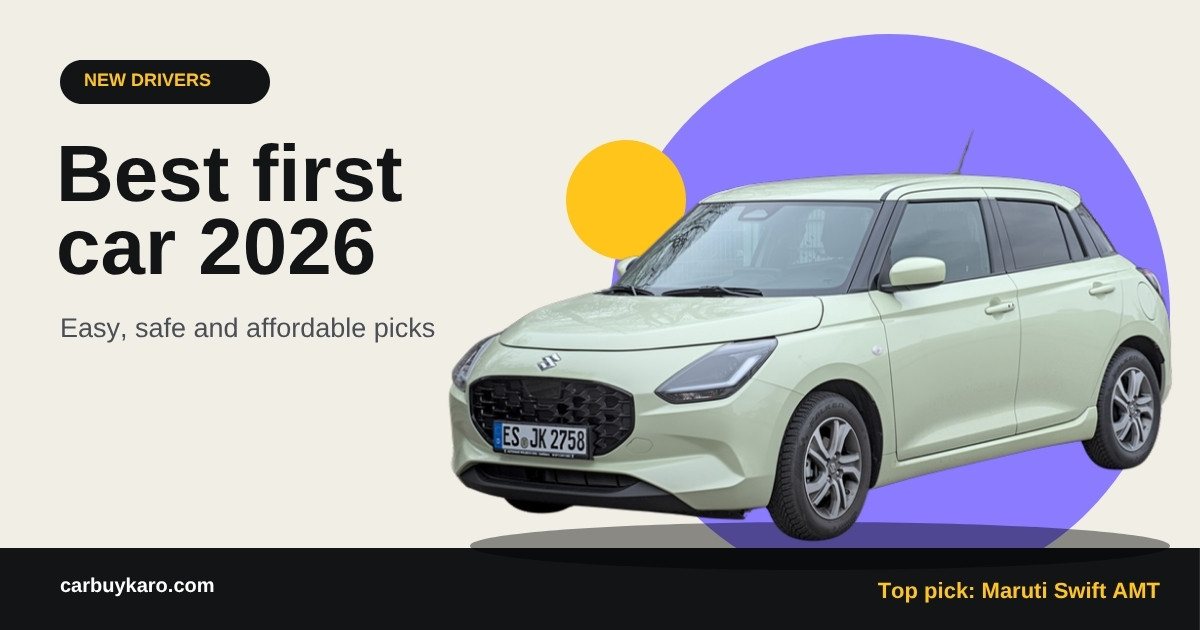
The best first car in India is one that is easy to drive, simple to park, safe, cheap to run and not too painful to repair when you inevitably scrape a bumper. Our top picks for 2026: the Maruti Swift AMT (best all-rounder for new drivers), Maruti Baleno AMT (more space), Hyundai Exter AMT (smooth and easy), Tata Punch (safest, 5-star Bharat NCAP) and the Maruti Wagon R (best on a tight budget). For city driving, we strongly suggest an automatic (AMT), which adds only about ₹50,000.
Here is what makes a good first car, our picks, and the money mistakes to avoid.
What makes a good first car?
- Compact size: easier to park, manoeuvre and judge in traffic.
- Good visibility: large windows and a clear view of the car’s corners.
- Light controls: light steering and clutch (or no clutch at all).
- Safety: six airbags, ESC and a strong crash rating.
- Low running costs: efficient engine, cheap parts, low insurance.
- Forgiving to repair: bumpers and panels that are cheap to replace.
- Wide service network: help is easy to find if something goes wrong.
Our picks
| Car | Approx. price (ex-showroom) | Why it suits new drivers |
|---|---|---|
| Maruti Swift AMT | from about ₹7.5 lakh | Light, agile, efficient, cheap to fix |
| Maruti Baleno AMT | from ₹7.50 lakh | More space, six airbags, efficient |
| Hyundai Exter AMT | from about ₹7.5 lakh | Smooth engine, high seating, six airbags |
| Tata Punch AMT | from about ₹7 lakh | 5-star safety, high ground clearance |
| Maruti Wagon R AMT | from about ₹6 lakh | Tall, easy to see out of, low cost |
Maruti Swift
Light steering, compact size and a responsive engine make the Swift very easy to drive. It is efficient, parts are cheap and every town has a Maruti workshop.
Maruti Baleno
If you want more space for family or friends, the Baleno is roomier, with six airbags standard. See our Baleno 2026 guide.
Hyundai Exter
A higher seating position helps new drivers see the road. The four-cylinder engine is smooth and six airbags are standard.
Tata Punch
The safest choice at this price, with a 5-star Bharat NCAP rating and high ground clearance for bad roads. Read our Tata Punch buyer’s guide.
Maruti Wagon R
Tall, boxy and very easy to see out of, the Wagon R is one of the most practical budget cars for learning.
Automatic or manual?
Choose an AMT if: you drive in busy city traffic, you are nervous about stalling or hill starts, or several family members will drive the car.
Choose a manual if: your budget is very tight, you drive mostly in smaller towns or open roads, or you want to learn full control of a car.
AMTs add only ₹50,000–60,000 and are as efficient as manuals. For most new city drivers, the AMT is worth it. Our AMT vs CVT vs DCT guide explains the types.
New or used?
A used car makes sense if:
- You are a new driver likely to scrape bumpers while learning.
- Your budget is limited.
- You find a well-maintained car with full service records.
A new car makes sense if:
- You want the latest safety features and a warranty.
- You plan to keep the car for many years.
- You want zero uncertainty about the car’s history.
A good compromise: buy a two- to three-year-old used hatchback with a full service history, drive it for a few years while you gain confidence, then buy new.
How much can you afford?
Keep total monthly car costs under about 15% of your take-home pay. That includes EMI, fuel, insurance and service.
Example: a first-time buyer earning ₹60,000 a month take-home.
- 15% of ₹60,000 = ₹9,000 a month for all car costs.
- Fuel for 600 km a month at 16 km/l and ₹95 per litre: about ₹3,600.
- Insurance and service averaged: about ₹1,500.
- That leaves about ₹3,900 for EMI, which supports a loan of roughly ₹1.9 lakh over five years at 9%.
In this case, a good used hatchback or a larger down payment on a new entry-level car makes more sense than a big loan. Try your own numbers in our car affordability calculator.
Insurance for new drivers
- Comprehensive cover is essential, not just third-party.
- Zero depreciation add-on is very useful for new drivers, because small dents and scrapes are common. Read our zero depreciation insurance guide.
- Compare online quotes rather than accepting the dealer’s first offer.
- Avoid small claims in the first years to build a no-claim bonus.
Tips for learning in your first car
- Take professional lessons, even if a family member can teach you.
- Practise in empty areas early in the morning before tackling traffic.
- Learn to park using the rear camera and mirrors.
- Avoid night highway driving until you are confident.
- Keep a safe distance from the vehicle ahead; it is the single best habit.
Common mistakes first-time buyers make
- Buying too big a car. A large SUV is harder to park and manoeuvre while learning.
- Stretching the budget. A car that strains your finances takes the fun out of owning it.
- Skipping safety features for a sunroof or big screen.
- Taking dealer insurance and accessories without comparing prices.
- Not checking on-road price. Compare on-road quotes with our on-road price calculator.
Checklist before you sign
- Test drive at least two cars, including in traffic.
- Confirm the variant has six airbags and ESC.
- Compare on-road prices from two dealers.
- Get your own insurance quotes.
- Arrange your loan in advance, comparing bank rates.
- Do a pre-delivery inspection before accepting the car. Our new car PDI checklist walks you through it.
Features that really help new drivers
Some features make a big difference when you are still learning:
- Rear parking camera and sensors. Parking is the hardest skill for most new drivers. A camera with guidelines makes it far less stressful.
- Automatic gearbox. No stalling, no clutch control on slopes. An AMT is enough.
- Hill-hold assist. Stops the car rolling back on slopes, useful in flyovers and multi-level parking.
- Electric power steering. Light at low speeds, which makes parking easier.
- Auto-dimming mirrors and good headlamps. Night driving is harder when you are new.
Features like sunroofs, ambient lighting and big alloy wheels add cost without helping you drive better. Put the money towards safety features or a better variant.
How to protect your first car
New drivers often scrape bumpers and scuff alloys. A few simple steps limit the damage and cost:
- Buy zero depreciation insurance so small repairs are fully covered.
- Fit parking sensors if your variant does not have them.
- Avoid tight parking spaces in the first few months.
- Use a car cover if you park outdoors under trees.
- Get small dents fixed quickly before rust sets in.
Your first 1,000 km
Modern cars do not need a strict “running-in” period, but the first 1,000 km are a good time to learn the car gently. Avoid very high revs and sudden hard braking, check tyre pressures weekly, and attend the first free service on time. Keep a small notebook or phone note of fuel fills and mileage to spot any problems early. Our mileage calculator makes tracking easy.
First car on a budget: used options
If your budget is ₹3–5 lakh, a used hatchback is often the smartest first car. Good used choices include the Maruti Swift, Baleno and Wagon R, Hyundai Grand i10 Nios and i20, and Tata Tiago. Look for a car that is three to five years old, with under 50,000 km, a full service history and a clean insurance claim record. Get it inspected by a trusted mechanic before paying. Our car resale value tips explain what to look for.
Paperwork every new owner should know
Keep these documents in order from day one:
- Registration certificate (RC): proof of ownership. A digital copy on DigiLocker or mParivahan is accepted.
- Insurance policy: carry a copy and set a reminder for renewal. Driving without valid insurance is illegal.
- PUC certificate: new cars come with one valid for a year; after that, renew it every six months or as required.
- FASTag: needed for toll plazas; link it to a bank account or wallet. Our FASTag annual pass guide explains the new yearly option.
- Driving licence: carry it or keep the digital version handy.
Missing documents are one of the most common reasons new drivers get fined. A few minutes of organisation saves a lot of trouble.
Should parents buy the first car for a young driver?
Many first cars in India are bought by parents for a son or daughter who has just got a licence. If that is your situation, prioritise safety and simplicity over style. A small car with six airbags, ESC and an automatic gearbox is ideal. Add the young driver as a named driver on the insurance policy, keep the first few months to daytime city driving, and consider a telematics or GPS tracker for peace of mind. Resist the urge to buy a powerful turbo car as a first car; inexperience and extra power are a risky combination.
Summary
The best first car in India is small, safe, easy to drive and cheap to run. Our picks are the Maruti Swift AMT, Baleno AMT, Hyundai Exter AMT, Tata Punch and Maruti Wagon R. Choose an AMT for city driving, keep total costs under about 15% of your take-home pay, and buy comprehensive insurance with zero depreciation. For more options, see our best cars under ₹10 lakh.
Frequently asked questions
Which is the best first car in India?
For most new drivers, a compact hatchback like the Maruti Swift, Baleno or Hyundai Exter is ideal: easy to drive and park, cheap to run and insure, and forgiving of small scrapes. The Tata Punch is the pick for buyers who put safety first.
Should my first car be automatic or manual?
In busy cities, an automatic (AMT) makes learning and daily driving much easier. A manual teaches full car control and is cheaper. Many new drivers are happier with an AMT.
Should I buy a new or used first car?
A used car costs less and new drivers often scrape their first car, so a good used hatchback is sensible. A new car offers warranty, the latest safety features and no hidden history.
How much should I spend on my first car?
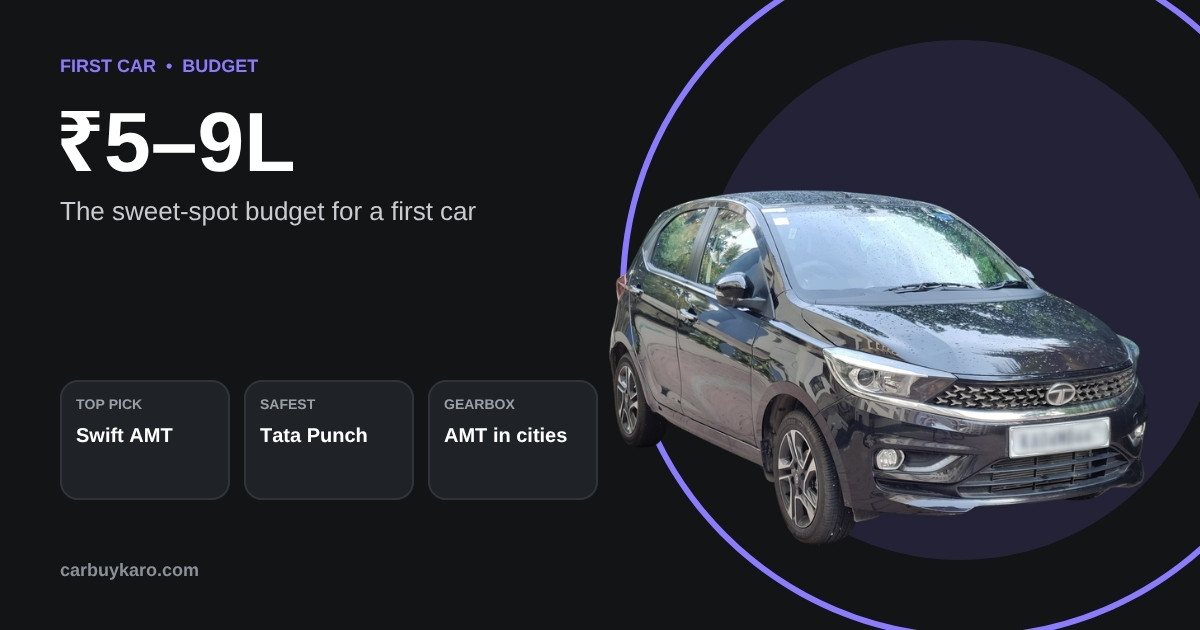
Keep the total monthly cost (EMI, fuel, insurance and service) under about 15% of your take-home pay. For many first-time buyers that means a car between ₹5 lakh and ₹9 lakh ex-showroom.
Prices are ex-showroom unless we say otherwise, and makers change them often. Confirm the latest price, offers and variant details with an authorised dealer before you book.


