On this page 20 sections
The best 7 seater cars in India in 2026, by budget, are the Maruti Ertiga (best value MPV), Kia Carens (best-equipped MPV under ₹20 lakh), Mahindra XUV 7XO and Tata Safari (best seven-seat SUVs), Toyota Innova Hycross (best premium people carrier, with a strong hybrid), Kia Sorento (premium hybrid SUV) and the MG Hector Tomahawk EV (best seven-seat EV). The key choice is between an MPV, which usually has a roomier third row, and an SUV, which offers more road presence and ground clearance.
Below, we rank them and explain how to judge a third row before you buy.
MPV or SUV?
MPVs (Ertiga, Carens, Innova Hycross) are designed around passengers. They have flatter floors, taller roofs and easier third-row access. They ride comfortably and are usually more efficient.
Seven-seat SUVs (XUV 7XO, Safari, Sorento) offer more ground clearance, stronger engines, AWD on some models and the look many buyers want. Their third rows are often tighter.
If you carry adults in the third row regularly, an MPV is usually the smarter choice. If the third row is for kids or occasional use, an SUV works well.
Our shortlist
| Car | Type | Approx. price (ex-showroom) | Best for |
|---|---|---|---|
| Maruti Ertiga | MPV | ₹9–13.5 lakh | Value, CNG, low running cost |
| Kia Carens | MPV | ₹11–20 lakh | Features, engine choice |
| Mahindra XUV 7XO | SUV | ₹13.66–24.92 lakh | Power, AWD, tech |
| Tata Safari | SUV | ₹13.29–26.14 lakh | Third-row space, comfort |
| Toyota Innova Hycross | MPV | ₹19–32 lakh | Premium comfort, hybrid |
| Kia Sorento | SUV | ₹27.99–40.39 lakh | Premium hybrid, AWD |
| MG Hector Tomahawk EV | Electric SUV | ₹19.49–23.49 lakh | Electric seven-seater |
1. Maruti Ertiga: best value
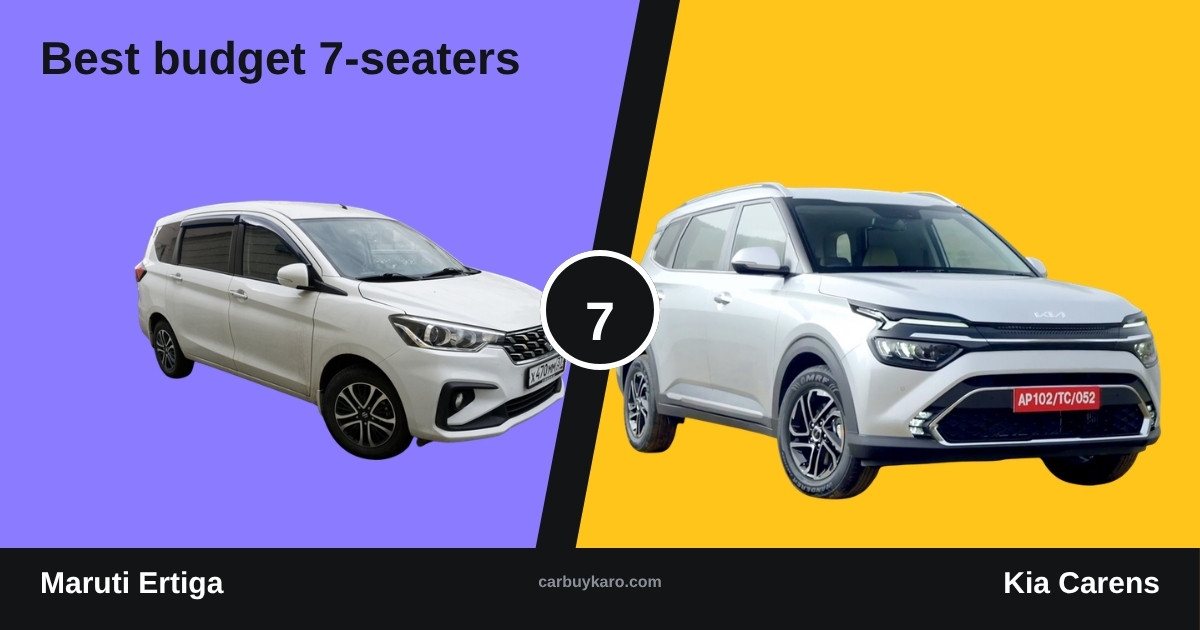
The Ertiga is India’s favourite budget seven-seater for good reason. Its 1.5 petrol mild-hybrid is smooth and efficient, a factory CNG version is very cheap to run, and Maruti’s service network is everywhere. The third row suits children and adults for short trips.
Buy: a mid variant petrol automatic for city families, or the CNG for high mileage. The Toyota Rumion is its twin, if you prefer Toyota’s warranty.
2. Kia Carens: best-equipped MPV
The Carens offers petrol, turbo-petrol and diesel engines, a long feature list and a comfortable, well-designed cabin. It feels more premium than the Ertiga and suits families who want features without moving to a large SUV.
Buy: a mid variant with the turbo-petrol DCT or diesel automatic. An electric version has also been introduced; check current availability.
3. Mahindra XUV 7XO: best seven-seat SUV for power
The renamed XUV700 facelift offers a 2.0 turbo-petrol (about 200 hp) and a 2.2 diesel, AWD on top diesel automatics and a three-screen dashboard. It is quick and loaded with features.
Buy: a mid variant diesel automatic. See our XUV 7XO vs Safari comparison.
4. Tata Safari: best third-row SUV
The Safari’s longer, taller body gives a more usable third row than most SUVs. It rides comfortably and offers a proven 2.0 diesel plus a new 1.5 turbo-petrol. An electric version is due around Diwali 2026.
Buy: a mid variant diesel automatic, six-seat layout if adults use the rear rows.
5. Toyota Innova Hycross: best premium people carrier
The Hycross offers limousine-like comfort in its captain-chair versions, a strong-hybrid powertrain that returns around 15–18 km/l in real use, and Toyota’s legendary reliability and resale.
Buy: a mid hybrid variant with captain chairs.
6. Kia Sorento: premium hybrid SUV
Launched on 4 September 2026, the Sorento offers a 1.6 turbo strong hybrid and a 2.2 diesel, AWD, ten airbags and Level 2 ADAS. It is an alternative to the Fortuner with far better efficiency.
Buy: see our Kia Sorento guide for our variant pick.
7. MG Hector Tomahawk EV: best seven-seat EV
At ₹19.49–23.49 lakh, it offers seven seats, a 69.2 kWh battery and a claimed 517 km range. With home charging, running costs are a fraction of a diesel SUV’s.
Buy: read our Hector Tomahawk EV guide for the BaaS maths.
How to judge a third row
Spec sheets do not tell you how comfortable the third row is. At the showroom:
- Sit in it yourself, with the second row set for an adult.
- Check knee room and headroom. Can an adult sit upright without their knees at their chest?
- Check entry and exit. How easy is it to climb in? Does the second row tumble or slide easily?
- Look for AC vents and charging points for third-row passengers.
- Check the boot with all seats up. Many seven-seaters have almost no luggage space in full seven-seat mode.
Six seats or seven?
Many of these cars offer captain chairs in the middle row (six seats). Choose six seats if you carry elderly parents or adults in the middle row, or if you want an easier path to the third row. Choose seven seats if you have young children who need the extra seat.
Running costs
For a family driving 1,500 km a month:
| Car | Real-world economy | Monthly fuel cost |
|---|---|---|
| Ertiga CNG | 20 km/kg | about ₹6,400 (₹85/kg) |
| Ertiga petrol AT | 13 km/l | about ₹11,000 (₹95/l) |
| Innova Hycross hybrid | 16 km/l | about ₹8,900 (₹95/l) |
| Safari diesel AT | 13 km/l | about ₹10,400 (₹90/l) |
| XUV 7XO petrol AT | 9 km/l | about ₹15,800 (₹95/l) |
| Tomahawk EV, home charging | 5.5 km/unit | about ₹2,200 (₹8/unit) |
Try your own numbers with our fuel cost calculator.
Worked example: EMI on a ₹15 lakh seven-seater
Assume an Ertiga or Carens mid variant at about ₹15 lakh on-road.
- Down payment: ₹3 lakh.
- Loan: ₹12 lakh at 9% for five years.
- EMI: about ₹24,900.
- Fuel (petrol) at 1,500 km a month: about ₹11,000.
- Insurance and service averaged: about ₹3,000.
Total: about ₹39,000 a month. Use the car EMI calculator to try other budgets.
Common mistakes seven-seater buyers make
- Not testing the third row. Always sit there yourself.
- Ignoring boot space. With seven people, luggage space is often tiny. Plan for a roof carrier if needed.
- Buying a big petrol SUV for high mileage. Running costs add up quickly; consider diesel, hybrid or CNG.
- Choosing AWD you do not need. It adds cost and weight.
- Overlooking MPVs because of image. For families, an MPV is often far more practical.
Who really needs a seven-seater?
Plenty of families buy a seven-seater and use the third row twice a year. That is fine if you value the flexibility, but it is worth being honest about how you will use it, because seven-seaters cost more to buy, run and park than five-seaters of similar quality.
A seven-seater makes clear sense if you are a family of five or more, if grandparents live with you and travel with you regularly, if you often do school runs for other children, or if you run a small business that moves people. It makes less sense if you are a family of four who wants the extra space “just in case”. In that case, a spacious five-seat SUV with a big boot, such as a Creta, Seltos or Elevate, may serve you better day to day. You can always rent a larger car for the occasional big family trip.
Living with a large car in the city
Seven-seaters are longer and heavier. A few practical points:
- Parking: many are close to 4.5–4.8 metres long. Check your building’s parking bay and the turning space in the basement.
- Turning circle: bigger vehicles need more room for U-turns. A 360-degree camera helps a lot.
- Fuel: a heavy SUV uses much more fuel in city traffic. Hybrids and CNG versions offset this.
- Tyres and brakes: heavier cars wear these faster. Budget for replacements.
Safety with a full load
A seven-seater full of people and luggage handles differently from an empty one. Braking distances increase and the car leans more in corners. Keep tyre pressures at the “full load” values printed on the door pillar, avoid overloading the roof, and make sure every passenger, including those in the third row, wears a seatbelt. Third-row passengers are closer to the rear of the car, so a strong body structure matters. Check crash ratings in our safest cars guide.
Resale value
Seven-seaters from Toyota, Maruti and Mahindra hold their value well because demand from families and small businesses is steady. The Innova Hycross and Ertiga in particular are very easy to sell. Diesel SUVs hold value well outside Delhi-NCR. Keep full service records and avoid damage to the third-row seats and boot area, which buyers check closely.
Road trip reality check
Picture a family of six heading from Bengaluru to Ooty, about 270 km, with luggage for four days.
In an Ertiga, the family fits, but with all seats up, the boot takes only a couple of soft bags. A roof carrier or folding one third-row seat solves it. The petrol engine copes well on the plains and needs some patience on the ghat section.
In a Safari or XUV 7XO, the diesel engine makes the climb effortless, and the ride over rough patches is more relaxed. Luggage is still tight with all seats up.
In an Innova Hycross, the captain chairs make the drive comfortable for the middle row, the hybrid returns strong efficiency and the cabin is quiet. This is the most relaxing option, and the most expensive.
The lesson: decide whether you are optimising for price, power or comfort, and choose accordingly.
Summary
The best 7 seater cars in India in 2026 are the Maruti Ertiga for value, the Kia Carens for features, the Mahindra XUV 7XO and Tata Safari for SUV buyers, the Toyota Innova Hycross for premium comfort, the Kia Sorento for a premium hybrid SUV, and the MG Hector Tomahawk EV for electric buyers. Choose an MPV if adults will use the third row, an SUV if presence and power matter more. See more in our buying guides.
Frequently asked questions
Which is the best 7 seater car in India?
It depends on budget. The Maruti Ertiga is the best value 7-seater, the Kia Carens the best-equipped MPV under ₹20 lakh, the Mahindra XUV 7XO and Tata Safari the best 7-seat SUVs, and the Toyota Innova Hycross the best premium people carrier.
Which 7 seater has the most comfortable third row?
MPVs like the Toyota Innova Hycross and Kia Carens usually have the most usable third rows. Among SUVs, the Tata Safari's third row is more comfortable for adults than most.
Which is the most fuel-efficient 7 seater?
The Maruti Ertiga CNG is the cheapest to run. The Toyota Innova Hycross strong hybrid offers excellent efficiency for a large vehicle, around 15–18 km/l in real use.
Is there an electric 7 seater in India?
Yes. The MG Hector Tomahawk EV is a seven-seat electric SUV, priced from ₹19.49 lakh. The Tata Safari EV is expected around Diwali 2026.
Prices are ex-showroom unless we say otherwise, and makers change them often. Confirm the latest price, offers and variant details with an authorised dealer before you book.


