On this page 15 sections
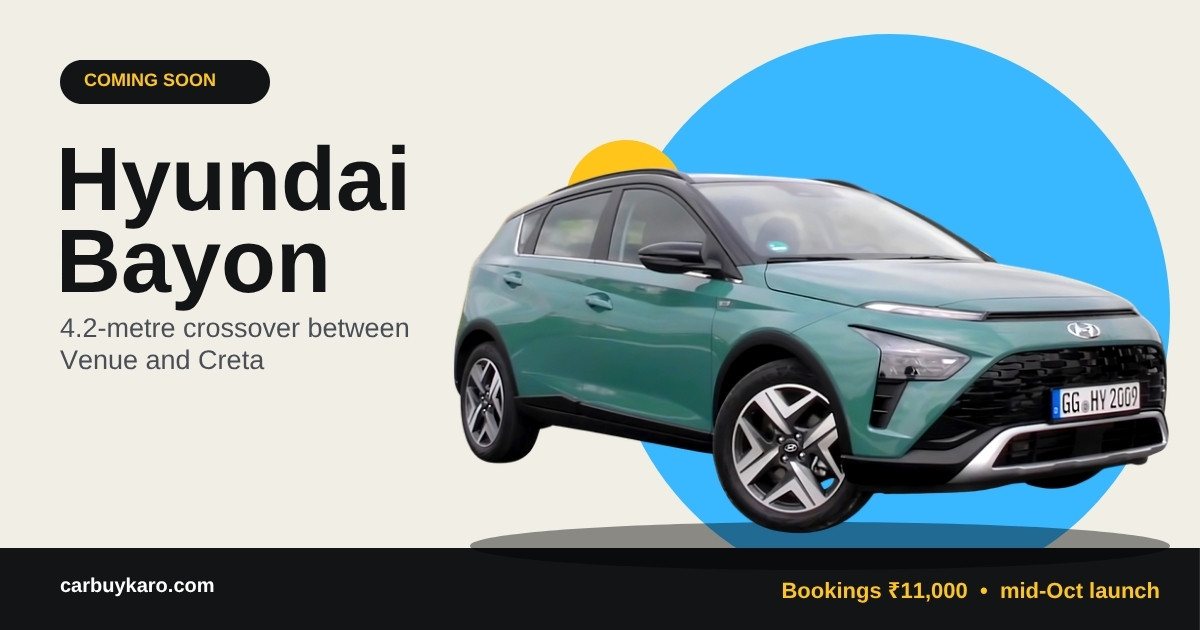
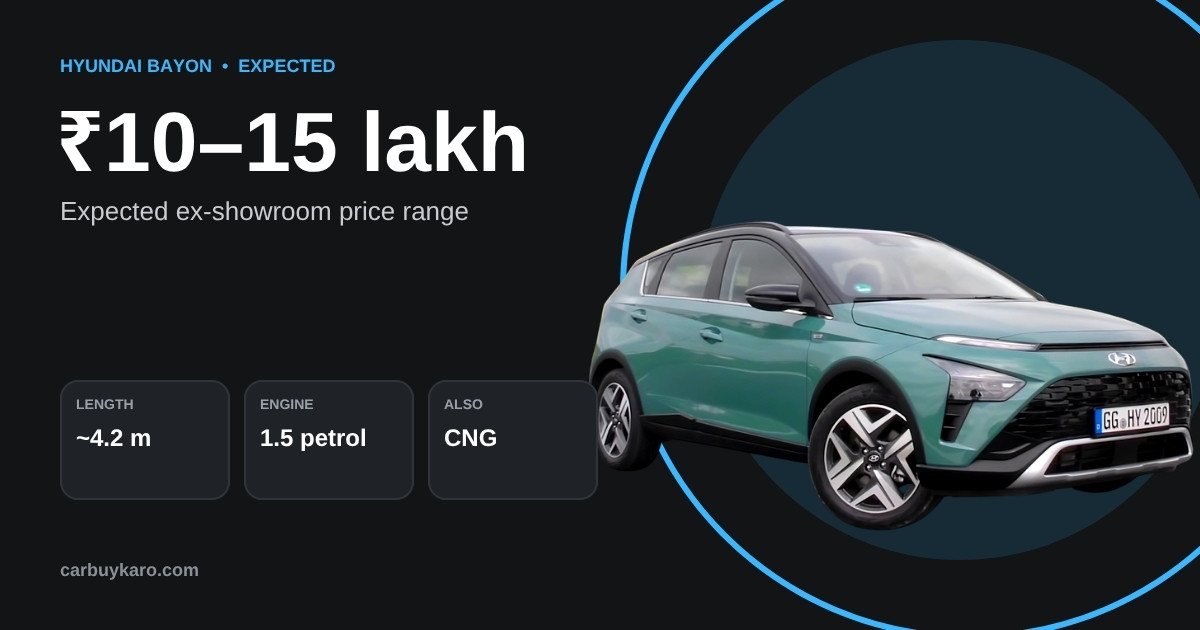
The Hyundai Bayon India launch is expected in mid-October 2026, and Hyundai has already opened bookings online and at dealers for ₹11,000. The Bayon is a roughly 4.2-metre crossover SUV that sits between the Venue and the Creta. Expected prices range from about ₹10 lakh to ₹15 lakh (ex-showroom). It is expected to use a 1.5-litre petrol engine with a factory CNG option, and to offer Level 2 ADAS, six airbags and twin 10.25-inch screens.
The Bayon is Hyundai’s answer to a segment that has grown fast: buyers who find sub-four-metre SUVs too small but cannot quite stretch to a Creta. Here is what to expect.
Where the Bayon fits
| Model | Length (approx.) | Price band (ex-showroom) |
|---|---|---|
| Hyundai Venue | under 4.0 m | ₹8–14 lakh |
| Hyundai Bayon | about 4.2 m | ₹10–15 lakh (expected) |
| Hyundai Creta | about 4.33 m | ₹11–20 lakh |
The Bayon’s extra length over the Venue should translate into a more usable rear seat and a larger boot. The Creta remains the choice for buyers who want diesel, turbo-petrol performance or the biggest cabin.
This “in-between” size has worked well for rivals. The Maruti Fronx and Toyota Urban Cruiser Taisor sit just under four metres, while cars like the Skoda Kylaq and Kia Syros target similar buyers. The Bayon will have plenty of competition on price.
Engines
Reports suggest a 1.5-litre naturally aspirated petrol engine with a factory-fitted CNG option. Hyundai’s 1.5 petrol in the Creta makes 115 PS and 144 Nm. If the Bayon uses the same unit, performance should be comfortable for city and highway use.
A factory CNG option on a 1.5-litre engine would be unusual and welcome. Most CNG cars use 1.2-litre engines that feel strained on highways. A bigger engine should make the CNG Bayon more relaxed with a full load.
Gearbox details are not confirmed. Expect a manual, and likely a CVT or other automatic on the petrol. CNG versions are usually manual only, though Hyundai may surprise us.
Features to expect
- Twin 10.25-inch screens (instrument cluster and touchscreen)
- Level 2 ADAS on the top trims
- Six airbags as standard
- Connected-car technology
- Likely a sunroof, wireless charging and ventilated seats on higher variants
Hyundai tends to be generous with features, and the Bayon should be no exception. Level 2 ADAS at this price would put pressure on rivals.
Bayon vs rivals
| Hyundai Bayon | Maruti Fronx | Kia Syros | Skoda Kylaq | |
|---|---|---|---|---|
| Length | about 4.2 m | under 4 m | under 4 m | under 4 m |
| Engines | 1.5 petrol, CNG (expected) | 1.2 petrol, 1.0 turbo, CNG | 1.0 turbo, 1.5 diesel | 1.0 turbo |
| ADAS | Expected | Coming with facelift | Yes | No |
The Bayon’s advantages should be size and a bigger CNG engine. The Fronx is cheaper and more efficient, and gets a facelift later in 2026 (see our Fronx facelift preview). The Syros has diesel, which the Bayon lacks.
Should you book now?
Booking costs ₹11,000 and is usually refundable. If the Bayon fits your needs, an early booking gives you a place in the delivery queue, which can matter for popular launches. Check the dealer’s refund policy in writing before paying.
Booking is not buying. You can wait for the price announcement and a test drive before finalising, and cancel if it does not suit you.
Should you wait for the Bayon or buy a Venue or Creta?
Wait if:
- The Venue feels too small in the back or the boot.
- You want CNG with a bigger engine.
- Your budget tops out around ₹13–14 lakh and you want more space than a sub-four-metre SUV.
Buy a Venue now if: you mostly drive in the city, you need an automatic now, and the Venue’s size works for you. It is proven and dealers may offer festive discounts.
Buy a Creta if: you want a diesel or turbo-petrol, or the most space and features. Our Creta vs Seltos comparison helps if you are choosing in that segment.
Is the Bayon affordable for you?
A useful rule for car buying is 20/4/10: put at least 20% down, keep the loan to four years, and keep total car costs (EMI, fuel, insurance) under 10% of your gross monthly income. It is conservative, but it keeps a car from straining your finances.
For a Bayon at about ₹13 lakh on-road:
- 20% down payment: ₹2.6 lakh.
- Loan of ₹10.4 lakh at 9% over four years: EMI about ₹25,900.
- Fuel and insurance: about ₹8,000 a month.
- Total: about ₹33,900 a month, which under the 10% rule suits a gross monthly income of around ₹3.4 lakh.
Most Indian buyers stretch this rule with five- to seven-year loans, and that is a personal choice. Test your own numbers with our car affordability calculator and the car EMI calculator.
Test drive checklist once it launches
- Sit in the rear seat and compare with the Venue and Creta. The whole point of the Bayon is its size.
- Check boot space in the CNG version, if one is offered. Cylinder placement decides how practical it is.
- Test the automatic in city traffic.
- Try the ADAS on a highway and learn how to disable features on narrow roads.
- Check how quickly the touchscreen responds and how easy it is to pair your phone.
Common mistakes to avoid
- Booking at multiple dealers. It locks up money and complicates refunds. Book with one dealer and ask for written delivery estimates.
- Assuming CNG always saves money. CNG pays off only if you drive a lot. Our petrol vs diesel vs CNG guide explains the break-even distance.
- Choosing the top trim for ADAS alone. ADAS is useful on highways but you pay a lot for it. Decide whether you really need it.
- Not checking the waiting period. Ask how long delivery will take for your chosen variant and colour.
Why Hyundai is adding another SUV
Hyundai already sells the Exter, Venue, Creta and Alcazar, so it is fair to ask why it needs the Bayon. The answer is in how Indian buyers shop. Many families start with a budget of ₹10–13 lakh, look at sub-four-metre SUVs, and find the rear seat or boot too small for a family of four plus luggage. The next step up, a Creta, often lands at ₹15 lakh or more on-road for a well-equipped version. That jump is too much for many buyers, who then settle for a compromise.
Carmakers have noticed this gap. The Maruti Fronx, Kia Syros and Skoda Kylaq all push features and space within the sub-four-metre limit. The Bayon takes a different path by simply being longer. It gives up the tax benefit that sub-four-metre cars enjoy, but offers more cabin and boot space in return. For buyers who carry parents or luggage regularly, that trade can make sense.
What the Bayon is like abroad
The Bayon has been sold in Europe since 2021 as a compact crossover based on the i20 hatchback. The European car is known for a comfortable ride, a practical boot of around 400 litres and small turbo-petrol engines. The India-bound Bayon is expected to be adapted for local roads and tastes, with a naturally aspirated 1.5 petrol and CNG instead of the European turbo engines, and likely more ground clearance and features.
Expect Hyundai to localise heavily to keep prices competitive. That usually means a cabin layout shared with other India-market Hyundais, such as the Venue and i20, and a feature list tuned for Indian buyers: ventilated seats, a sunroof and connected-car tech.
Things we still do not know
- Official prices and variant names.
- Whether an automatic will be offered with the CNG version.
- Exact boot capacity and rear-seat dimensions for the Indian car.
- Claimed mileage for petrol and CNG.
- Bharat NCAP crash-test plans.
We will update this page after the launch with the full price list and our verdict on the best variant.
Hyundai’s CNG track record
Hyundai has offered factory CNG on the Grand i10 Nios, Aura and Exter for years, and these cars are widely used by families and fleet operators. Owners generally report reliable CNG systems when the car is serviced on time. Hyundai has also started using twin-cylinder CNG layouts on some models to free up boot space, and it would make sense to bring that approach to the Bayon.
A few points to know about any factory CNG car. The CNG cylinder must be hydro-tested at regular intervals as required by law, and your service centre will remind you. Starting the engine on petrol and switching to CNG is normal and protects the engine. Real-world CNG mileage depends heavily on traffic; expect lower figures in stop-go city driving than the claimed number. And CNG pump queues can be long at peak hours in some cities, so plan refills for quieter times.
Colours and variants to watch for
Hyundai usually launches new models with five or six trims and a wide palette of single and dual-tone colours. White and grey hold resale value best in the Indian used-car market, while bright colours can take longer to sell. Dual-tone roofs look good but can add ₹15,000–20,000 to the price. Decide on colour early, because popular shades often have the longest waiting periods.
Summary
The Hyundai Bayon India launch is due in mid-October 2026, with bookings open at ₹11,000. At about 4.2 metres, it fills the gap between the Venue and the Creta, with an expected 1.5 petrol and CNG, Level 2 ADAS and twin screens. Expected prices are ₹10–15 lakh. If a sub-four-metre SUV feels too small but a Creta feels too much, wait for the Bayon’s price. See our list of upcoming cars under ₹10 lakh for more options on a tighter budget.
Frequently asked questions
When will the Hyundai Bayon launch in India?
Hyundai has opened bookings and the launch is expected in mid-October 2026. Some reports mention 12 October and others 15 October; Hyundai will confirm the exact date.
What is the expected price of the Hyundai Bayon?
Estimates range from about ₹10 lakh to ₹15 lakh ex-showroom. It will sit between the Venue and the Creta in Hyundai's line-up.
How do I book the Hyundai Bayon?
Bookings are open online and at Hyundai dealers for a token amount of ₹11,000. The token is usually refundable, but check the dealer's cancellation terms.
Is the Bayon bigger than the Venue?
Yes. At around 4.2 metres, the Bayon is longer than the sub-four-metre Venue but shorter than the Creta, which is about 4.33 metres long.
Prices are ex-showroom unless we say otherwise, and makers change them often. Confirm the latest price, offers and variant details with an authorised dealer before you book.


