On this page 17 sections
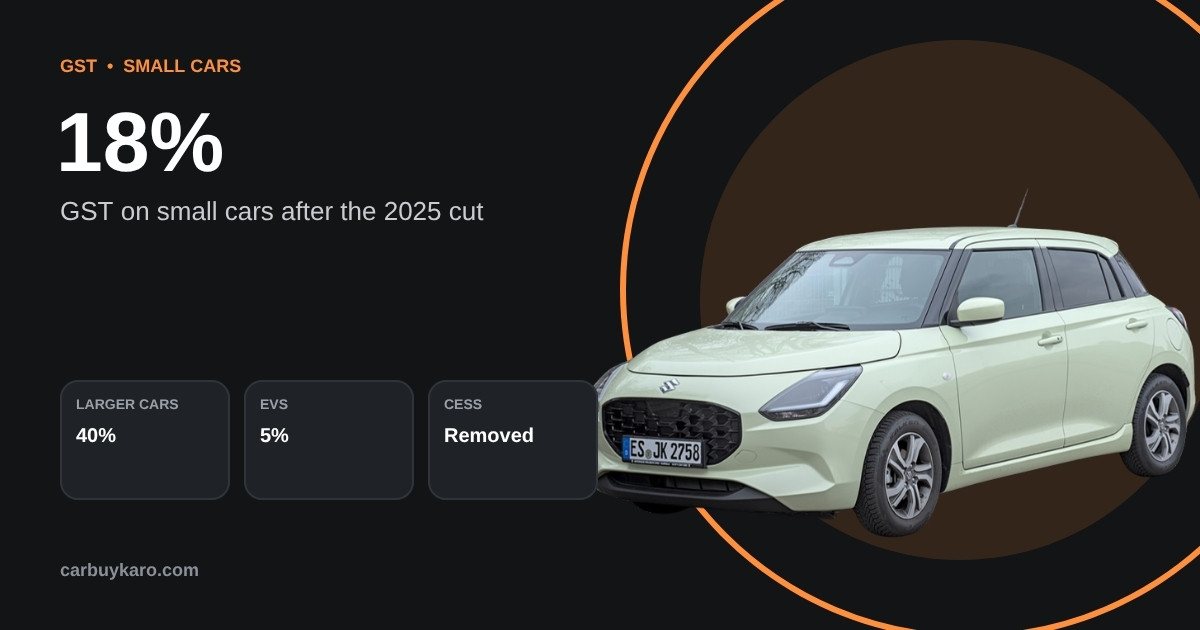
GST on cars in India changed on 22 September 2025. Under the current structure, small cars (under 4 metres, with petrol, CNG or LPG engines up to 1,200 cc or diesel engines up to 1,500 cc) attract 18% GST. Larger cars and SUVs attract 40% GST. Electric cars attract 5% GST. The separate compensation cess that used to sit on top of GST has been removed. Small cars became noticeably cheaper as a result, while larger cars saw smaller changes.
Here is what changed, how it affects prices, and what it means when you buy.
Before and after
Before 22 September 2025:
- Cars attracted 28% GST plus a compensation cess of 1% to 22% depending on size, engine and body type.
- Total tax ranged from about 29% for small petrol cars to about 50% for large SUVs.
After 22 September 2025:
- 18% for small cars.
- 40% for larger cars and SUVs.
- No compensation cess.
- 5% for EVs (unchanged).
Which cars are “small” for GST?
To qualify for 18%, a car must meet both conditions:
- Length under 4,000 mm.
- Engine size: petrol, CNG or LPG up to 1,200 cc, or diesel up to 1,500 cc.
Examples that typically qualify: Maruti Swift, Baleno, Dzire, Wagon R; Tata Punch, Tiago, Nexon (1.2 petrol and 1.5 diesel); Hyundai Exter, i20, Venue (1.2 petrol).
Examples that typically do not: midsize SUVs like the Creta and Seltos (over 4 metres), and sub-four-metre cars with petrol engines above 1,200 cc, such as the Maruti Brezza’s 1.5 petrol.
Hybrids generally follow the same size and engine rules as the corresponding petrol cars.
How much did prices fall?
For small cars, the tax dropped from roughly 29–31% to 18%. That translated into ex-showroom price cuts of roughly 7–9% on many models, often ₹40,000–₹1 lakh depending on the car.
For larger cars, the change varied. Where the old total (28% plus cess) was below 40%, prices rose slightly or stayed similar. Where the old total was higher (large SUVs at up to 50%), prices fell.
For EVs, nothing changed; they remain at 5%.
Example (illustrative): a small hatchback with a pre-tax value of ₹5.5 lakh.
- Old tax at about 29%: ₹1.6 lakh, ex-showroom about ₹7.1 lakh.
- New tax at 18%: ₹99,000, ex-showroom about ₹6.49 lakh.
- Saving: about ₹60,000.
What GST means for your on-road price
GST is built into the ex-showroom price. Road tax is then calculated on the ex-showroom price in most states. So a lower GST also slightly lowers your road tax, because road tax is a percentage of a smaller number. That is a double benefit for small car buyers.
Our on-road price explainer and road tax by state guide show how the pieces fit together.
GST on other car-related costs
- Car insurance: premiums attract GST at the applicable rate for insurance services.
- Service and repairs: labour and parts attract GST at their respective rates.
- Accessories: taxed separately according to their category.
- Used cars: used car sales by registered dealers are taxed on the dealer’s margin under special rules, not on the full price.
GST and the EV vs petrol decision
At 5%, EVs have a large tax advantage over larger petrol and diesel cars at 40%. Against small cars at 18%, the gap is smaller than before the reform. Combined with state road tax waivers, EVs can still be very competitive on price. See our EV road tax and subsidy guide and best electric cars in India.
Can businesses claim input tax credit on cars?
Generally, input tax credit on passenger cars is blocked under GST, except in specific cases such as when the car is used for further supply of vehicles, passenger transport or driving training. Businesses should consult a tax professional for their situation.
What changed for buyers in practice
- Small cars got more affordable, making models like the Baleno, Swift, Punch and Nexon better value. See our best cars under ₹10 lakh.
- The price gap between small and larger cars widened in some cases, because larger cars pay 40%.
- Engine size matters more. A sub-four-metre car with a 1.2 petrol pays 18%, while one with a 1.5 petrol pays 40%.
- Carmakers adjusted line-ups, in some cases emphasising variants that qualify for the lower rate.
Worked example: two compact SUVs
Consider two compact SUVs under 4 metres with similar pre-tax prices of ₹8 lakh:
- SUV A with a 1.2 turbo-petrol: 18% GST, about ₹9.44 lakh ex-showroom.
- SUV B with a 1.5 petrol: 40% GST, about ₹11.2 lakh ex-showroom.
The engine choice alone makes a difference of about ₹1.76 lakh before road tax. This is why checking the tax category matters when comparing cars. Estimate on-road prices with our on-road price calculator.
Common misconceptions
- “All cars became cheaper.” Small cars did; some larger cars did not.
- “GST is added on top of the ex-showroom price.” No, it is already included.
- “EV GST was cut in 2025.” EV GST was already 5% and stayed there.
- “Hybrids get EV tax rates.” Generally no; they follow the rules for combustion cars.
Why the government changed car GST
The September 2025 reform was part of a wider simplification of GST into fewer rate slabs. For cars, the old structure had become complicated: a 28% base rate, plus a compensation cess that varied from 1% to 22% depending on length, engine size, ground clearance and body type. Buyers and even dealers struggled to explain why two similar cars were taxed so differently.
The compensation cess had been introduced in 2017 to make up for states’ revenue losses in the early years of GST. With that period ending, the cess was folded into a simpler two-rate structure for cars: a lower rate for small, affordable cars that most first-time buyers choose, and a higher rate for larger and premium vehicles. The aim was to make entry-level cars more affordable while keeping overall revenue broadly stable from the larger segments.
Impact on the car market
Small car sales had been under pressure for several years as prices rose with new safety and emission rules. The lower 18% rate made hatchbacks, compact sedans and many compact SUVs noticeably more affordable almost overnight. Dealers reported strong festive demand in late 2025, and carmakers adjusted prices across their line-ups.
For buyers, the practical effect is that ₹10 lakh now buys more car than it did before, and the difference between an entry-level car and a well-equipped variant has narrowed in rupee terms.
How to check which GST rate your car falls under
- Check the car’s length on the official spec sheet. It must be under 4,000 mm for the lower rate.
- Check the engine displacement in cc and the fuel type.
- If both conditions for the lower rate are met, the car pays 18%; otherwise 40%.
- For EVs, the rate is 5% regardless of size.
Carmakers already build the correct GST into the ex-showroom price, so you do not calculate it yourself. But knowing the category helps you understand why two similar-looking cars are priced differently.
GST and resale
GST changes do not directly affect the value of your existing car, but they influence used-car prices indirectly. When new small cars became cheaper, the used-market prices of nearly new small cars adjusted downward slightly, because buyers compare used prices with new ones. Owners planning to sell a one- or two-year-old small car soon after the change saw somewhat lower offers than they might have expected. Our car resale value tips explain how to protect your car’s value.
Quick reference
- Hatchback with a 1.2 petrol under 4 m: 18%.
- Compact sedan with a 1.2 petrol under 4 m: 18%.
- Compact SUV under 4 m with a 1.5 diesel: 18%.
- Compact SUV under 4 m with a 1.5 petrol: 40%.
- Midsize SUV over 4 m (any engine): 40%.
- Luxury sedan or SUV: 40%.
- Any electric car: 5%.
If you are unsure, ask the dealer which rate applies to the variant you are considering. It explains a lot about price differences between similar cars.
Will GST rates change again?
Tax rates can always change through the GST Council, usually announced well in advance. If you hear of a proposed change, check whether it affects your car’s category before timing your purchase around it. Most buyers are better served by choosing the right car at the right price now than by waiting for a possible tax change.
Summary
GST on cars in India is now 18% for small cars, 40% for larger cars and SUVs, and 5% for EVs, with the old compensation cess removed from 22 September 2025. Small cars became noticeably cheaper, and engine size and length now decide which rate a car pays. Because road tax is based on the ex-showroom price, lower GST also lowers road tax. For more money guides, visit our ownership section.
Frequently asked questions
What is the GST on cars in India now?
Since 22 September 2025, small cars (petrol, CNG or LPG up to 1,200 cc and diesel up to 1,500 cc, both under 4 metres long) attract 18% GST. Larger cars and SUVs attract 40%. Electric cars attract 5%. The separate compensation cess has been removed.
Did car prices fall after the GST change?
Yes, especially for small cars, whose effective tax fell from about 29–31% (28% GST plus cess) to 18%. Larger cars saw smaller changes, because the higher 40% rate replaced 28% GST plus a cess of up to 22%.
What is the GST on electric cars?
Electric cars attract 5% GST.
What counts as a small car for GST?
A car under 4,000 mm long with a petrol, CNG or LPG engine up to 1,200 cc, or a diesel engine up to 1,500 cc.
Prices are ex-showroom unless we say otherwise, and makers change them often. Confirm the latest price, offers and variant details with an authorised dealer before you book.


