
On this page 17 sections
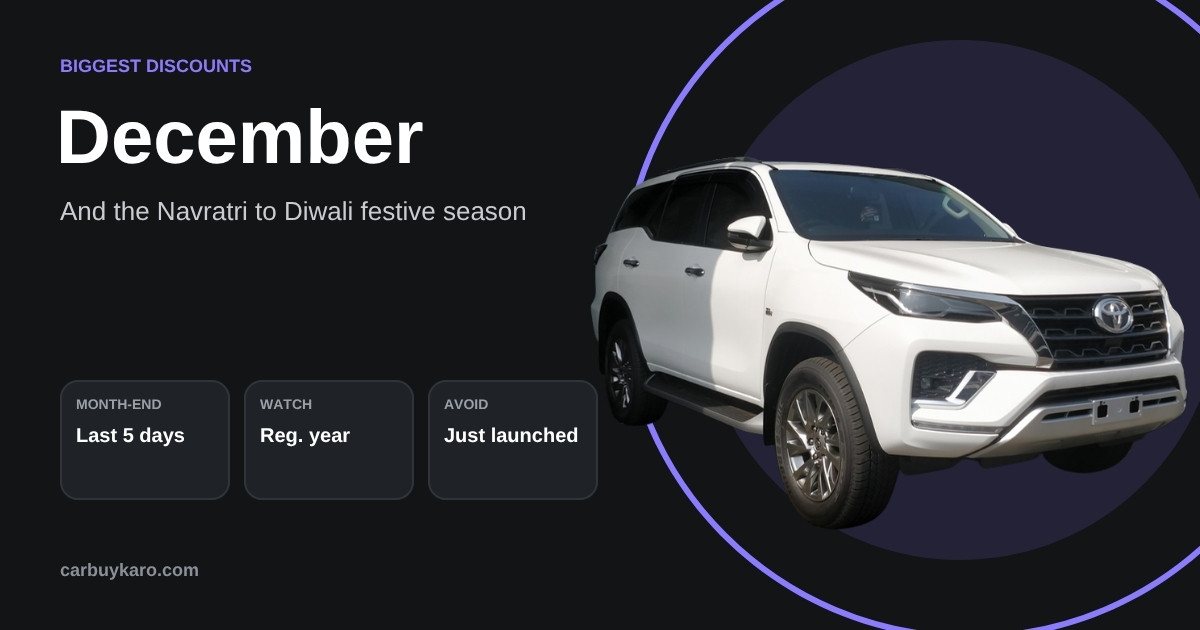
The best time to buy a car in India is usually December, when dealers offer year-end discounts to clear stock, followed by the festive season from Navratri to Diwali. The last few days of any month, when dealers chase targets, and the weeks before a facelift or new model also bring good deals on outgoing cars. But timing has trade-offs: a December purchase carries that year’s registration, which slightly lowers resale value, and festive demand can mean longer waiting periods on popular models.
Here is how the Indian car-buying calendar works, and how to use it.
The car-buying calendar
| Period | Discounts | Watch out for |
|---|---|---|
| January–March | Moderate; price hikes often in January | Year-start price increases |
| April–June | Moderate | Financial-year changes, new rules |
| July–August | Moderate, monsoon offers | Stock can be thin before festivals |
| September–November (festive) | Strong, but high demand | Waiting periods, inflated “benefits” |
| December | Strongest discounts | Registration year effect on resale |
December: year-end discounts
Carmakers and dealers want to clear stock manufactured during the year before January arrives, because a car built in the current year becomes “last year’s” model in the eyes of buyers. That is why December brings the biggest discounts, sometimes including cash off, free insurance, accessories and exchange bonuses.
The catch: the car’s registration year. A car registered in December 2026 is treated as a 2026 car at resale. The same car registered a month later in January 2027 is treated as a 2027 car. When you sell it five years later, the 2027 car usually fetches a bit more. For buyers who keep cars for eight to ten years, this gap barely matters. For those who change cars every three years, it matters more.
Also check the manufacturing date. A car sold in December might have been built in March. Used-car buyers sometimes check this too.
Festive season: Navratri to Diwali
For many Indian families, buying a car on Navratri, Dussehra, Dhanteras or Diwali is auspicious. Carmakers know this and launch new models and offers in this window. You will see big advertised “benefits”.
The catch: demand is high. Popular models may have long waiting periods, and dealers may offer smaller real discounts on cars that sell themselves. Offers are often bundled, so the headline number may include exchange and corporate discounts that do not apply to you. Our October 2026 launches guide explains how to separate real discounts from marketing.
Tip: book early. If you want delivery on a specific festival day, confirm the date in writing weeks in advance.
Month-end and quarter-end targets
Dealers and salespeople work to monthly, quarterly and yearly targets. In the last few days of a month, especially the end of a quarter (March, June, September, December), they are more willing to negotiate to close a sale.
Tip: visit early in the month to test drive and negotiate, then close the deal in the last few days of the month.
Before a facelift or new model
When a new version of a car is about to launch, dealers want to clear old stock. That means good discounts on the outgoing model.
When to take the deal:
- The discount is large (₹75,000 or more on a compact car).
- You do not need the new version’s features.
- You plan to keep the car for a long time.
When to wait:
- The new model adds features you want, such as ADAS or ventilated seats.
- You change cars every few years, because the outgoing model will look older sooner.
Currently, facelifts of the Honda Elevate, Toyota Glanza and Maruti Fronx are due soon. See our Elevate facelift and Fronx facelift guides.
When not to buy
- Right after a launch, when prices are firm, discounts are rare and waiting periods can be long. The exception is introductory pricing, which can be attractive.
- Just before a known price hike, unless you can lock the price at booking.
- When you feel rushed. A salesperson saying “offer ends today” is a sales tactic. Good offers return.
Tax changes and rule changes
Government rules can change prices. In September 2025, GST on small cars was cut from 28% plus cess to 18%, lowering prices of small cars noticeably. Larger cars moved to a 40% rate without cess. Our GST on cars guide explains the details. Keep an eye on budget announcements and state road tax changes; our road tax by state guide lists current rates.
Worked example: December deal vs January registration
A buyer is choosing a compact SUV with an on-road price of ₹12 lakh.
- December offer: ₹60,000 total real discount, registration in December 2026.
- January purchase: ₹25,000 discount, registration in January 2027.
- Resale after five years: the January-registered car may fetch about ₹20,000–30,000 more.
Net, the December deal still saves about ₹5,000–15,000 in this example, and more if the buyer keeps the car longer. But if the December discount were only ₹35,000, the January purchase would come out ahead. Run the numbers for your own case, and check the on-road price in your state with our on-road price calculator.
How to negotiate, whatever the month
- Get quotes from two or three dealers for the same variant.
- Ask for an itemised on-road quote and question every line.
- Buy insurance separately if the dealer’s quote is higher than online quotes.
- Refuse bundled accessories you do not want.
- Arrange your own loan or compare the dealer’s finance offer with your bank. Our car loan interest rates guide explains what to compare.
- Get the final offer in writing before paying.
Common mistakes
- Chasing the biggest advertised number instead of the real discount that applies to you.
- Ignoring waiting periods during festive rush.
- Forgetting the registration year effect on resale.
- Buying an outgoing model you do not really want just because it is discounted.
Timing your purchase around your old car
If you are replacing an existing car, timing matters on both sides.
- Sell or exchange before insurance renewal so you do not pay a full year’s premium on a car you are about to sell.
- Transfer your no-claim bonus. Your NCB belongs to you, not the car. Ask your insurer for an NCB retention letter and use it on the new car’s policy.
- Check your old car’s registration date. Selling before it turns another year older can add a little to its value.
- Compare exchange offers with independent buyers. Dealers sometimes offer a high exchange bonus but a low valuation. Look at the total.
Timing your loan
Loan rates change with the RBI repo rate and bank policies. When rates fall, new car loans become cheaper. Many banks also run festive loan offers with lower processing fees or slightly lower interest. Compare the bank’s offer with the dealer’s in-house finance, and check the total interest, not just the EMI. Our car EMI calculator shows the total interest for any rate.
Buying for delivery on a specific date
Many families want delivery on a particular date, such as Dhanteras, a birthday or an anniversary. To make it happen:
- Book at least four to six weeks ahead for popular models.
- Choose a common colour; special colours have longer waits.
- Complete loan paperwork and insurance in advance.
- Ask the dealer to confirm the delivery slot in writing.
- Do the pre-delivery inspection a day or two before, not on the day itself. Our PDI checklist explains what to check.
Seasonal factors beyond discounts
Monsoon (June–September): a good time to test how a car handles wet roads and whether the wipers, demister and headlamps are good. Some buyers avoid taking delivery during heavy rain to reduce the risk of early damage.
Summer (April–June): test the air conditioning properly. A car that cools well in May will cope all year.
Winter (December–February): great for year-end deals, but if you live in the north, check cold-start behaviour and heater performance on the test drive.
Price hikes: when they usually happen
Carmakers in India typically raise prices at the start of the calendar year and sometimes in April, citing input costs and new regulations. Hikes are usually small, around 1–3%, but on a ₹12 lakh car that is ₹12,000–36,000. If you plan to buy early in the year, check whether a hike has been announced and whether booking before the date locks in the old price. Ask the dealer to confirm price protection in writing.
One more tip: shop in the morning
Showrooms are quieter on weekday mornings. Salespeople have more time for proper test drives and detailed quotes, and you are less likely to feel rushed. Weekends and festival evenings are the busiest times, when negotiation is hardest and test drives are short. Visit early, take notes, and come back at month-end to close the deal.
Above all, buy when the car, the price and your finances all line up. A good deal on a car that does not suit you is never a good deal.
Summary
The best time to buy a car in India is usually December for the biggest discounts, the festive season for good offers and auspicious timing, and the last days of any month for negotiation. Weigh year-end discounts against the registration-year effect on resale, avoid being rushed, and always compare real on-road prices. For more buying help, see our buying guides.
Frequently asked questions
Which month is best to buy a car in India?
December usually has the biggest discounts because dealers clear stock before the model year changes. The festive season from Navratri to Diwali also brings strong offers, although demand is high.
Is it good to buy a car in December?
Yes for the discount, but a car registered in December counts as a year older than one registered in January, which can reduce resale value slightly. It suits buyers who keep cars for many years.
Do dealers give more discount at month-end?
Often yes. Dealers and salespeople have monthly targets, so the last few days of a month can bring better deals, especially on slower-selling models.
Should I buy a car during Diwali?
Diwali brings good offers and is an auspicious time for many families. But demand is high, so waiting periods can be longer and discounts on popular models smaller.
Prices are ex-showroom unless we say otherwise, and makers change them often. Confirm the latest price, offers and variant details with an authorised dealer before you book.


