On this page 19 sections
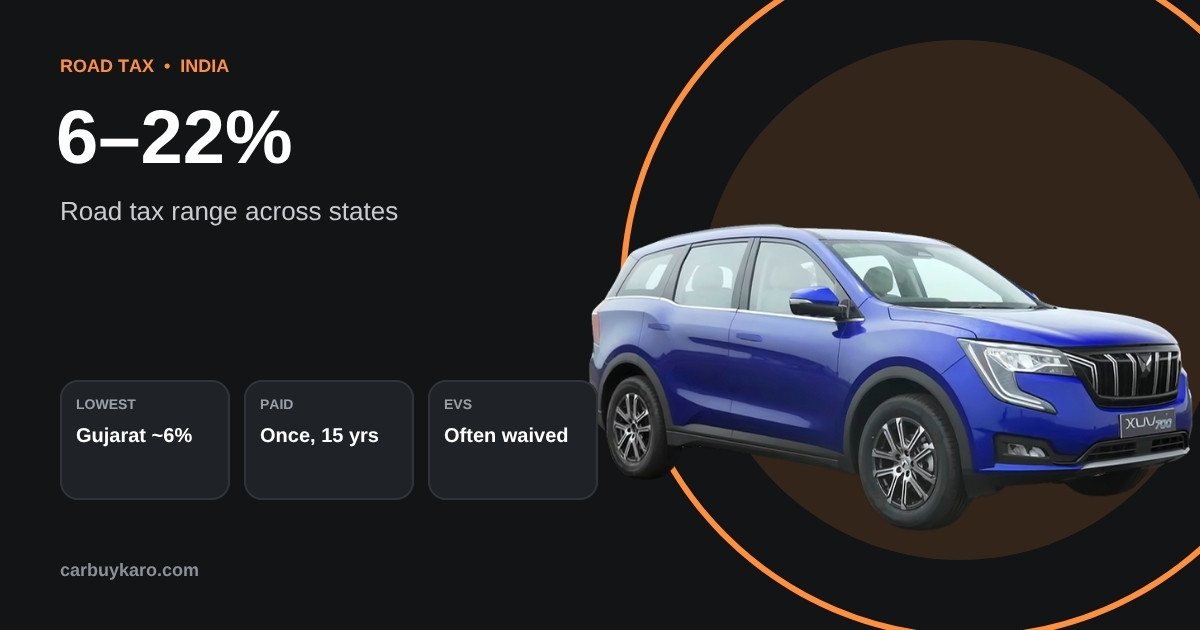
Car road tax by state in India varies hugely, which is why the same car can cost ₹1–4 lakh more on-road in one state than another. Road tax is a one-time charge paid at registration, usually covering 15 years, and calculated as a percentage of the ex-showroom price. In 2026, rates range from around 6% in Gujarat to 18–22% in states like Kerala, Tamil Nadu, Telangana and Karnataka for expensive cars. Most states use price slabs, and many charge more for diesel than petrol. Electric cars are often exempt or pay less.
Below are approximate current slabs for major states, how to calculate your tax, and tips to get it right.
How road tax works
- Who sets it: each state and union territory sets its own rates under its motor vehicles tax law.
- When it is paid: at the time of first registration, as part of the on-road price.
- Duration: usually covers 15 years for private cars. After 15 years, you pay again to renew registration.
- Basis: most states calculate it on the ex-showroom price (some on the pre-GST price).
- Slabs: higher-priced cars pay a higher percentage.
- Fuel: diesel cars often pay more; EVs often pay less or nothing.
Road tax rates by state (approximate, 2026)
| State | Petrol cars | Diesel cars | Notes |
|---|---|---|---|
| Delhi | 4% up to ₹6L, 7% ₹6–10L, 10% above | 5%, 8.75%, 12.5% | EVs up to ₹30L waived until 2030 |
| Maharashtra | 11% up to ₹10L, 12% ₹10–20L, 13% above | 13%, 14%, 15% | CNG slightly different |
| Karnataka | 13% up to ₹5L, 14% ₹5–10L, 17% ₹10–20L, 18% above | same | Plus 11% cess on the tax |
| Tamil Nadu | 12% up to ₹5L, 13% ₹5–10L, 18% ₹10–20L, 20% above | same | EVs exempt till end-2027 |
| Kerala | 10% up to ₹5L, 13% ₹5–10L, 15–17% ₹10–20L, 22% above | same | Among the highest |
| Uttar Pradesh | 9% up to ₹10L, 11% above | same | |
| Haryana | 5% up to ₹6L, 8% ₹6–20L, 10% above | higher for diesel | |
| Gujarat | about 6% flat | about 6% | On pre-GST price |
| Telangana | 13% up to ₹5L, 14% ₹5–10L, 18% ₹10–20L, 20–21% above | same | |
| West Bengal | 5.5% up to ₹10L, 10% above | similar | |
| Rajasthan | 6–9% under ₹10L, 9–10% ₹10–20L, 10% above | 8–12% | |
| Punjab | 10% up to ₹10L, 12% ₹10–20L, 13% above | similar |
These rates change from time to time and some states add cesses or surcharges. Always confirm with your RTO or the state transport department before buying. For EV-specific rules, see our EV road tax and subsidy guide.
How to calculate your road tax
- Take the ex-showroom price of the variant you are buying.
- Find your state’s slab for that price and fuel type.
- Multiply the price by the slab percentage.
- Add any cess or surcharge your state applies.
Example 1: ₹8 lakh petrol hatchback
- Delhi (7%): about ₹56,000
- Maharashtra (11%): about ₹88,000
- Karnataka (14% plus 11% cess): about ₹1.24 lakh
- Gujarat (about 6%): about ₹48,000
Example 2: ₹15 lakh petrol SUV
- Delhi (10%): about ₹1.5 lakh
- Maharashtra (12%): about ₹1.8 lakh
- Karnataka (17% plus 11% cess): about ₹2.83 lakh
- Tamil Nadu (18%): about ₹2.7 lakh
The difference between the cheapest and most expensive state for the same ₹15 lakh SUV is well over ₹1 lakh. Use our on-road price calculator to estimate your exact figure.
Road tax and the on-road price
Road tax is the biggest single addition to the ex-showroom price, but not the only one. The on-road price also includes registration charges, insurance, TCS on cars above ₹10 lakh, FASTag, and sometimes handling or extended warranty. Our on-road price explainer breaks down every line on a dealer quote.
Why the slab boundaries matter
Because rates jump at price thresholds, a small difference in ex-showroom price can mean a big difference in tax. For example, in Karnataka, a car priced at ₹9.95 lakh pays 14%, while one priced at ₹10.05 lakh pays 17%. That ₹10,000 difference in price adds about ₹30,000 in extra tax plus cess.
Tip: if you are choosing between two variants on either side of a slab boundary, compare on-road prices, not ex-showroom prices.
Moving to another state
If you move to another state and take your car with you, you may need to re-register it there after 12 months and pay road tax in the new state for the remaining years. You can then apply for a refund of the unused portion from your original state. The process is paperwork-heavy.
For people who move often for work, the BH (Bharat) series registration lets you pay road tax every two years and move between states without re-registration. See our BH series number plate guide for eligibility.
Road tax on used cars
When you buy a used car in the same state, road tax has already been paid for its 15-year life, so you do not pay it again. You pay only a transfer fee. When you bring a used car from another state, re-registration rules apply.
Can you reduce road tax legally?
A few legitimate ways:
- Choose an EV in a state with EV exemptions.
- Pick a variant below a slab boundary where it makes sense.
- Check scrappage incentives. Some states offer a road tax concession when you scrap an old vehicle and buy a new one.
- Use BH series if you are eligible and move frequently.
Registering a car in a cheaper state where you do not live, using a false address, is illegal and can cause insurance claim rejections.
Worked example: Bengaluru vs Pune for a ₹12 lakh SUV
- Karnataka: 17% plus 11% cess on the tax, about ₹2.26 lakh.
- Maharashtra: 12%, about ₹1.44 lakh.
- Difference: about ₹82,000 for the same car.
For a buyer relocating between these cities, the choice of where to buy and register, within the law, matters.
Common mistakes
- Comparing ex-showroom prices across states instead of on-road prices.
- Ignoring cess and surcharges. Karnataka’s cess adds a noticeable amount.
- Assuming EVs are exempt everywhere. Check current rules.
- Forgetting the refund when you move states and re-register.
Road tax for CNG and hybrid cars
Many states treat CNG cars like petrol cars for road tax, and some charge slightly different rates. A few have offered concessions for CNG or strong hybrids in the past to encourage cleaner fuels. These concessions come and go, so check your state’s current notification.
For strong hybrids like the Maruti Grand Vitara or Toyota Hyryder, most states charge the normal petrol rate. Uttar Pradesh has at times offered registration fee waivers for strong hybrids. Our hybrid vs electric car guide explains the difference between hybrid types.
Road tax refund when you sell or scrap
If your car is written off in an accident, stolen, or scrapped before the end of its tax period, some states allow a partial refund of unused road tax. The process varies by state and needs documentation from the RTO, insurer or scrapping facility. It is worth asking, especially for newer cars.
How road tax is shown on your RC and invoice
Your registration certificate usually shows the tax paid up to a date, often 15 years from registration. The dealer’s invoice and the RTO receipt show the exact amount paid. Keep both documents safely; you will need them when selling the car, moving states or claiming a refund.
Commercial vs private cars
Commercial vehicles, such as taxis, pay road tax differently, often annually or quarterly, and at different rates from private cars. If you plan to use your car commercially, it must be registered as a commercial (transport) vehicle with a yellow number plate, and the tax and insurance will differ.
A simple way to estimate before visiting the dealer
Take the ex-showroom price, find your state’s slab from the table above, multiply, and add about ₹5,000 for registration and plates. Then add insurance, TCS if the car costs more than ₹10 lakh, and a FASTag. That gives a close estimate of the on-road price. Our car EMI calculator can then show your monthly payment.
Frequently confused terms
- Road tax vs registration fee: road tax is the large, percentage-based tax; the registration fee is a small fixed RTO charge.
- Road tax vs GST: GST is a central tax included in the ex-showroom price; road tax is a state tax added on top.
- Road tax vs toll: tolls are paid per trip on specific roads through FASTag; road tax is a one-time payment for using public roads in the state.
- Green tax: some states charge an extra green tax when older vehicles renew registration after 15 years.
Understanding these helps when you read a dealer quote or an RTO receipt. For the full picture, see our on-road price explainer.
Road tax for luxury cars
Luxury car buyers feel road tax most, because it is a percentage of a large price. On a ₹60 lakh SUV, the difference between a 10% state and a 20% state is ₹6 lakh. Buyers in high-tax states sometimes consider EVs for this reason, since many states waive or reduce EV road tax. Our BMW 7 Series and i7 guide shows how dramatic the difference can be at the top end.
Where to pay and how
For new cars, the dealer usually pays road tax on your behalf through the state’s online system and includes it in your invoice. For re-registration or transfers, you can often pay online through the Parivahan or state transport portal. Always keep the payment receipt.
Summary
Car road tax by state in India ranges from around 6% in Gujarat to over 20% for expensive cars in Kerala, Tamil Nadu and Telangana, with most states using price slabs and charging more for diesel. It is paid once for 15 years and is the largest addition to your on-road price. Check your state’s current slab, compare on-road prices and consider EV exemptions or BH series where relevant. For more ownership guides, see our ownership and money section.
Frequently asked questions
Which state has the lowest car road tax in India?
Gujarat is among the lowest, with a flat rate of around 6%. Delhi, Haryana, West Bengal and Uttar Pradesh are also relatively low for cars under ₹10 lakh.
Which state has the highest car road tax?
Kerala, Tamil Nadu, Telangana and Karnataka have some of the highest rates, reaching 18–22% for cars above ₹20 lakh. Karnataka also adds a cess on the tax.
Is road tax paid every year?
No. For private cars, road tax is usually paid once at registration and covers 15 years. BH series registration is an exception, where tax is paid every two years.
Do electric cars pay road tax?
Many states waive or reduce road tax on EVs, but not all. Delhi and Tamil Nadu offer full exemptions in 2026, while Karnataka now charges 5–10% on electric cars.
Prices are ex-showroom unless we say otherwise, and makers change them often. Confirm the latest price, offers and variant details with an authorised dealer before you book.


