On this page 19 sections
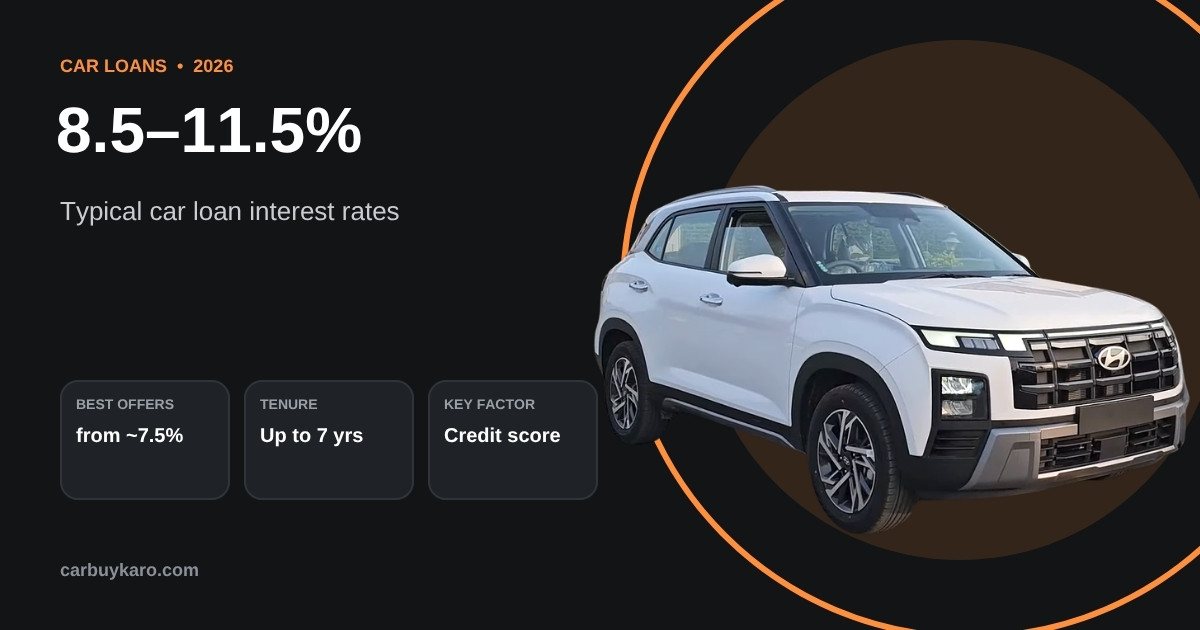
Car loan interest rates in India in September 2026 typically range from about 8.5% to 11.5% a year for new cars, with the best offers starting around 7.5–8.5% for borrowers with strong credit profiles. Public sector banks like SBI often quote around 8.75–9.25% for new cars, ICICI Bank from about 8.4% for its customers, and HDFC Bank from around 9.4%. Your actual rate depends on your credit score, income, employer, loan amount, tenure and whether you are an existing customer. A difference of even 1% on a ₹10 lakh loan over five years changes your total interest by about ₹28,000.
Here is how car loan rates work, what affects them, and how to get the best deal.
How car loans work
A car loan is a secured loan: the car is the collateral. The lender registers a hypothecation on the car’s registration certificate until you repay in full. Because it is secured, rates are lower than personal loans.
Key terms:
- Principal: the amount you borrow.
- Interest rate: usually quoted annually. Most car loans are fixed-rate, though some are linked to external benchmarks like the RBI repo rate.
- Tenure: typically one to seven years.
- EMI: your equal monthly instalment, covering interest and principal.
- Processing fee: a one-time charge, often 0.25–1% of the loan, sometimes capped.
- Prepayment or foreclosure charges: fees for paying off early. Floating-rate loans to individuals often have no foreclosure charges; fixed-rate loans may.
What affects your rate
Credit score
The single biggest factor. Scores of 750 and above usually get the best rates. Between 650 and 750, you may pay 0.5–2% more. Below 650, loans become difficult or expensive. Check your score for free on the credit bureau websites before applying.
Income and employer
Salaried employees of large, well-known companies and government employees often get lower rates. Self-employed borrowers may need more paperwork and may pay slightly more.
Existing relationship
Banks often offer better rates to existing salary account holders, home loan customers or customers with long relationships.
Loan-to-value
Borrowing 80% of the car’s value usually gets a better rate than borrowing 100%. A bigger down payment reduces risk for the bank.
Tenure
Some lenders charge slightly higher rates for longer tenures.
Car type
New cars get lower rates than used cars. Some lenders offer special rates for EVs.
EMI maths: how much does the rate matter?
Here is the EMI for a ₹10 lakh loan over five years at different rates:
| Interest rate | EMI | Total interest over 5 years |
|---|---|---|
| 8.0% | about ₹20,280 | about ₹2.17 lakh |
| 9.0% | about ₹20,760 | about ₹2.45 lakh |
| 10.0% | about ₹21,250 | about ₹2.75 lakh |
| 11.0% | about ₹21,740 | about ₹3.05 lakh |
Each 1% adds about ₹480 to the EMI and about ₹28,000–30,000 to the total interest. Try your own figures in our car EMI calculator.
Tenure: EMI vs total interest
For a ₹10 lakh loan at 9%:
| Tenure | EMI | Total interest |
|---|---|---|
| 3 years | about ₹31,800 | about ₹1.45 lakh |
| 5 years | about ₹20,760 | about ₹2.45 lakh |
| 7 years | about ₹16,090 | about ₹3.51 lakh |
A seven-year loan cuts the EMI by about ₹4,700 compared with five years, but adds more than ₹1 lakh in interest. It also means you may still be paying for the car when its value has dropped a lot. For most buyers, five years is a sensible balance.
Bank loan vs dealer finance
Dealers offer loans through tie-ups with banks and NBFCs. These can be convenient, sometimes with special schemes. But compare:
- Interest rate: is it really lower, or is the “low EMI” achieved with a longer tenure?
- Processing and documentation fees.
- Mandatory insurance or add-ons bundled with the loan.
- Prepayment rules.
Get a pre-approved offer from your own bank first. It gives you a benchmark and bargaining power at the dealership.
Zero down payment and 100% finance
Some lenders offer up to 100% on-road funding for strong borrowers. It sounds attractive, but you pay interest on everything, including road tax and insurance, and you start with negative equity because the car loses value immediately. A down payment of at least 15–20% is healthier. Our car affordability calculator uses the 20/4/10 rule to help you set a sensible budget.
Documents you usually need
- Identity and address proof (Aadhaar, PAN, passport)
- Income proof: salary slips and Form 16 for salaried; ITRs and business proof for self-employed
- Bank statements for three to six months
- Passport-size photos
- The car’s pro forma invoice from the dealer
How to get a lower rate
- Check and improve your credit score before applying. Pay existing dues on time and keep credit card use low.
- Compare at least three lenders, including your salary bank.
- Ask for the processing fee to be waived or reduced, especially during festive offers.
- Make a larger down payment.
- Choose a shorter tenure if the EMI is manageable.
- Negotiate. Banks have some flexibility, especially for existing customers.
- Consider a floating-rate loan if you expect rates to fall and want freedom to prepay without penalty.
Prepaying your car loan
If you get a bonus or extra savings, part-prepaying the loan reduces total interest. Check your loan agreement for prepayment charges. On a ₹10 lakh loan at 9%, prepaying ₹2 lakh after the first year can save a substantial amount of interest over the remaining term.
Loan closure: don’t forget the RC
When you finish repaying, the bank issues a No Objection Certificate (NOC) and Form 35. You must apply to the RTO to remove the hypothecation from your RC. Until you do, the bank’s name remains on your registration, which complicates selling the car. Update your insurance policy too.
Worked example: choosing between two offers
A buyer needs ₹8 lakh for five years.
- Dealer offer: 8.75%, ₹10,000 processing fee, EMI about ₹16,510.
- Bank offer: 9.0%, processing fee waived, EMI about ₹16,610.
Over five years, the dealer loan costs about ₹6,000 less in interest (₹16,510 vs ₹16,610 a month), but the ₹10,000 fee more than cancels that. The bank offer works out slightly cheaper in total, and it has no bundled conditions. Always compare total cost, not just the rate.
Common mistakes
- Choosing the longest tenure for a low EMI. It costs much more in total.
- Ignoring processing fees and add-ons.
- Not checking the credit score first.
- Borrowing 100% of the on-road price.
- Forgetting to remove hypothecation after closing the loan.
Fixed or floating rate?
Fixed-rate loans keep the same interest rate for the whole tenure, so your EMI never changes. They offer certainty but may carry prepayment charges.
Floating-rate loans are linked to an external benchmark, often the RBI repo rate. When the repo rate falls, your rate and EMI or tenure can fall too; when it rises, they increase. Floating-rate loans to individuals usually have no foreclosure charges, which helps if you plan to prepay.
If you expect to prepay part of the loan from bonuses, a floating-rate loan is often more flexible. If you want a predictable budget, a fixed rate is simpler.
Car loans for self-employed buyers
Self-employed borrowers can get car loans easily, but banks look at income proof differently. Expect to provide two to three years of income tax returns, profit and loss statements and bank statements. Consistent declared income and a good credit score help secure a better rate. Some lenders offer special schemes for professionals such as doctors and chartered accountants.
Used car loans
Loans for used cars usually carry higher rates, often 11–15%, and shorter tenures, because the car’s value is lower and harder to assess. Many banks lend on cars up to a certain age. If you are buying used, compare the loan cost with using savings plus a smaller loan. Our car resale value tips explain how to judge a used car’s worth.
How the EMI fits your budget
A useful rule is that total car costs, including EMI, fuel, insurance and maintenance, should stay under 10–15% of your gross monthly income. Our car affordability calculator applies the 20/4/10 rule to help you set a realistic budget before you apply. And to see how the full purchase price is built up, read our on-road price explainer.
Balance transfer and refinancing
If rates fall significantly after you take a loan, or your credit score improves, you can sometimes move your car loan to another lender at a lower rate. Compare the interest you would save with the foreclosure charges on the old loan and the processing fee on the new one. Refinancing usually makes sense only early in the loan, when most of the interest is still to be paid.
Should you pay cash instead?
If you have enough savings, paying cash avoids interest entirely. But compare the loan rate with what your savings earn. If your money earns less than the loan rate after tax, paying cash usually makes sense, as long as you keep a healthy emergency fund. Many buyers choose a middle path: a large down payment and a short loan.
Summary
Car loan interest rates in India in 2026 mostly fall between 8.5% and 11.5%, with the best offers from about 7.5–8.5% for strong borrowers. Your credit score, income, down payment and tenure decide your rate. Compare at least three offers, look at total cost including fees, keep the tenure around five years and put down at least 15–20%. For more money guides, see our on-road price explainer and ownership section.
Frequently asked questions
What is the current car loan interest rate in India?
In September 2026, new car loans typically range from about 8.5% to 11.5% a year, with the best offers for strong borrowers starting around 7.5–8.5%. Rates vary by bank, credit score, income and loan amount.
Which bank gives the lowest car loan interest rate?
Public sector banks such as SBI often offer some of the lowest rates, with private banks like ICICI and HDFC competitive for their own customers. The best rate for you depends on your profile, so compare at least three offers.
Does credit score affect car loan interest?
Yes. Borrowers with high credit scores (typically 750 and above) get the lowest rates. A low score can add one to three percentage points or lead to rejection.
Should I choose a longer loan tenure?
A longer tenure lowers the EMI but increases the total interest you pay. Five years is a common balance. Seven-year loans make EMIs small but cost much more overall.
Prices are ex-showroom unless we say otherwise, and makers change them often. Confirm the latest price, offers and variant details with an authorised dealer before you book.


