On this page 20 sections
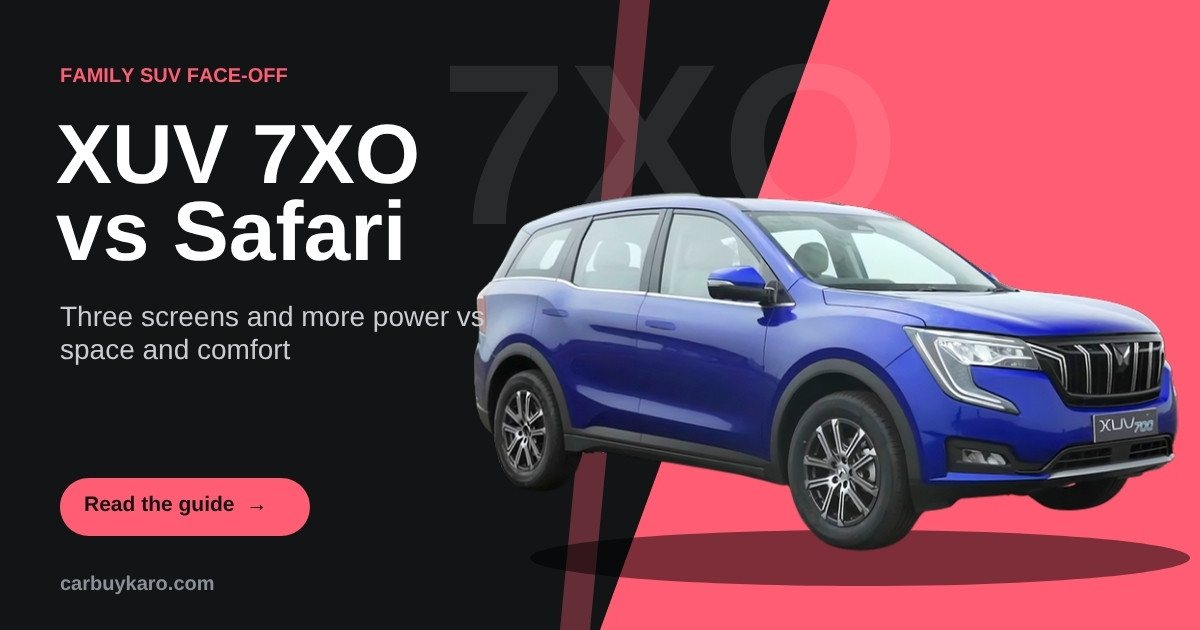
The XUV 7XO vs Safari question is the biggest decision for Indian families buying a seven-seat SUV under ₹25 lakh. Short answer: the Mahindra XUV 7XO (the renamed XUV700 facelift, ₹13.66–24.92 lakh ex-showroom) is more powerful, offers AWD, and gets a new three-screen dashboard. The Tata Safari (₹13.29–26.14 lakh) has a more spacious third row, a comfortable ride, a strong feature list and now a 1.5 turbo-petrol alongside its 2.0 diesel. Pick the XUV 7XO for performance, AWD and tech; pick the Safari for third-row space and comfort.
Here is the detailed comparison.
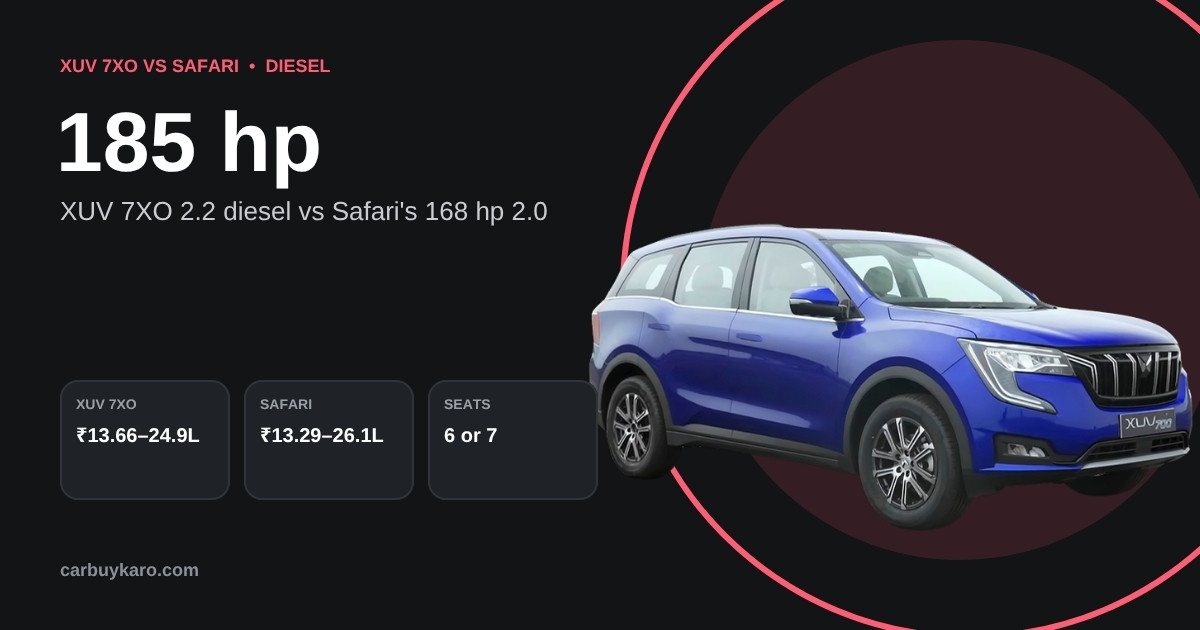
XUV 7XO vs Safari: key specs
| Mahindra XUV 7XO | Tata Safari | |
|---|---|---|
| Price (ex-showroom) | ₹13.66–24.92 lakh | ₹13.29–26.14 lakh |
| Petrol | 2.0 turbo, about 200 hp | 1.5 turbo, about 168 hp, 280 Nm |
| Diesel | 2.2, about 185 hp | 2.0, about 168 hp, 350 Nm |
| Gearboxes | 6MT, 6AT | MT, AT |
| AWD | Yes (diesel AT, top variants) | No |
| Seats | 6 or 7 | 6 or 7 |
Prices are ex-showroom as of September 2026. The XUV 7XO’s lowest price was an introductory offer; check the current list.
What is new on the XUV 7XO
Mahindra launched the XUV 7XO on 5 January 2026 as the facelifted XUV700 with a new name. Changes include revised LED headlamps with boomerang-shaped daytime running lights, a new grille, refreshed tail-lamps and, inside, a three-screen setup with 12.3-inch displays for the driver, the centre and the front passenger. There is also a new upholstery colour scheme. The 2.0 turbo-petrol and 2.2 diesel engines carry over.
Engines and performance
The XUV 7XO is the more powerful car. Its 2.0 turbo-petrol makes about 200 hp and is genuinely quick. The 2.2 diesel offers roughly 15 hp and 100 Nm more than the Safari’s diesel, and it feels strong with seven people on board.
The Safari’s 2.0 diesel (about 168 hp, 350 Nm) is a well-proven engine with good real-world efficiency. The new 1.5 turbo-petrol (about 168 hp, 280 Nm) gives petrol buyers a choice they did not have before.
If you often drive fully loaded on highways or up ghats, the XUV 7XO’s extra torque is noticeable. The Safari is adequate and relaxed but not as punchy.
AWD
The XUV 7XO offers AWD with the diesel automatic on top variants. AWD helps on wet, muddy or snowy roads and improves traction when fully loaded on steep climbs.
The Safari is front-wheel drive only. For most Indian families who drive on tarmac, FWD is enough. If you regularly visit hill stations in winter or drive on unpaved estate roads, AWD is worth considering.
Space and third row
This is the Safari’s strength. Its longer, taller body gives more headroom and legroom in the third row. Adults can sit there for moderate journeys. Access to the third row is also easier, especially in the six-seat captain-chair layout.
The XUV 7XO’s third row is best for children or short trips. The second row is spacious in both.
If your third row will carry adults regularly, the Safari is the better choice.
Ride and comfort
The Safari is known for a comfortable, well-damped ride that handles broken roads well. The XUV 7XO has a slightly firmer ride with sharper handling, which suits drivers who enjoy the drive more than passengers who want to relax.
Test both on a bad road with family in the back.
Features
Both are loaded in top variants: panoramic sunroofs, ventilated seats, 360-degree cameras, Level 2 ADAS, premium audio, powered seats and connected-car tech.
The XUV 7XO’s three-screen dashboard is its headline feature, and Mahindra’s ADAS is well calibrated. The Safari offers a large touchscreen, digital cluster, premium JBL audio and ventilated seats in both front and middle rows on some variants.
Compare the exact variants you can afford rather than top trims.
Safety
Both have scored 5-star ratings in crash tests in their earlier forms and offer up to seven airbags on top variants, ESC and Level 2 ADAS. Check the latest Bharat NCAP ratings in our safest cars guide.
Running costs
For a family driving 1,500 km a month, with diesel at ₹90 and petrol at ₹95:
| Version | Real-world economy | Monthly fuel cost |
|---|---|---|
| XUV 7XO 2.2 diesel AT | 12 km/l | about ₹11,250 |
| XUV 7XO 2.0 petrol AT | 9 km/l | about ₹15,800 |
| Safari 2.0 diesel AT | 13 km/l | about ₹10,400 |
| Safari 1.5 petrol AT | 10 km/l | about ₹14,300 |
Diesel remains the sensible choice for high-mileage families outside Delhi-NCR. Run your own numbers with our fuel cost calculator.
Service and resale
Mahindra has a large network, especially strong in smaller towns. Tata’s network has grown quickly. Service quality varies by dealer for both; check local reviews.
Both hold value well, with the XUV700/7XO diesel in particularly high demand in the used market.
XUV 7XO vs Safari: which should you buy?
Buy the XUV 7XO if:
- You want the most power and performance.
- You need AWD.
- You like the three-screen dashboard and tech focus.
- Your third row is mostly for kids.
Buy the Safari if:
- Adults will use the third row regularly.
- Ride comfort is the priority.
- You want a well-proven diesel with good economy.
- You prefer the Safari’s design and presence.
Worked example: EMI on a mid-spec diesel automatic
Assume a mid-spec diesel automatic of either car at about ₹21 lakh ex-showroom and ₹25.5 lakh on-road in Hyderabad.
- Down payment: ₹6 lakh.
- Loan: ₹19.5 lakh at 9% for five years.
- EMI: about ₹40,500.
- Fuel at 1,500 km a month: about ₹10,400–11,250.
- Insurance and service averaged: about ₹4,500.
Total: about ₹55,000–56,000 a month. Model other options in the car EMI calculator, and check affordability with the car affordability calculator.
Test drive checklist
- Put the whole family in the car, including the third row.
- Drive over a bad road to compare ride comfort.
- Try the automatic gearbox in city traffic.
- Fold the third row and check boot space.
- Test the ADAS on a highway.
- Check the ease of third-row access in both six- and seven-seat layouts.
Common mistakes
- Buying AWD you will never use. It adds cost and slightly reduces efficiency.
- Picking petrol for high mileage. Both petrols are thirsty in a heavy seven-seater.
- Ignoring third-row comfort. Sit there yourself before buying.
- Choosing diesel in Delhi-NCR. The 10-year diesel limit hurts resale.
- Stretching to the top trim. Mid variants of both are well equipped.
Other seven-seaters worth a look
The Mahindra Scorpio-N is tougher and body-on-frame. The Toyota Innova Hycross is an MPV with a strong hybrid and excellent comfort. The Hyundai Alcazar and MG Hector Plus offer strong feature lists. For electric options, see the MG Hector Tomahawk EV and the upcoming Safari EV in our upcoming EVs guide. For a bigger budget, see our Kia Sorento guide. Our best 7-seater cars list ranks them all.
Six seats or seven?
Both SUVs offer six-seat (captain chairs) and seven-seat (bench) layouts. Choose based on who sits in the middle row.
Seven seats suit families with young children. The bench fits child seats on the outer positions, and you get the extra seat for school runs or visiting relatives.
Six seats suit families with elderly parents or teenage children. Captain chairs are more comfortable on long trips, each passenger has their own armrests, and there is a walkway to the third row, so nobody has to fold a seat to get in or out.
In the Safari, the captain-chair layout also makes the third row easier to reach, which adds to its advantage for adult third-row passengers.
Weekend road trip: Delhi to Jaipur
Picture a family of six driving about 280 km each way on a mostly good highway.
In the XUV 7XO diesel automatic, overtaking trucks at highway speeds takes little effort, even fully loaded. The firmer suspension keeps body movement in check on fast bends. Third-row passengers, if adults, will want a stop every couple of hours.
In the Safari diesel automatic, the ride is more relaxing over expansion joints and patchy stretches. Adults in the third row are more comfortable. Overtakes need a little more planning, but the engine is never short of breath.
Fuel for the round trip would be roughly 45–48 litres in either car, about ₹4,000–4,300 at ₹90 a litre.
Ownership over five years
Both are proven models with large owner communities. Common advice from owners of both includes keeping up with software updates for the infotainment system, checking brake pad wear more often if you drive heavily loaded, and choosing a trusted service centre. Service costs are similar and reasonable for the segment, typically ₹8,000–15,000 per routine service depending on what is due.
Buy an extended warranty if you plan to keep the car for more than five years. Modern SUVs have many electronic components, and an out-of-warranty repair to a screen or sensor can be expensive.
Delhi-NCR buyers: petrol or diesel?
In Delhi-NCR, diesel cars must be deregistered after 10 years, which reduces their resale value in the region. If you live there and keep cars for a long time, consider the petrol versions despite higher fuel costs, or plan to sell a diesel well before the 10-year mark. Our petrol vs diesel vs CNG guide explains the maths.
Summary
In the XUV 7XO vs Safari contest, the XUV 7XO wins on power, AWD and tech, while the Safari wins on third-row space, ride comfort and diesel efficiency. Families who use the third row for adults should pick the Safari; drivers who want performance and AWD should pick the XUV 7XO. For more head-to-heads, see our comparisons section.
Frequently asked questions
Is the XUV 7XO the same as the XUV700?
The XUV 7XO is the facelifted XUV700 with a new name, launched on 5 January 2026. It gets revised styling, a three-screen dashboard and updated features, with the same 2.0 turbo-petrol and 2.2 diesel engines.
Which is more powerful, XUV 7XO or Safari?
The XUV 7XO. Its 2.0 turbo-petrol makes about 200 hp and its 2.2 diesel offers about 15 hp and 100 Nm more than the Safari's 2.0 diesel.
Does the Tata Safari have AWD?
No. The Safari is front-wheel drive. The XUV 7XO offers AWD with the diesel automatic on the top AX7 variants.
Which has a better third row, XUV 7XO or Safari?
The Safari's third row is generally more usable for adults thanks to its longer, taller body. The XUV 7XO's third row is better suited to children and short trips.
Prices are ex-showroom unless we say otherwise, and makers change them often. Confirm the latest price, offers and variant details with an authorised dealer before you book.


