On this page 16 sections
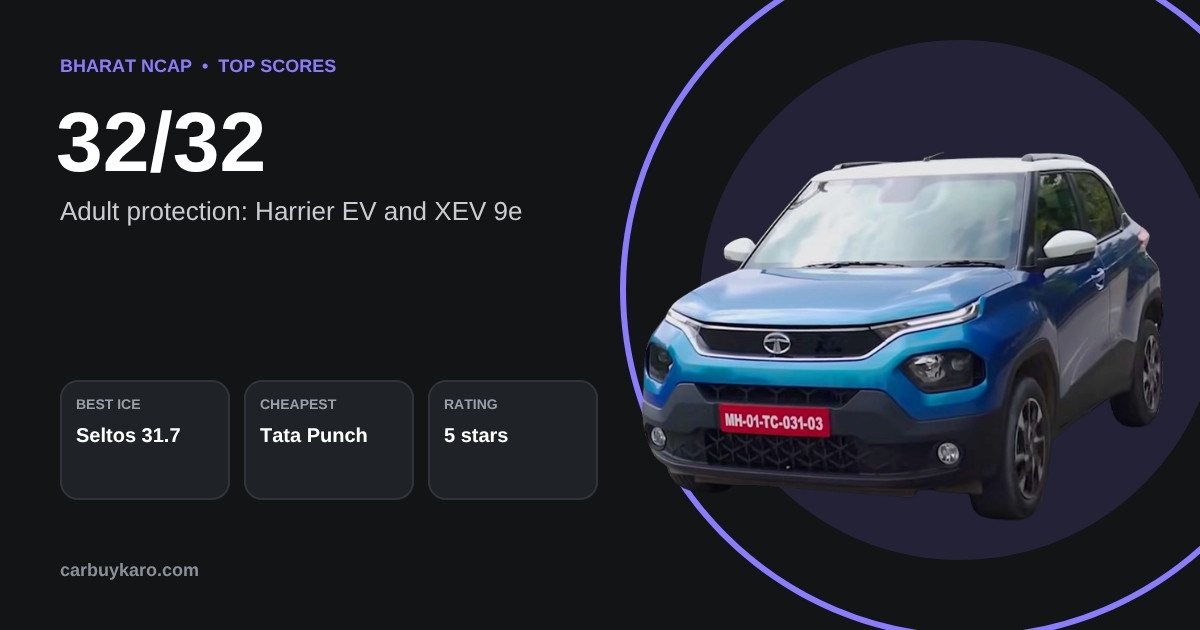
The safest cars in India in 2026, according to Bharat NCAP crash tests, include the Tata Harrier EV and Mahindra XEV 9e (both a perfect 32/32 for adult protection), the Kia Seltos (31.70/32, the best petrol-diesel car), Tata Sierra (31.14/32), Hyundai Venue (31.15/32), Maruti Dzire (29.46/32) and the Tata Punch, the cheapest 5-star car at around ₹5.6 lakh. The good news: every budget now has a 5-star option.
Below we list the key 5-star cars by budget, explain what the scores mean, and cover the safety features that matter most in Indian driving.
5-star Bharat NCAP cars by budget
| Budget | Car | Notes |
|---|---|---|
| Under ₹7 lakh | Tata Punch | 5-star, cheapest in the list |
| Under ₹10 lakh | Maruti Dzire | 5-star, 29.46/32 adult |
| Under ₹10 lakh | Nissan Magnite | 5-star, strong value |
| ₹8–14 lakh | Hyundai Venue | 31.15/32 adult |
| ₹8–15 lakh | Tata Nexon | 5-star record |
| ₹11–20 lakh | Kia Seltos | 31.70/32 adult, best ICE car |
| ₹11–20 lakh | Tata Sierra | 31.14/32 adult, 44.73/49 child |
| ₹20 lakh+ | Tata Harrier EV | 32/32 adult |
| ₹20 lakh+ | Mahindra XEV 9e | 32/32 adult |
| New entrant | VinFast VF6, VF7 | 5-star EVs |
This list covers well-known examples, not every 5-star car. Ratings apply to the specific variants tested, so check the official Bharat NCAP report for the exact version you plan to buy.
How Bharat NCAP works
Bharat NCAP was launched in 2023 as India’s official crash-test programme. It tests cars in:
- Frontal offset impact at 64 km/h into a deformable barrier.
- Side impact at 50 km/h.
- Side pole impact at 29 km/h (for cars that qualify).
Cars get two scores:
- Adult Occupant Protection (AOP): out of 32 points. 5 stars needs at least 27 points plus minimum performance in each test.
- Child Occupant Protection (COP): out of 49 points. 5 stars needs at least 41 points.
Safety assist features, such as electronic stability control and seatbelt reminders, also count towards the rating.
How to read the scores
Look at both scores. A car can score 5 stars for adults and 4 for children. If you have young kids, the child score matters.
Look at the points, not just the stars. A car with 31/32 protects adults better in these tests than one with 27/32, even though both have 5 stars.
Check the variant. Makers often test a variant with specific safety equipment. A base variant with fewer airbags may not offer the same protection.
Structure matters. The report notes whether the body shell was rated stable or unstable. A stable structure can withstand further loads, which is an important sign of a well-engineered car.
Safety features that matter most in India
Six airbags
Front, side and curtain airbags protect in frontal and side impacts. Six airbags are now standard on many cars, including the new Baleno, Exter and many Hyundai and Kia models. Check the exact variant.
Electronic stability control (ESC)
ESC helps prevent skids and rollovers when you swerve or brake hard, which is common when a dog, cyclist or cow appears suddenly. It is one of the most important safety features and is now becoming standard.
ISOFIX child seat mounts
If you have young children, use a proper child seat mounted on ISOFIX anchors. Holding a child on your lap is extremely dangerous.
Three-point seatbelts for all seats
Including the rear middle seat. Rear passengers should wear seatbelts; unbelted rear passengers can injure themselves and the people in front during a crash.
ADAS
Automatic emergency braking can prevent or reduce low-speed collisions. It is useful but not a substitute for attentive driving. ADAS does not affect the core crash rating the same way structure and airbags do.
Safety tips beyond the car
A 5-star car is only as safe as how you use it:
- Everyone buckles up, including rear passengers.
- Use child seats for young children, rear-facing for infants.
- Check tyres monthly. Worn or under-inflated tyres increase braking distances.
- Keep headlamps clean and aligned, especially for highway night driving.
- Do not overload the car. It changes braking and handling.
- Service brakes on time.
Safety vs price: the trade-offs
Some buyers ask whether paying more guarantees more safety. Not always. The Tata Punch at around ₹5.6 lakh has a 5-star rating, while some more expensive cars have not been tested or scored lower. Always check ratings rather than assuming.
If two cars fit your budget and one has a clearly better crash rating, choose it, even if the other has a sunroof or bigger screen. You can add comfort features later; you cannot upgrade a car’s structure.
Worked example: choosing a safe family car on ₹10 lakh
A family of four with a toddler has ₹10 lakh on-road to spend.
- Shortlist 5-star cars under ₹9 lakh ex-showroom: Tata Punch, Maruti Dzire, Nissan Magnite, lower variants of the Tata Nexon.
- Check child occupant scores, because of the toddler.
- Confirm the variant they can afford has six airbags, ESC and ISOFIX.
- Compare on-road prices with our on-road price calculator.
- Test drive the two finalists.
This process produces a safe, well-matched car in under a week. For more options by budget, see our best cars under ₹10 lakh.
Common safety myths
- “Bigger cars are always safer.” Size helps in some crashes, but structure and restraint systems matter more. A well-built small car can outperform a poorly built large one.
- “Heavier steel means stronger.” Modern cars use high-strength steels designed to absorb energy. Thick metal alone is not the answer.
- “Airbags alone make a car safe.” Without a strong structure and seatbelts, airbags cannot protect fully.
- “Rear seatbelts aren’t necessary.” They are essential, and required by law.
Safety and insurance
A safe car can help reduce injury risk, but you still need good insurance. Zero depreciation cover and personal accident cover are worth considering. Read our zero depreciation insurance guide for details.
Crash-test ratings and your budget
A few practical rules help you balance safety against price:
- Set a minimum. Decide that your next car must have at least a 4-star rating, six airbags and ESC. Then compare only cars that meet this bar.
- Compare within the rated variant. Some ratings apply only to specific variants. If you buy a lower variant, confirm it has the same airbags and safety equipment.
- Do not trade safety for a sunroof. If a safer car costs ₹50,000 more, it is usually worth it. Features can be added later; structure cannot.
- Think about who rides with you. If you carry children, give extra weight to child occupant scores.
Why Bharat NCAP matters for Indian buyers
Before Bharat NCAP, Indian buyers relied on voluntary tests by Global NCAP. Many popular cars were never tested, and some performed poorly. Bharat NCAP created a standard Indian rating that carmakers can volunteer for, and that customers can compare easily. It has already pushed several makers to improve their cars, add airbags and strengthen body structures.
The programme is voluntary, so not every car has a rating. If a car you like has not been tested, ask the dealer why, and compare its safety equipment with rated rivals.
Safety in EVs
EVs have performed very well in Bharat NCAP, with the Harrier EV and XEV 9e scoring perfect adult protection. EVs benefit from a rigid battery pack in the floor, which adds strength and lowers the centre of gravity. If you are considering an EV, see our best electric cars in India guide.
Safest cars by body type
- Hatchback: strong options include the Maruti Baleno and Hyundai i20 with six airbags as standard; check the latest ratings.
- Sedan: the Maruti Dzire (5-star) and Hyundai Verna (5-star in Global NCAP).
- Compact SUV: Tata Nexon, Hyundai Venue, Mahindra XUV 3XO and Nissan Magnite.
- Midsize SUV: Kia Seltos and Tata Sierra.
- Seven-seater: Tata Safari and Mahindra XUV 7XO; see our XUV 7XO vs Safari comparison.
What to do if your current car is not rated
Many older cars on Indian roads were never crash-tested or scored poorly. If you are not ready to replace yours, you can still reduce risk:
- Replace worn tyres and keep pressures correct. Tyres are the only part of the car touching the road.
- Get the brakes checked at every service, including brake fluid.
- Fit child seats properly for young children.
- Replace wiper blades before the monsoon and keep headlamps clean.
- Avoid night highway driving when tired; fatigue causes many serious crashes.
- Plan your upgrade with safety as the first filter. Our best cars under ₹10 lakh list focuses on safe choices.
Checklist for the showroom
Before you sign, ask the salesperson to show you, on the actual variant you are buying:
- The number and location of airbags (look for the SRS labels on the pillars and seats).
- Whether ESC and hill-hold are fitted.
- ISOFIX anchors in the rear seat.
- Three-point seatbelts and adjustable headrests for all rear seats.
- The official crash-test report for that model, and which variant was tested.
If any of these are missing, compare the price of the next variant up. The extra cost is often small compared with the protection it adds.
Summary
The safest cars in India in 2026 include the Harrier EV and XEV 9e at the top, the Kia Seltos as the best petrol-diesel car, and affordable 5-star options like the Tata Punch, Maruti Dzire and Nissan Magnite. Read both adult and child scores, check the exact variant, and prioritise six airbags, ESC and ISOFIX. For more help choosing, see our buying guides.
Frequently asked questions
Which is the safest car in India in 2026?
The Tata Harrier EV and Mahindra XEV 9e have scored a perfect 32/32 for adult occupant protection in Bharat NCAP. Among petrol and diesel cars, the Kia Seltos leads with 31.70/32.
Which is the cheapest 5-star safety car in India?
The Tata Punch, starting at around ₹5.6 lakh ex-showroom, carries a 5-star Bharat NCAP rating. The Maruti Dzire and Nissan Magnite are other affordable 5-star options.
What is Bharat NCAP?
Bharat NCAP is India's official car crash-test programme, launched in 2023. It rates cars from 0 to 5 stars for adult and child occupant protection using frontal, side and pole impact tests, plus checks on safety assist features.
Is a Global NCAP rating the same as Bharat NCAP?
They use similar test methods, but they are separate programmes. Global NCAP is an independent international body; Bharat NCAP is run under the Indian government. Newer cars are more likely to have Bharat NCAP ratings.
Prices are ex-showroom unless we say otherwise, and makers change them often. Confirm the latest price, offers and variant details with an authorised dealer before you book.


