
On this page 19 sections
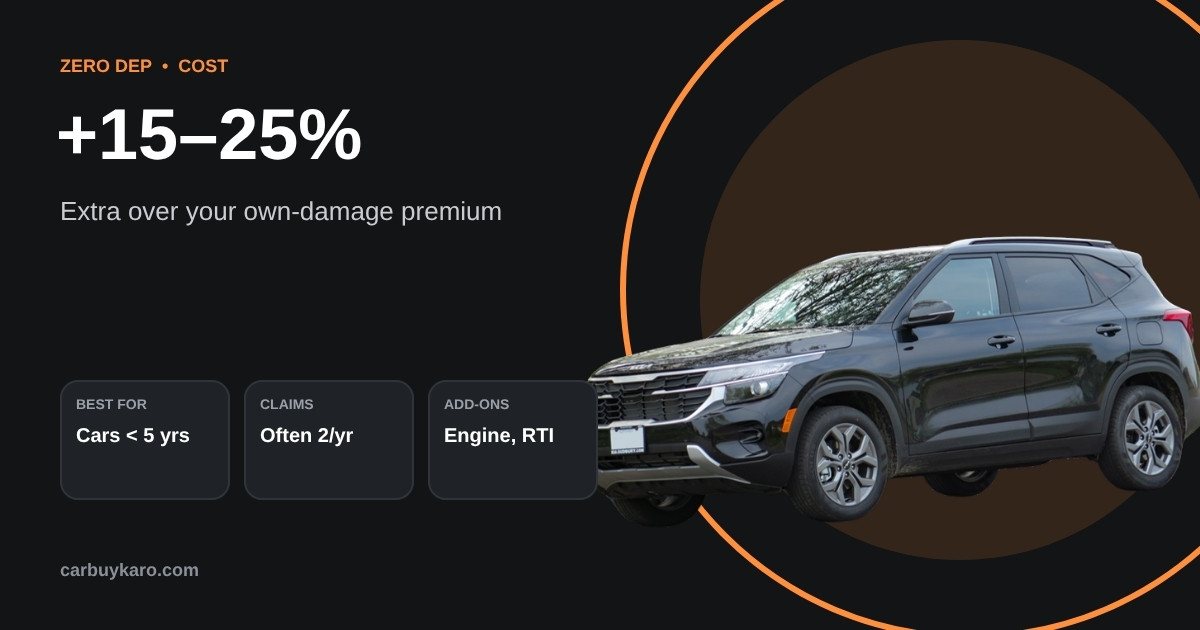
Zero depreciation car insurance is an add-on to a comprehensive policy that removes depreciation deductions on replaced parts when you make a claim. Without it, the insurer pays only part of the cost of parts like bumpers, headlamps, plastic trims and rubber components, deducting depreciation based on your car’s age. With zero-dep, you get close to the full cost of parts, minus a small compulsory deductible. It usually costs about 15–25% extra on the own-damage premium and is worth it for new cars and cars up to about five years old, especially in cities where minor accidents and scrapes are common.
Here is how it works, what it excludes and which other add-ons are worth buying.
How depreciation works in a normal claim
Under standard comprehensive insurance, when a part is replaced, the insurer deducts depreciation from the part’s cost. Typical deductions:
- Rubber, nylon, plastic parts, tyres and tubes, batteries and airbags: 50%.
- Fibreglass parts: 30%.
- Glass parts: usually nil.
- Metal parts: based on the car’s age, from nil for cars under six months to 50% for cars over ten years.
So if a new bumper costs ₹12,000 on a three-year-old car, a normal policy may pay only ₹6,000 after 50% depreciation on plastic. With zero-dep, you get almost the full ₹12,000.
Worked example: a typical city claim
A two-year-old hatchback has a minor collision, damaging the front bumper, one headlamp and the bonnet.
| Part | Cost | Normal policy pays | Zero-dep pays |
|---|---|---|---|
| Front bumper (plastic) | ₹10,000 | ₹5,000 | ₹10,000 |
| Headlamp (plastic housing) | ₹8,000 | ₹4,000 | ₹8,000 |
| Bonnet (metal, 2 years old) | ₹12,000 | ₹10,800 | ₹12,000 |
| Paint and labour | ₹8,000 | ₹8,000 | ₹8,000 |
| Total | ₹38,000 | ₹27,800 | ₹38,000 |
With zero-dep, the owner saves about ₹10,000 on this single claim (minus the compulsory deductible in both cases). If the zero-dep add-on cost ₹4,000–5,000 that year, one claim more than pays for it.
What zero depreciation does not cover
- Mechanical breakdown and wear and tear.
- Tyres, unless damaged in the same accident (some policies limit this).
- Damage from driving under the influence or without a valid licence.
- Consequential engine damage, such as driving through water and hydrolocking the engine; this needs an engine protection add-on.
- Claims beyond the allowed number per year.
- The compulsory deductible, which you still pay.
Claim limits
Many insurers allow two zero-dep claims per policy year. Some offer unlimited claims at a higher premium. For most careful drivers, two is enough. Remember that each claim affects your no-claim bonus.
How much does it cost?
The zero-dep add-on typically adds about 15–25% to the own-damage part of your premium. For a new ₹10 lakh car, that might mean ₹3,000–6,000 extra a year. The price rises as the car ages.
Other add-ons worth considering
Engine protection
Covers damage to the engine and gearbox from water ingress or oil leakage, which standard policies exclude as consequential damage. Very useful in cities that flood during the monsoon, such as Mumbai, Chennai and Bengaluru.
Return to invoice (RTI)
If your car is stolen or declared a total loss, RTI pays the gap between the insured declared value (IDV) and the original invoice price, including road tax and registration. Useful for new cars in the first three years.
Roadside assistance
Towing, jump-starts, flat tyre help and fuel delivery. Many carmakers include it for the first few years; check before paying twice.
Consumables cover
Pays for items like engine oil, nuts, bolts, coolant and grease used during a repair, which standard policies exclude. Cheap and handy.
Key replacement
Covers the cost of replacing lost or stolen keys. Modern smart keys can cost ₹10,000–30,000 to replace.
Tyre protection
Covers tyre damage from cuts and bursts, useful if you drive on poor roads or have expensive low-profile tyres.
NCB protection
Lets you make one or more claims without losing your no-claim bonus, depending on the policy.
Which add-ons for which car?
- New car, city use: zero-dep, engine protect, RTI, consumables, roadside assistance.
- Three- to five-year-old car: zero-dep, engine protect, consumables.
- EV: zero-dep, plus any battery or charger cover the insurer offers.
- Luxury car: zero-dep, engine protect, RTI, key replacement, tyre protection.
- Car older than seven years: zero-dep may not be available; focus on engine protect if available and a sensible IDV.
How to buy car insurance smartly
- Compare quotes online from several insurers with the same add-ons.
- Do not automatically accept the dealer’s policy. It is often more expensive.
- Check the IDV. A very low IDV cuts the premium but reduces payouts. Keep it close to the car’s market value.
- Check the cashless garage network near you.
- Read claim limits and exclusions for each add-on.
- Transfer your no-claim bonus from your previous car.
No-claim bonus and zero-dep
The no-claim bonus (NCB) reduces your own-damage premium by 20–50% for each consecutive claim-free year. Small claims can cost you more in lost NCB than the claim is worth. For minor scratches, it is sometimes cheaper to pay yourself and keep the NCB. Zero-dep is most valuable for medium and large claims.
Common mistakes
- Skipping zero-dep on a new car to save a few thousand rupees.
- Choosing a very low IDV to cut the premium.
- Not buying engine protect in flood-prone cities.
- Claiming for tiny dents and losing the NCB.
- Not reading exclusions.
Zero-dep and new drivers
New drivers are more likely to have small bumps and scrapes. For them, zero-dep is especially valuable. Our best first car guide includes more tips for new owners.
Comprehensive vs third-party insurance
Third-party insurance is mandatory by law. It covers damage or injury you cause to other people and their property, but nothing for your own car.
Comprehensive insurance includes third-party cover plus own-damage cover for your car against accidents, theft, fire, floods and other perils. Zero depreciation and other add-ons can only be added to comprehensive policies.
New cars in India come with long-term third-party cover (usually three years) and one year of own-damage cover. After the first year, you renew the own-damage part annually, and you can switch insurers for it.
How to make a smooth claim
- Inform the insurer quickly, usually within 24–48 hours, through the app or helpline.
- Take photos of the damage and the scene.
- File an FIR for theft, major accidents or injuries.
- Take the car to a cashless network garage if possible, so the insurer settles directly.
- Keep documents ready: policy copy, RC, driving licence and FIR if applicable.
- Wait for the surveyor’s inspection before repairs begin.
With zero-dep and a cashless garage, you typically pay only the compulsory deductible and any items not covered.
Insurance for EVs
EV insurance works the same way, but the battery is the most expensive single component. Look for policies or add-ons that cover battery damage from accidents or water, and the charger and cable. Our EV battery life and warranty guide explains what the manufacturer’s warranty covers and what insurance needs to cover.
Insurance at purchase: dealer or online?
The dealer will offer insurance as part of the on-road price. It is convenient, but you are free to buy elsewhere. Compare online quotes with identical add-ons and IDV, then decide. Our on-road price explainer shows how insurance fits into the total, and our guide to the best time to buy a car covers festive insurance offers.
IDV explained
The insured declared value (IDV) is the maximum amount the insurer will pay if the car is stolen or written off. For a new car, it is close to the ex-showroom price, and it falls each year as the car ages. A lower IDV reduces the premium but also reduces the payout. Keep IDV close to the car’s real market value. Use our resale value calculator for a rough idea of what your car is worth.
Renewal tips
Renew before the policy expires. If it lapses, you may need a fresh inspection and could lose your no-claim bonus after 90 days. Check whether add-ons still make sense each year: zero-dep is worth keeping for the first five years, while return-to-invoice matters most in the first three. Compare quotes at every renewal; loyalty rarely brings the best price.
How much zero-dep saves over five years
Suppose you make two medium claims over five years, each involving about ₹15,000 of plastic and rubber parts on a three- to four-year-old car. Without zero-dep, roughly half of those part costs, about ₹15,000 in total, would come out of your pocket. If zero-dep costs ₹4,000–6,000 a year, the add-on costs ₹20,000–30,000 over five years. On two claims it roughly breaks even; on three or on one large claim it clearly wins. For new cars with expensive parts, the maths tilts further in favour of zero-dep.
Summary
Zero depreciation car insurance removes depreciation deductions on replaced parts, so you get close to the full cost of repairs. It is well worth buying for new cars and cars up to about five years old, and one medium claim usually covers the extra premium. Pair it with engine protection in flood-prone cities and return-to-invoice for new cars, compare quotes online, and keep an eye on claim limits and your no-claim bonus. For the full cost of buying a car, see our on-road price explainer.
Frequently asked questions
What is zero depreciation car insurance?
It is an add-on to comprehensive car insurance that removes depreciation deductions on replaced parts during a claim. Without it, the insurer deducts a percentage of the cost of parts like plastic, rubber and fibreglass based on the car's age.
Is zero depreciation insurance worth it?
For new cars and cars up to about five years old, usually yes. The extra premium is often recovered in a single claim, especially for bumpers, lights and plastic parts.
How many claims are allowed under zero depreciation?
Many insurers limit zero-dep claims to two per policy year, though some offer unlimited claims at a higher premium. Check the policy wording.
Can I buy zero depreciation for an old car?
Most insurers offer zero-dep for cars up to five years old, and some up to seven years. It becomes harder to get and more expensive for older cars.
Prices are ex-showroom unless we say otherwise, and makers change them often. Confirm the latest price, offers and variant details with an authorised dealer before you book.


