On this page 17 sections
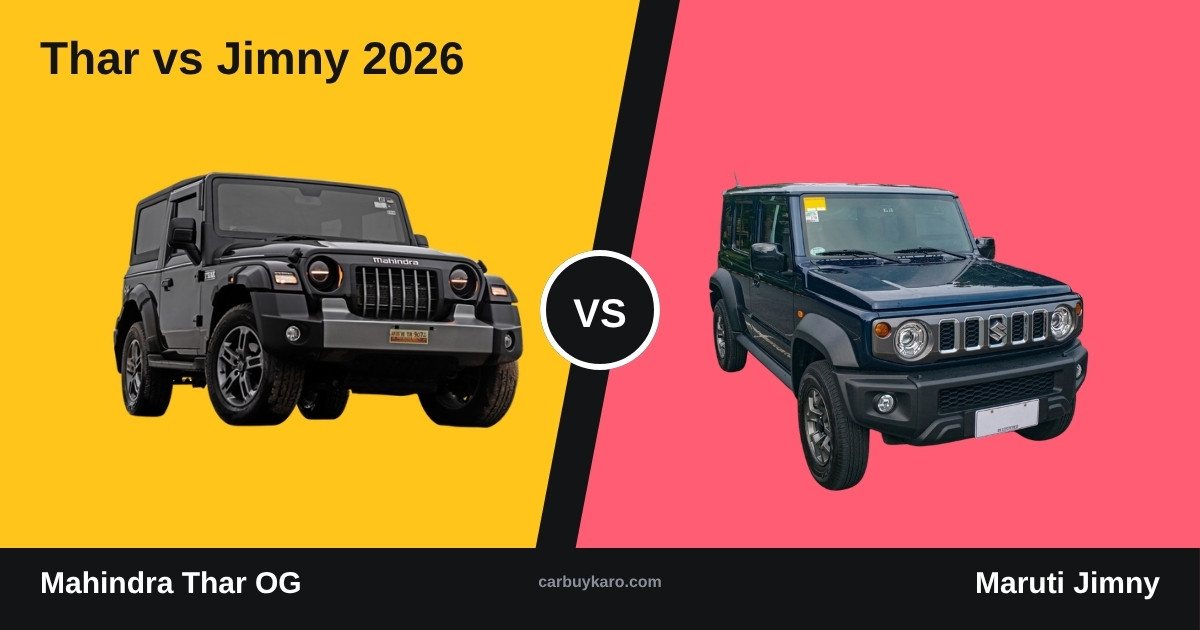
The Thar vs Jimny debate is the favourite argument among Indian off-road fans. Short answer: the Mahindra Thar OG (₹10.32–18.99 lakh ex-showroom, updated in September 2026) is more powerful, offers diesel engines and rear-wheel-drive versions, and now has six airbags and all-disc brakes. The Maruti Jimny (roughly ₹12.5–14.7 lakh) is lighter, narrower, has five doors and a smooth 1.5 petrol, and is far easier to live with in the city. Pick the Thar for highway power, diesel economy and outright capability. Pick the Jimny for city practicality, rear-seat access and hill roads.
Here is the detailed comparison.
Thar OG vs Jimny: key specs
| Mahindra Thar OG | Maruti Jimny | |
|---|---|---|
| Price (ex-showroom) | ₹10.32–18.99 lakh (introductory) | about ₹12.5–14.7 lakh |
| Doors | 3 | 5 |
| Engines | 2.0 turbo petrol (~160 hp), 2.2 diesel (~152 hp), 1.5 diesel (~117 hp) | 1.5 petrol (~103 hp) |
| Gearboxes | Manual, automatic | 5MT, 4AT |
| Drive | RWD and 4WD | 4WD with low range, standard |
| Airbags | Up to 6 | 6 |
Engines and performance
The Thar OG is much more powerful. Its 2.2 diesel now makes about 152 hp and 330 Nm, and the 2.0 turbo-petrol about 160 hp and 330 Nm. That means relaxed highway cruising, easy overtakes and effortless climbs. The 1.5 diesel (about 117 hp) is the budget option.
The Jimny’s 1.5 petrol makes about 103 hp and 134 Nm. In town and on hill roads it is fine. On a highway with four people and luggage, overtaking needs planning. The four-speed automatic is dated but reliable.
If you drive long distances regularly, the Thar will feel far less stressed.
Off-road ability
Both are proper off-roaders with ladder frames and low-range four-wheel drive (on 4x4 Thars).
Thar strengths: more torque, a locking rear differential, terrain modes and big wheel articulation. The 2026 update added a new five-link rear suspension and better damping, which helps on rough trails too.
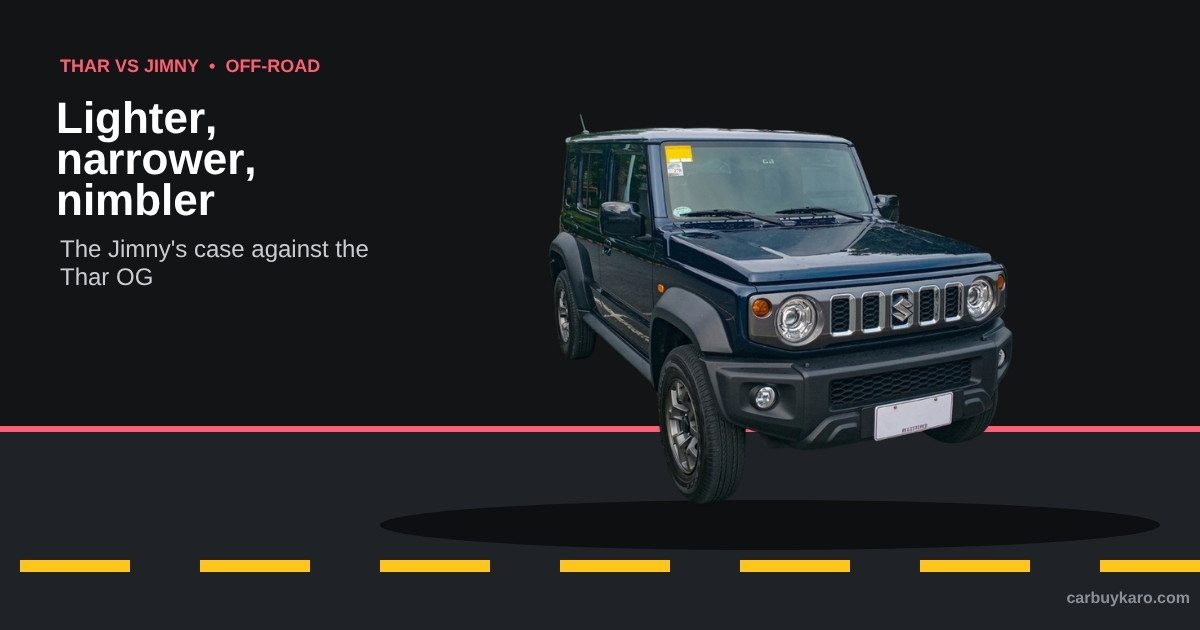
Jimny strengths: very light, narrow and short, with a tight turning circle. On narrow mountain trails and between trees, the Jimny can squeeze through places a Thar struggles with. Its brake-based limited-slip system does a good job of managing traction.
For most owners, either car will go further off-road than they will ever push it. The deciding factor is where you drive: wide trails and sand favour the Thar; narrow hill tracks favour the Jimny.
City driving and daily comfort
This is where the Jimny clearly wins.
- Size: it is narrower and lighter, making city traffic and tight parking easy.
- Doors: five doors mean rear passengers can get in and out easily. In the three-door Thar, rear access means folding the front seat.
- Turning circle: tighter than the Thar’s.
The Thar OG’s 2026 update brought electric power steering, which makes parking easier, and a more settled ride. It is better than before, but it is still a larger three-door vehicle.
Space and practicality
The Jimny’s rear seat is small but usable for two adults on short trips. The boot is tiny with all seats up, but the rear seats fold flat. The Thar OG’s rear seat is also cramped and harder to reach, and the boot is small.
If you need a family car that can go off-road, neither is ideal. Look at the five-door Thar Roxx or a larger SUV instead.
Safety
The Thar OG top trim now gets six airbags, all-disc brakes, ESP and tyre-pressure monitoring. The Jimny offers six airbags and ESP. Both are sturdy body-on-frame vehicles. Check the latest crash ratings in our safest cars guide.
Running costs
| Version | Real-world economy | Monthly cost at 1,200 km |
|---|---|---|
| Thar 2.2 diesel | 12 km/l | about ₹9,000 (₹90/l) |
| Thar 2.0 petrol | 9 km/l | about ₹12,700 (₹95/l) |
| Jimny 1.5 petrol MT | 13 km/l | about ₹8,800 (₹95/l) |
| Jimny 1.5 petrol AT | 11.5 km/l | about ₹9,900 (₹95/l) |
The Jimny petrol is about as cheap to run as the Thar diesel in town. The Thar petrol is the thirstiest. Run your own numbers in our fuel cost calculator.
Service costs favour the Jimny, thanks to Maruti’s cheap parts and huge network. Mahindra’s service network is also wide, especially in smaller towns.
Thar vs Jimny: which should you buy?
Buy the Thar OG if:
- You drive long highway distances and want power.
- You want a diesel for economy.
- You like the Thar’s bold image and presence.
- You want a rear-wheel-drive automatic without paying for 4x4.
Buy the Jimny if:
- You drive mostly in the city or on hill roads.
- Rear passengers ride with you often. Five doors help a lot.
- You want the easiest car to park and manoeuvre.
- You live in a hill town with narrow roads.
Consider the Thar Roxx if: you want the Thar’s power and presence but need a proper family car with five doors and a big boot.
Worked example: EMI and running cost
Let us compare a Thar OG LXT diesel automatic RWD with a Jimny Alpha automatic, both on-road in Pune.
- Thar: about ₹19.7 lakh on-road; ₹4 lakh down, ₹15.7 lakh loan at 9% for five years gives an EMI around ₹32,600.
- Jimny: about ₹16.9 lakh on-road; ₹4 lakh down, ₹12.9 lakh loan at 9% for five years gives an EMI around ₹26,800.
- Fuel at 1,200 km a month: about ₹9,000 for the Thar diesel and ₹9,900 for the Jimny automatic.
Monthly total: about ₹41,600 for the Thar and ₹36,700 for the Jimny. Adjust these in our car EMI calculator. For the full Thar OG price list, see our Thar OG 2026 guide.
Test drive tips
- Drive both on a broken road to compare ride comfort.
- Park both in a tight spot.
- Get into the rear seats of both.
- Take both onto a highway and try an overtake with passengers.
- If possible, attend a brand off-road event or experience day. Both Mahindra and Maruti run them.
Common mistakes
- Buying for the 1% of off-road use. Be honest about how often you will leave tarmac.
- Ignoring rear-seat access. In a three-door, it is a real daily hassle for passengers.
- Choosing the Thar petrol for high mileage. The diesel is much cheaper to run.
- Expecting SUV comfort. Both are off-roaders first. They ride more firmly than monocoque SUVs.
- Over-accessorising. Big tyres and lift kits can affect warranty, ride and insurance. Check before modifying.
Insurance and modifications
Off-roaders attract modifications: bigger tyres, bull bars, light bars and snorkels. In India, some modifications are illegal (like bull bars on many vehicles) and others need to be declared to your insurer and sometimes endorsed on the RC. Undeclared modifications can lead to rejected claims. Read our zero depreciation insurance guide to understand how add-ons and claims work.
Who actually buys these cars?
Understanding the typical owner helps you decide which camp you belong to.
Thar owners are often young professionals and families who use the Thar as a second car for weekends, road trips and the occasional trail. Many choose diesel automatics for long drives. Some are serious off-roaders who modify their cars and join club drives. The Thar’s image and road presence are a big part of its appeal.
Jimny owners tend to be city dwellers who want something different from a regular SUV, hill-town residents who need a compact 4x4, and enthusiasts who value lightness and simplicity. Many use the Jimny as their only car, which works because of its five doors.
If you see yourself in one of these descriptions, that is probably your car.
Living with a 4x4 in the city
Four-wheel-drive vehicles bring some trade-offs for daily city use:
- Fuel economy is lower than a comparable two-wheel-drive SUV because of extra weight and drivetrain losses.
- Tyres on off-road-focused vehicles are often all-terrain types, which are noisier on tarmac and can wear faster.
- Ride is firmer on body-on-frame vehicles, especially over sharp bumps.
- Parking a tall, boxy vehicle in older buildings with low basement ceilings can be tricky. Check the height clearance of your parking.
For many buyers, the Thar OG’s rear-wheel-drive versions are a smart compromise: all the style, a lower price and better economy, without 4x4 hardware they rarely use.
Buying used
Both cars hold their value well, so used examples are not cheap. When buying a used Thar or Jimny, check for underbody damage from off-roading, water ingress in the cabin, modified suspension or tyres that might not be legal or insured, and a complete service history. A pre-purchase inspection by an independent mechanic is money well spent.
Weekend trip test: Pune to Mahabaleshwar
Picture a typical weekend: two adults, two small bags, about 120 km each way on expressway and ghat roads.
In the Thar OG diesel automatic, the expressway section is relaxed. The engine cruises easily at 100 km/h and overtaking trucks takes little effort. On the ghat, the torque makes climbs easy and the new suspension handles the corners better than the old Thar did. Rear passengers would find the trip less comfortable, but for two people up front it is a fun, easy drive.
In the Jimny automatic, the expressway is fine up to about 100 km/h, but overtakes need planning and the engine is working harder. On the ghat, its light weight and narrow body make tight hairpins easy, and it feels agile. Parking in the crowded hill-station market is much easier in the Jimny.
Both cars make this trip enjoyable. The Thar is better on the fast sections; the Jimny is better once you reach the hills.
Summary
In the Thar vs Jimny contest, the updated Thar OG wins on power, diesel choice, highway comfort and new safety kit, while the Jimny wins on city practicality, five-door access, size and running costs. Choose the Thar for highways and presence, the Jimny for cities and hill roads. See more head-to-heads in our comparisons section.
Frequently asked questions
Which is better off-road, Thar or Jimny?
Both are genuinely capable. The Thar has more power, more torque, a locking rear differential and terrain modes. The Jimny is lighter and narrower, which helps on tight trails and in the hills. For most off-road use either will go further than its owner dares.
Which is better for city driving, Thar or Jimny?
The Jimny. It is narrower, lighter and easier to park, and the five-door version has proper rear doors. The Thar OG is a three-door and larger, although its 2026 update improved ride and steering.
Does the Jimny have a diesel engine?
No. The Jimny only has a 1.5-litre petrol. The Thar offers a 2.0 turbo-petrol and two diesel engines.
Which has better resale, Thar or Jimny?
Both hold value well. The Thar, especially the 4x4 diesel, has very strong demand in the used market. The Jimny also has a loyal following and holds value well.
Prices are ex-showroom unless we say otherwise, and makers change them often. Confirm the latest price, offers and variant details with an authorised dealer before you book.


