On this page 21 sections
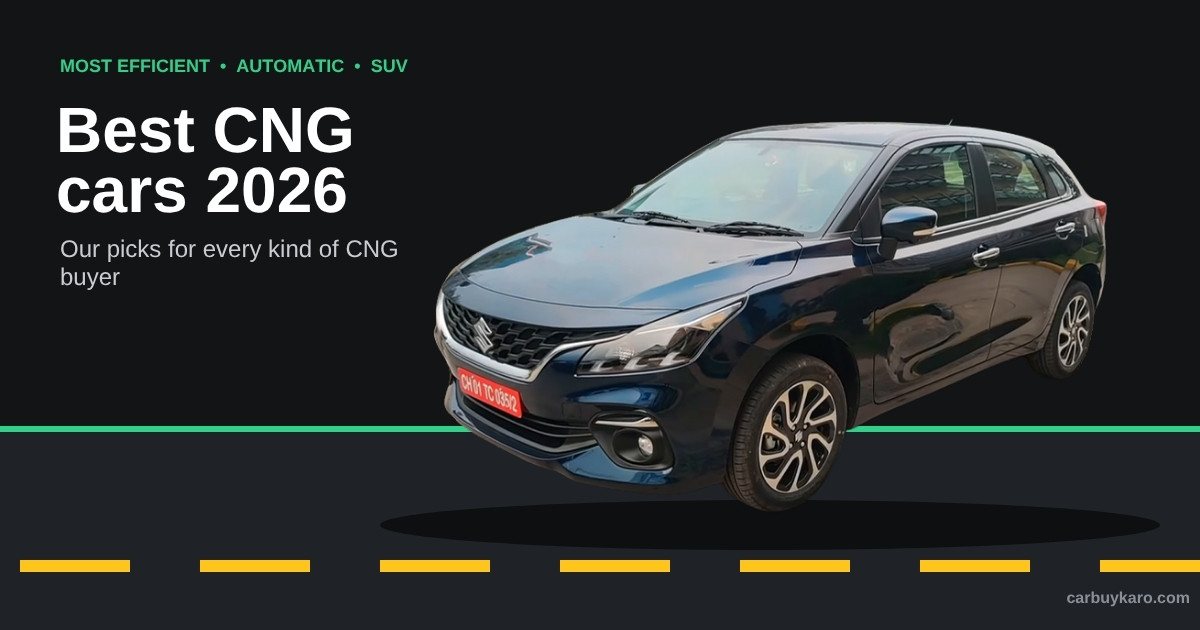
The best CNG cars in India in 2026 are the Maruti Baleno, Swift and Dzire CNG (most efficient, over 32 km/kg claimed), the Maruti Wagon R CNG (best budget option), the Tata Punch CNG AMT (best CNG automatic), the Hyundai Exter CNG (smooth and well equipped), the Tata Nexon and Maruti Brezza CNG (best CNG SUVs) and the Maruti Ertiga CNG (best seven-seater). CNG remains the cheapest way to run a combustion car in India, at roughly ₹3–4 per km.
Here is our shortlist, real-world mileage, and what to know before you buy.
Why CNG?
CNG costs roughly ₹75–90 per kg depending on the city, and CNG cars travel 20–28 km per kg in real use. That puts running costs at ₹3–4 per km, against ₹5–8 per km for petrol. For buyers driving more than 1,200 km a month, the savings recover the CNG premium within two to three years. Our petrol vs diesel vs CNG guide explains the break-even maths.
Our shortlist
| Car | Claimed | Real-world | Gearbox | Best for |
|---|---|---|---|---|
| Maruti Baleno CNG | 33.61 km/kg | 25–28 km/kg | Manual | Efficiency + space |
| Maruti Swift / Dzire CNG | over 32 km/kg | 25–28 km/kg | Manual | Efficiency |
| Maruti Wagon R CNG | about 34 km/kg | 25–29 km/kg | Manual | Tight budget |
| Tata Punch CNG | about 26 km/kg | 20–23 km/kg | Manual, AMT | CNG automatic, safety |
| Hyundai Exter CNG | about 27 km/kg | 21–24 km/kg | Manual | Smooth engine |
| Tata Nexon CNG | varies by variant | 18–21 km/kg | Manual | CNG SUV, safety |
| Maruti Brezza CNG | about 25 km/kg | 19–22 km/kg | Manual | CNG SUV, easy ownership |
| Maruti Ertiga CNG | about 26 km/kg | 19–22 km/kg | Manual | Seven seats |
Maruti Baleno, Swift and Dzire CNG: most efficient
With the Z12E engine, these three are the efficiency leaders. The Baleno offers the most space, the Swift the most fun, and the Dzire the biggest boot and a 5-star Bharat NCAP rating. See our Baleno 2026 guide.
Maruti Wagon R CNG: best on a budget
Tall, practical and very cheap to run. The Wagon R CNG is a favourite with families and commercial users.
Tata Punch CNG AMT: best CNG automatic
The Punch is one of the few cars that combine CNG with an AMT, so you get automatic convenience with CNG running costs. It also has a 5-star Bharat NCAP rating and high ground clearance. Read our Tata Punch buyer’s guide.
Hyundai Exter CNG: smooth and well equipped
The Exter’s four-cylinder engine is smoother than most three-cylinder rivals, and six airbags are standard. Hyundai’s dual-cylinder CNG layout keeps some boot space. Compare in Punch vs Exter.
Tata Nexon and Maruti Brezza CNG: best CNG SUVs
The Nexon CNG uses a twin-cylinder layout that preserves boot space, and it has strong crash-test credentials. The Brezza CNG is smooth, reliable and backed by Maruti’s network. See Nexon vs Brezza.
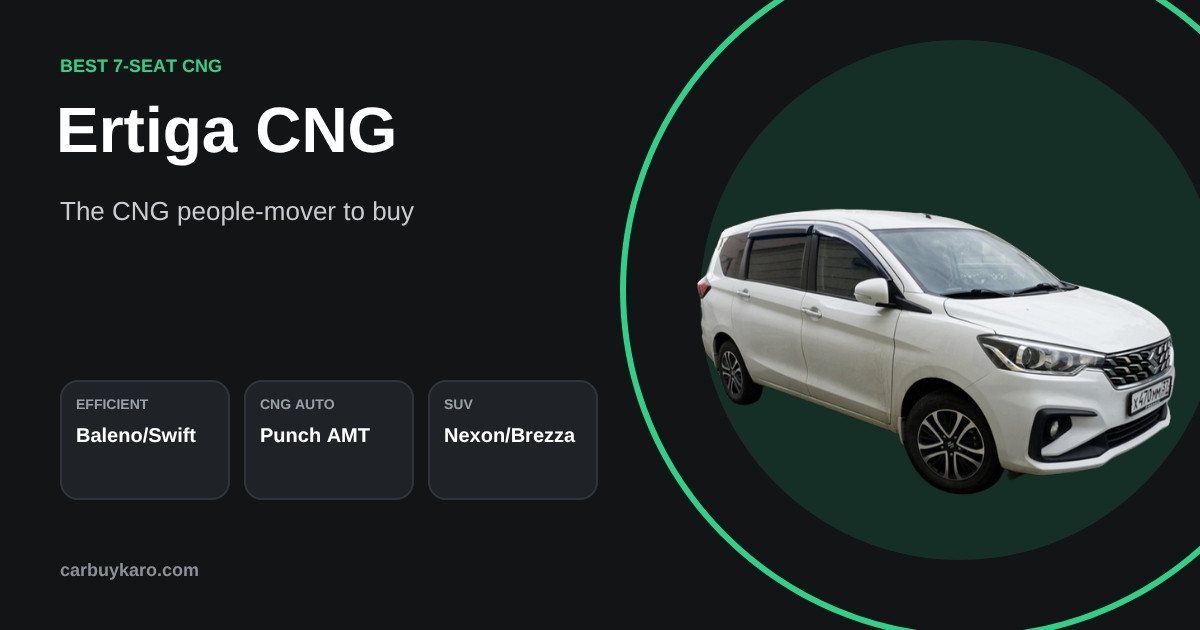
Maruti Ertiga CNG: best CNG seven-seater
The Ertiga CNG is one of the cheapest ways to move six or seven people. It is popular with large families and fleet operators. See our best 7-seater cars.
Boot space: single vs twin cylinders
Traditional CNG cars place a single large cylinder in the boot, taking up much of the luggage space. Twin-cylinder layouts (Tata, Hyundai) use two smaller cylinders under the boot floor, leaving a flat, usable boot. If you carry luggage often, check the boot of the exact CNG version before buying.
CNG ownership: what to know
Refuelling: CNG availability varies. It is widespread in Delhi-NCR, Mumbai, Pune, Gujarat and many northern cities, thinner elsewhere. Peak-hour queues can be long.
Starting on petrol: most factory CNG cars start on petrol and switch to CNG automatically. This is normal and protects the engine.
Performance: CNG reduces power by roughly 10–15%. It is fine in the city; on highways with a full load, plan overtakes.
Maintenance: CNG cars need periodic cylinder hydro-testing as required by law, and spark plugs may need more frequent replacement. Service costs are slightly higher than petrol but still low.
Insurance: factory CNG is covered automatically. Aftermarket kits must be declared and endorsed on the RC.
Monthly savings: worked example
A buyer in Pune drives 1,500 km a month and is choosing between a Baleno petrol AMT and a Baleno CNG.
- Petrol AMT at 18.5 km/l and ₹104 per litre: about ₹8,400 a month.
- CNG at 26 km/kg and ₹90 per kg: about ₹5,200 a month.
- Monthly saving: about ₹3,200.
- CNG premium over petrol manual: ₹92,000. Payback: about 29 months.
After that, the saving is pure gain. Try your own numbers in our fuel cost calculator.
CNG or EV?
For high-mileage city users, both CNG and EVs cut running costs sharply. An EV with home charging is cheaper per kilometre (around ₹1–1.5 per km) but costs more to buy and needs home charging. CNG costs less upfront and refuels quickly, but has boot and queue compromises. Our EV charging cost guide and best electric cars list help you compare.
Common mistakes CNG buyers make
- Buying CNG for low mileage. Under about 1,000 km a month, the premium takes too long to recover.
- Not checking pumps. Map CNG stations near home and work before buying.
- Choosing aftermarket kits. Factory CNG is safer and better supported.
- Ignoring boot space. Check the boot with your usual luggage.
- Skipping cylinder testing. It is a legal requirement and a safety essential.
How CNG works in a car
A factory CNG car is a petrol car with a second fuel system. Compressed natural gas is stored in a high-pressure cylinder at around 200 bar. When you drive on CNG, a regulator lowers the pressure and injectors feed the gas into the engine, just as petrol injectors would. A switch on the dashboard lets you choose the fuel, and most cars change over automatically when the CNG runs out.
Because CNG burns cleanly, engines running on it produce fewer particulates and lower carbon monoxide emissions than petrol. The gas is lighter than air, so in the rare event of a leak it disperses upwards rather than pooling on the ground, which is one reason CNG is considered safe when systems are properly installed and maintained.
The trade-offs are power and range. CNG has less energy per unit volume than petrol, so engines make less power on gas, and a cylinder holds only enough for roughly 200–300 km in most small cars. The petrol tank acts as a backup, which removes range anxiety.
Choosing a CNG car: step by step
- Check your monthly distance. If it is under about 1,000 km, stick to petrol. Between 1,200 and 2,500 km, CNG makes strong financial sense.
- Map CNG stations near your home, office and regular routes. Check queues at the times you are likely to refuel.
- Decide on a gearbox. If you want an automatic, the choice narrows to Tata’s CNG AMT models.
- Check the boot of the exact variant, especially if you carry luggage or a pram.
- Compare safety ratings and airbags, just as you would for any car.
- Compare on-road prices, including the CNG premium, and work out the payback period.
Real-world tips for CNG owners
- Refuel at off-peak times. Early morning and late night queues are usually shortest.
- Do not run the petrol tank dry. The car starts on petrol, and running on a nearly empty petrol tank for long periods is not good for the fuel pump. Keep at least a quarter tank of petrol.
- Service on time. Air filters, spark plugs and the CNG filter matter more on CNG cars.
- Check the cylinder test date printed on the cylinder and renew testing before it expires.
- Expect lower mileage in heavy traffic and with AC. Real figures of 20–26 km/kg are normal for small cars.
CNG for businesses and taxi use
Many fleet operators and taxi drivers choose CNG because it minimises running costs on high daily mileage. The Wagon R, Dzire and Ertiga CNG are especially popular. If you plan to use a car commercially, check that the variant is approved for commercial registration and that the warranty terms cover commercial use.
CNG prices across Indian cities
CNG prices are set by city gas distribution companies and change from time to time. Delhi-NCR has historically had some of the lowest prices, around the high ₹70s per kg, while cities like Mumbai, Pune and Bengaluru have generally been in the ₹80–90 range. Even at the higher end, CNG remains far cheaper per kilometre than petrol. Check the current price at your nearest station and plug it into our fuel cost calculator to see your real saving.
Is a CNG SUV worth it?
CNG SUVs like the Nexon and Brezza carry more weight and have bigger engines, so their CNG mileage is lower than small hatchbacks, usually 18–22 km/kg in real use. They still cost far less to run than petrol SUVs. They suit families who want an SUV but drive a lot in the city. The trade-off is boot space and some performance on highways.
One last check before you book
Ask the dealer to show you the CNG version in person, open the boot, and point out the cylinder’s test date and valve. A good dealer will explain the refuelling process and the service schedule clearly.
Summary
The best CNG cars in India in 2026 are the Maruti Baleno, Swift and Dzire for efficiency, the Wagon R for budget buyers, the Tata Punch CNG AMT for a clutch-free CNG car, the Hyundai Exter for smoothness, the Nexon and Brezza for SUV buyers and the Ertiga for seven seats. CNG makes the most sense above about 1,200 km a month in cities with good CNG supply. For more, see our EV and CNG section.
Frequently asked questions
Which is the best CNG car in India?
For efficiency and value, the Maruti Baleno, Swift and Dzire CNG are excellent. The Tata Punch CNG AMT is the best CNG automatic. The Tata Nexon and Maruti Brezza CNG are the best CNG SUVs, and the Maruti Ertiga CNG is the best seven-seater.
Which CNG car has an automatic gearbox?
Tata offers CNG with an AMT on models such as the Punch and Tiago. The upcoming Tata Aeris is also expected to offer it.
Does CNG reduce boot space?
Yes, because the cylinder sits in or under the boot. Tata and Hyundai use twin-cylinder layouts that keep more of the boot usable.
Is factory CNG better than aftermarket CNG?
Yes. Factory-fitted CNG is designed and tested for the car, keeps the warranty intact and is easier to insure. Aftermarket kits carry more risk.
Prices are ex-showroom unless we say otherwise, and makers change them often. Confirm the latest price, offers and variant details with an authorised dealer before you book.


