On this page 15 sections
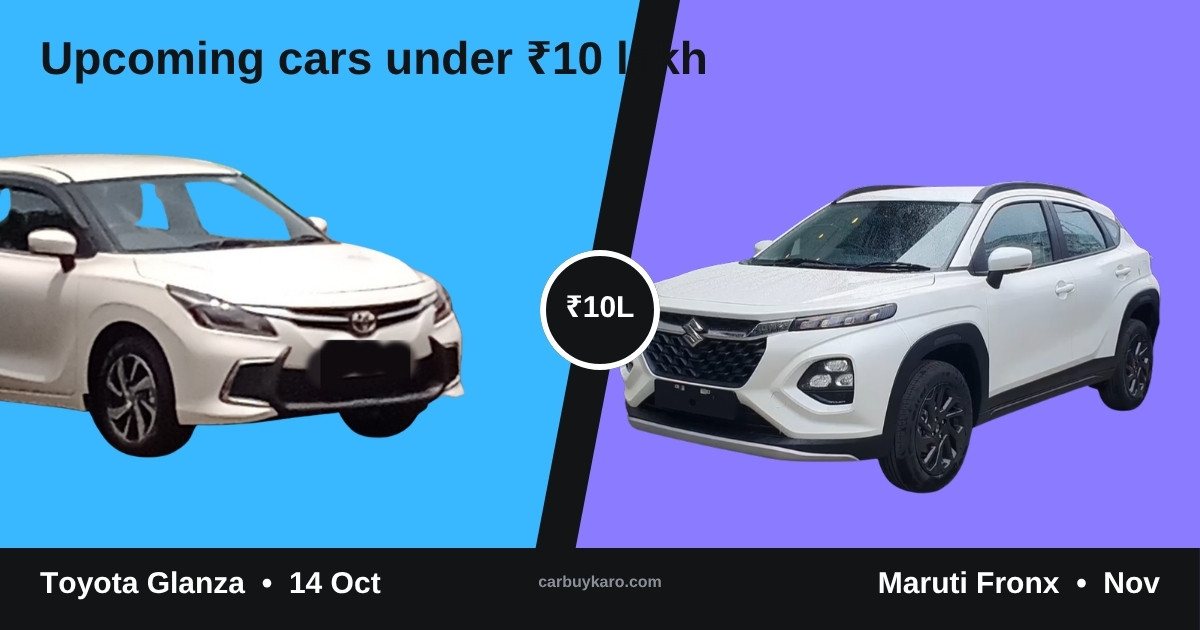
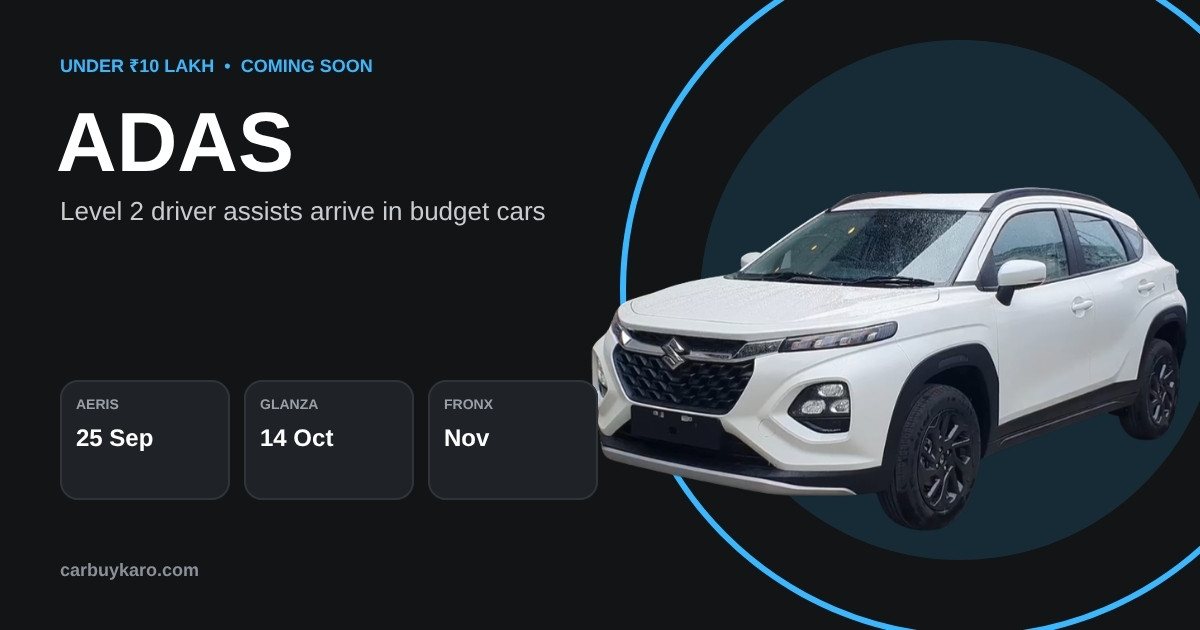
The upcoming cars under 10 lakh in India over the next year include the Tata Aeris compact sedan (25 September 2026), the Toyota Glanza facelift (14 October), the lower variants of the Hyundai Bayon (mid-October) and the Maruti Fronx facelift (expected November). Looking further ahead, Maruti’s first in-house strong hybrid and several small EVs are due in 2027. The common thread is that budget cars are getting features that were limited to expensive cars a few years ago: Level 2 ADAS, ventilated seats, six airbags as standard and big efficiency gains.
This guide lists each launch, what it brings and who should wait for it. It also shows how to decide between waiting and buying now, because the ₹10 lakh segment is where most Indian buyers shop and where a wrong decision hurts most.
Upcoming cars under ₹10 lakh at a glance
| Car | Type | Expected launch | Expected price (ex-showroom) |
|---|---|---|---|
| Tata Aeris | Compact sedan | 25 Sep 2026 | ₹6–9 lakh |
| Toyota Glanza facelift | Premium hatchback | 14 Oct 2026 | ₹6.5–9.4 lakh |
| Hyundai Bayon (lower trims) | Compact crossover | Mid-Oct 2026 | from about ₹10 lakh |
| Maruti Fronx facelift | Compact crossover | Nov 2026 | ₹7–12 lakh |
| Maruti Fronx strong hybrid | Compact crossover | 2027 (expected) | likely above ₹10 lakh |
| Small EVs (various) | Hatchback / crossover | 2027 | around ₹8–12 lakh |
Remember that “under ₹10 lakh” usually means ex-showroom. On-road prices add 10–15%, so a ₹9.5 lakh car costs close to ₹11 lakh on the road. Our on-road price explainer shows why.
Tata Aeris
The Aeris replaces the Tigor as Tata’s compact sedan. It gets new sheet metal, slim LED lighting and a cabin modelled on the updated Tiago, with a 10.25-inch touchscreen, digital cluster and possibly a 360-degree camera. Expect the 1.2 petrol with manual and AMT, plus factory CNG, likely with Tata’s twin-cylinder layout that saves boot space.
Best for: families who want a proper boot and a comfortable rear seat, and high-mileage city drivers wanting a CNG automatic. Full details in our Tata Aeris guide.
Toyota Glanza facelift
The Glanza is Toyota’s version of the Baleno. The facelift brings the Z12E three-cylinder engine with better mileage, Level 2 ADAS on the top trim, ventilated seats and a sportier front end.
Best for: buyers who want a spacious, efficient hatchback and prefer Toyota’s warranty and service. Read our Glanza facelift preview.
Hyundai Bayon (lower variants)
The Bayon’s price is expected to start near ₹10 lakh, so only its base variants will fall in this bracket. It is longer than a sub-four-metre SUV, with a 1.5 petrol and CNG option.
Best for: buyers who can stretch slightly beyond ₹10 lakh for more space. See our Hyundai Bayon guide.
Maruti Fronx facelift and hybrid
The Fronx facelift should add ADAS, a sunroof and ventilated seats. Its lower variants will sit under ₹10 lakh. The big news is Maruti’s in-house series hybrid, reported to deliver over 35 km/l claimed, which could arrive in 2027.
Best for: buyers who want an SUV look with hatchback running costs. Our Fronx facelift guide has the details.
Small EVs in 2027
Several affordable EVs are expected in 2027, including compact electric hatchbacks and crossovers from Indian and global brands. Entry-level EVs today, like the Tata Tiago EV and MG Comet, already fall under ₹10 lakh. Newer models should bring longer range and faster charging. See our upcoming electric cars list for what is confirmed.
What is changing in the ₹10 lakh segment
Safety as standard
Six airbags are now standard on many budget cars, including the new Baleno. Bharat NCAP crash tests have pushed makers to build stronger bodies too. Our guide to the safest cars in India lists the best-rated models, including several under ₹10 lakh.
ADAS arrives
Level 2 ADAS used to be limited to cars costing ₹15 lakh or more. The Baleno facelift brought it under ₹10 lakh, and rivals will follow. On Indian roads, ADAS is most useful on expressways with clear lane markings. In city traffic, features like automatic emergency braking can still help, but they are not a substitute for careful driving.
Efficiency jumps
Three-cylinder engines like Maruti’s Z12E, factory CNG and upcoming hybrids are pushing running costs down. For a buyer driving 1,500 km a month, the gap between a 15 km/l car and a 25 km/l car is about ₹3,800 a month at ₹95 per litre, or ₹45,000 a year.
Should you wait or buy now?
Here is a simple way to decide.
Wait if:
- The launch you are interested in is less than two months away.
- It adds a feature you really want (ADAS, CNG automatic, ventilated seats).
- You can manage without a car, or your current car is fine for a few more weeks.
Buy now if:
- The launch is more than three months away.
- A current model in your segment has a strong festive discount.
- You need a car soon for work or family reasons.
- The new features do not matter much to you.
A practical tip: even if you plan to buy an existing model, wait for a rival’s launch before signing. New competition often pushes dealers to offer better deals.
Worked example: can you afford a ₹9 lakh car?
The 20/4/10 rule says: put down at least 20%, finance for no more than four years, and keep total monthly car costs under 10% of gross income. Let us apply it to a car costing ₹10.2 lakh on-road (₹9 lakh ex-showroom).
- Down payment (20%): ₹2.04 lakh.
- Loan: ₹8.16 lakh at 9% for four years. EMI about ₹20,300.
- Fuel (1,200 km a month at 18 km/l, ₹95 per litre): about ₹6,300.
- Insurance and service averaged: about ₹2,000.
- Total monthly cost: about ₹28,600.
Under the 10% guideline, this suits a gross monthly income of about ₹2.9 lakh. Most Indian buyers stretch this with longer loans and higher percentages, which is a personal choice, but know the trade-off. Check your own numbers with our car affordability calculator.
Best cars under ₹10 lakh you can buy today
If you cannot wait, several strong options are on sale now. The 2026 Baleno, Maruti Swift and Dzire, Tata Punch, Hyundai Exter and Tata Nexon’s lower variants all fall in this range. We rank them in our best cars under ₹10 lakh guide.
Petrol, CNG or wait for hybrid?
For buyers under ₹10 lakh, the powertrain choice has a big effect on monthly costs.
- Petrol: cheapest to buy, simplest to own. Best under about 1,000 km a month.
- CNG: the cheapest to run today. Best above 1,200–1,500 km a month if CNG is easy to find where you live.
- Strong hybrid: coming to this segment. Likely to cost more than CNG but without CNG’s boot and refuelling downsides.
- EV: cheapest per km with home charging. Best for predictable daily commutes under 150 km.
Our petrol vs diesel vs CNG guide walks through the break-even maths for each.
Common mistakes budget buyers make
- Stretching to the top trim of a small car instead of a mid trim of a bigger car. Sometimes the better buy is a mid-spec larger car.
- Ignoring on-road price. The ₹10 lakh ex-showroom car may cost ₹11.5 lakh on the road.
- Chasing features over safety. A sunroof is nice; a strong crash rating matters more.
- Underestimating insurance. First-year insurance is a real cost. Compare quotes rather than accepting the dealer’s.
- Buying the base variant. It often misses basics that affect comfort and resale. Our variant guide explains how to pick.
Hatchback, compact sedan or small SUV?
In the ₹10 lakh bracket you can choose between three body styles, and each suits a different buyer.
Hatchback (Baleno, Glanza, i20, Swift): easiest to drive and park in cities, usually the most efficient, and often the best-equipped for the money. The boot is smaller and the rear seat is tighter than in a sedan.
Compact sedan (Aeris, Dzire, Amaze, Aura): the biggest boot in the segment and a comfortable rear seat. Sedans are usually calmer on highways because they sit lower. They are less suited to broken roads and big speed breakers.
Compact SUV or crossover (Punch, Exter, Fronx, lower Nexon and Brezza variants): a higher seating position, better ground clearance and the look most buyers want. You often pay more for less space than a sedan, and mileage is a little lower.
For daily city commuting on reasonable roads, a hatchback is often the smartest buy. For families who travel with luggage, a compact sedan offers the most practical space. For bad roads or buyers who simply want the SUV feel, a compact SUV is worth the premium.
Resale value in the budget segment
Cars in this segment are bought and sold in huge numbers, so resale values depend heavily on brand, variant and condition. Maruti models usually sell fastest in the used market, followed by Hyundai, Tata and Toyota. Mid variants, white or silver paint and a complete service history all help. Our resale value tips cover simple ways to add value when you sell.
Summary
The upcoming cars under 10 lakh include the Tata Aeris, Toyota Glanza facelift, Maruti Fronx facelift and lower variants of the Hyundai Bayon, with Maruti’s first strong hybrid and several small EVs due in 2027. Budget cars are getting ADAS, six airbags and big efficiency gains. Wait if a launch in your segment is weeks away; otherwise, use festive offers to buy a proven model now. See all upcoming cars for the full calendar.
Frequently asked questions
Which new cars under 10 lakh are launching soon in India?
The main ones are the Tata Aeris compact sedan (25 September 2026), Toyota Glanza facelift (14 October), Maruti Fronx facelift (expected November) and lower variants of the Hyundai Bayon (mid-October). Several EVs in this price range are also expected in 2027.
Is it worth waiting for a new car under 10 lakh?
If a launch in your segment is only weeks away, yes. New models in this segment are adding ADAS, ventilated seats and better mileage. If the launch is many months away, buying a current model with festive discounts is usually smarter.
Will cars under 10 lakh get ADAS?
Yes. The new Baleno already offers Level 2 ADAS on its top trim at under ₹10 lakh ex-showroom, and the Glanza and Fronx facelifts are expected to follow.
Which is the best upcoming car for high mileage?
The Maruti Fronx strong hybrid, expected in 2027 with a claimed figure above 35 km/l, could be the most efficient. For now, factory CNG cars like the Baleno CNG and upcoming Aeris CNG are the cheapest to run.
Prices are ex-showroom unless we say otherwise, and makers change them often. Confirm the latest price, offers and variant details with an authorised dealer before you book.


