On this page 18 sections
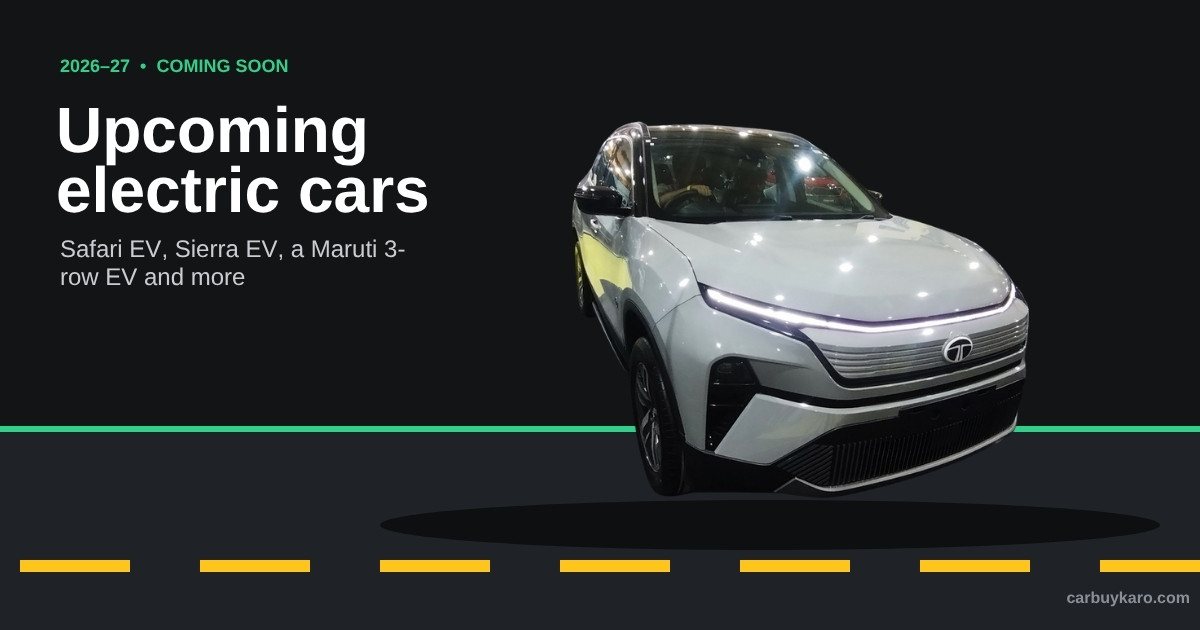
The upcoming electric cars in India over the next 12–18 months are led by Tata’s big electric SUVs: the Safari EV, expected around Diwali 2026 at roughly ₹23–30 lakh, and the Sierra EV, due in late 2026. Also expected are the Volvo EX90 (12 October), an electric sedan to follow the Tigor EV, a compact electric SUV from Hyundai, Maruti Suzuki’s first three-row electric MPV, and in 2027, Tata’s premium Avinya range and new Mahindra EVs.
The trend is clear. EVs in India are getting bigger batteries, more seats and more realistic range figures. Here is what is coming, what each brings and whether you should wait.
Upcoming EVs at a glance
| EV | Type | Expected launch | Expected price | Key detail |
|---|---|---|---|---|
| Volvo EX90 | Luxury 7-seat SUV | 12 Oct 2026 | about ₹1.2 crore | Flagship Volvo EV |
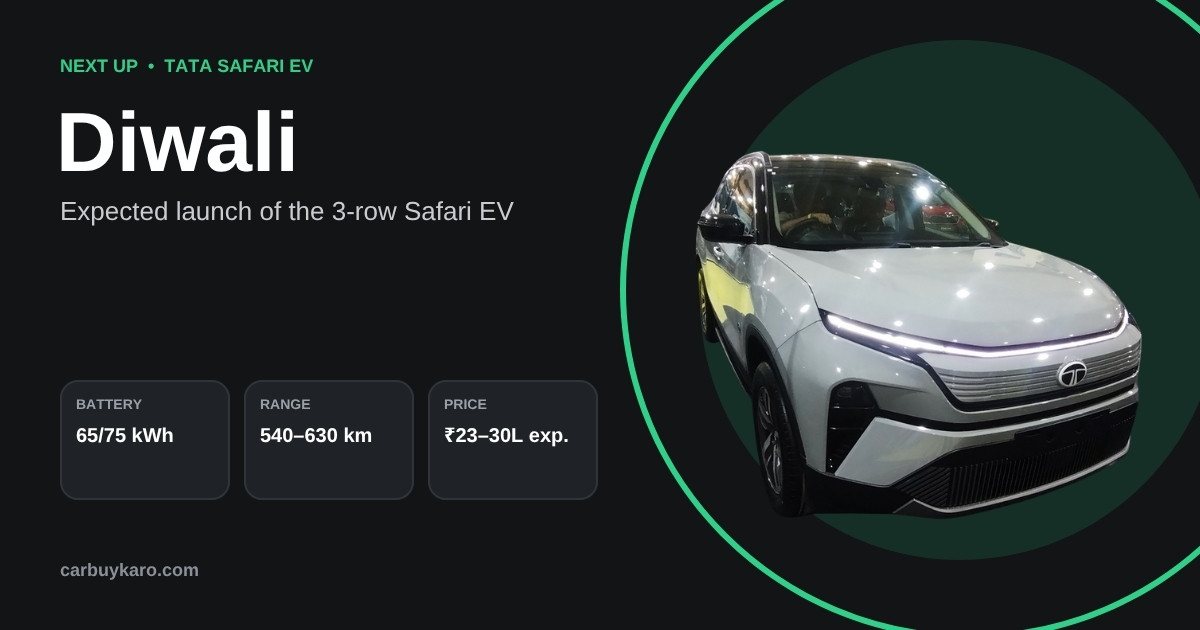
| Tata Safari EV | 7-seat SUV | Around Diwali 2026 | ₹23–30 lakh | 65/75 kWh, ~540–630 km claimed |
| Tata Sierra EV | Midsize SUV | Late 2026 | ₹20 lakh+ | RWD and AWD options |
| Tata compact sedan EV | Sedan | Late 2026 | ₹10–13 lakh | Tigor EV successor |
| Hyundai compact EV | Small SUV | End 2026 | ₹10–14 lakh | India-focused model |
| Maruti Suzuki 3-row EV | MPV | End 2026 / 2027 | ₹20 lakh+ | Maruti’s second EV |
| Tata Avinya range | Premium EVs | 2027 | ₹30 lakh+ | New dedicated EV platform |
| New Mahindra EVs | SUVs | 2027 | varies | Expanding the BE and XEV lines |
Dates and prices are industry estimates as of September 2026.
Tata Safari EV
Tata’s flagship seven-seater is expected to go electric around Diwali 2026. It is likely to share its electric hardware with the Harrier EV, with 65 kWh and 75 kWh battery options and a claimed range of about 540–630 km. It would be one of the first fully electric three-row SUVs from a mainstream Indian brand at this price.
Who should wait: families who need seven seats and want to go electric. Until now, the choice was limited to plug-in hybrids like the MG Hector Tomahawk PHEV or the Tomahawk EV. For a combustion comparison, see our XUV700 vs Safari guide.
Tata Sierra EV
The revived Sierra name returns as a midsize SUV, and its electric version is expected in late 2026 with 55 kWh and 65 kWh batteries, and both rear-wheel-drive and all-wheel-drive versions making around 180–200 bhp.
Who should wait: buyers who want a distinctive midsize EV with AWD capability.
Volvo EX90
Volvo’s flagship EV is a seven-seat luxury SUV expected at around ₹1.2 crore. It focuses on safety, comfort and minimalist Scandinavian design. In states that waive EV road tax, the on-road savings at this price can be substantial.
Who should wait: luxury buyers who want seven seats in an EV.
Tata’s compact sedan EV
The Tigor EV has been a popular electric compact sedan, especially with fleet operators. With the new Tata Aeris replacing the Tigor, an electric version is expected later.
Who should wait: budget buyers and taxi operators who want an affordable electric sedan.
Hyundai’s compact EV
Hyundai is expected to launch an India-focused compact electric SUV by the end of 2026. It would sit below the Creta Electric and target buyers in the ₹10–14 lakh range.
Who should wait: first-time EV buyers on a budget who want a trusted brand.
Maruti Suzuki three-row EV
After its first EV, the e Vitara, Maruti is working on a three-row electric MPV. It is expected towards the end of 2026 or in 2027.
Who should wait: Ertiga and XL6 owners who want to go electric.
2027 and beyond
Tata’s Avinya range will use a new dedicated EV platform and target premium buyers. Mahindra is expanding its BE and XEV electric lines with new body styles. Global brands are also bringing more EVs, including smaller models like the VinFast VF3 and Hyundai Inster. Expect more affordable EVs under ₹10 lakh too.
Buy an EV now or wait?
EV technology has improved quickly. Some buyers keep waiting for the “next” model and never buy. A better approach:
Buy now if:
- A current EV fits your range needs with a buffer of about 30%.
- You can charge at home.
- The current price, with any state road tax waiver, works for you.
Wait if:
- You need a body style not yet available as an EV, such as a seven-seater at a mid-range price.
- A specific launch is less than three months away.
- You are worried about resale and want a newer platform.
For a list of the best EVs you can buy today, see our best electric cars in India.
How much can an EV save?
For a buyer driving 1,500 km a month:
| Energy use | Monthly cost | |
|---|---|---|
| Petrol SUV | 12 km/l at ₹95 | about ₹11,900 |
| Diesel SUV | 15 km/l at ₹90 | about ₹9,000 |
| EV, home charging | 6.5 km/unit at ₹8 | about ₹1,850 |
| EV, public fast charging | 6.5 km/unit at ₹22 | about ₹5,100 |
Home charging makes the biggest difference. Over five years, an EV charged at home could save ₹5–6 lakh in energy costs compared with a petrol SUV. Model your own case with our EV vs petrol calculator, and see city-wise electricity tariffs in our EV charging cost guide.
What to check before choosing any EV
- Real-world range. Expect 70–80% of the claimed MIDC figure in daily use.
- Charging at home. Check your building’s rules and your sanctioned electrical load. Our home charger guide explains the steps.
- Battery warranty. Look for at least eight years and 1.6 lakh km, and check what capacity loss qualifies. Read our EV battery life and warranty guide.
- State incentives. Road tax waivers vary widely by state. See our EV road tax guide.
- Fast-charging network on your regular routes.
- Service network for EV-specific repairs in your city.
EV myths worth clearing up
“EV batteries die in five years.” Modern EV batteries, especially LFP types, are designed to last well beyond 1.5 lakh km with gradual capacity loss. Warranties of eight years are common.
“Charging takes all night, so long trips are impossible.” Home charging does take hours, but it happens while you sleep. On highways, DC fast chargers can add 150–250 km in 20–30 minutes.
“EVs are unsafe in Indian heat.” Batteries have thermal management systems, and LFP chemistry in particular is stable at high temperatures. Sensible habits like parking in shade help battery life.
“Resale is terrible.” Early EVs lost value quickly. Newer EVs with longer ranges and good warranties are holding value much better.
Common mistakes EV buyers make
- Buying more range than you need. A bigger battery costs more and weighs more. Size it for your real use plus a buffer.
- Relying on public charging. Without home charging, the savings shrink sharply.
- Ignoring insurance. EV insurance premiums can be higher because of the battery’s value. Compare quotes.
- Waiting endlessly. There will always be a newer model. Buy when the numbers work for you.
Understanding EV range numbers
Indian EVs are tested on the MIDC cycle, which produces optimistic range figures. The European WLTP cycle is a little more realistic, and some luxury brands quote it instead. Neither reflects a hot afternoon in Indian traffic with the AC on full.
A practical way to estimate real-world range is to take 70–80% of the MIDC figure for mixed driving. For highway runs at 100–110 km/h, take about 65–70%. So an EV rated at 500 km MIDC will realistically cover 350–400 km in mixed use and around 325–350 km on the highway.
Several things reduce range in daily use:
- Speed. Air resistance rises sharply above 90 km/h.
- AC use. In peak summer, the AC can use 10–15% of the energy on short trips.
- Load. A full car with luggage uses more energy, especially on hills.
- Tyre pressure. Under-inflated tyres cost range. Check them every two weeks.
- Driving style. Hard acceleration wastes energy. Smooth driving and regenerative braking recover it.
Charging speeds explained
Charging speed depends on both the charger and the car.
- AC home charging at 3.3 kW adds about 15–20 km of range per hour; a 7.2 kW wallbox adds about 35–45 km per hour; an 11 kW wallbox about 55–65 km per hour, if the car supports it.
- DC fast charging at 30–60 kW adds 100–200 km in 30 minutes. At 100–150 kW, compatible cars can go from 10% to 80% in around 25–35 minutes.
Charging is fastest between about 20% and 80%. Above 80%, the car slows charging to protect the battery. On road trips, several short stops at 20–80% are often quicker than one long stop to 100%.
Which upcoming EV suits which buyer?
- Family of six or seven: Tata Safari EV, or the Maruti three-row EV if you prefer an MPV.
- Midsize SUV with AWD: Tata Sierra EV.
- Budget first EV: Hyundai’s compact EV or the Tata sedan EV.
- Luxury seven-seater: Volvo EX90.
Home charging costs by city
Electricity tariffs vary by state and slab. In many cities, residential rates for the higher slabs fall between ₹6 and ₹10 per unit. Some power companies now offer special EV tariffs or time-of-day rates that are cheaper at night. A typical 40 kWh top-up at ₹8 per unit costs about ₹320, enough for roughly 250 km in a compact EV. That is well under ₹1.5 per km, compared with ₹5–7 per km for a petrol car. Ask your power company whether a separate EV meter or tariff is available in your area.
Summary
The upcoming electric cars in India include the Tata Safari EV and Sierra EV, the Volvo EX90, a Tata compact sedan EV, a Hyundai compact EV and Maruti’s three-row electric MPV, with Tata’s Avinya range and new Mahindra EVs in 2027. EVs are getting bigger batteries and more seats. If a current EV fits your needs and you can charge at home, buying now makes financial sense. Follow our EV and CNG section for launch updates.
Frequently asked questions
Which electric cars are launching in India in late 2026?
Expected launches include the Tata Safari EV around Diwali, the Tata Sierra EV, the Volvo EX90 (12 October), a Tigor-replacement EV from Tata, a compact electric SUV from Hyundai and Maruti Suzuki's three-row electric MPV.
What is the expected price of the Tata Safari EV?
Estimates suggest around ₹23–30 lakh ex-showroom, with 65 kWh and 75 kWh battery options and a claimed range of roughly 540–630 km.
Should I buy an EV now or wait for new models?
If a current EV fits your needs and budget, buying now makes sense; EVs have improved a lot. Wait only if a specific launch offers something you need, like seven seats or a longer range, within the next few months.
Are there affordable EVs coming under 10 lakh?
Yes. Several compact EVs are expected in 2027. Today, the Tata Tiago EV and MG Comet EV already sit under ₹10 lakh ex-showroom.
Prices are ex-showroom unless we say otherwise, and makers change them often. Confirm the latest price, offers and variant details with an authorised dealer before you book.


