On this page 14 sections
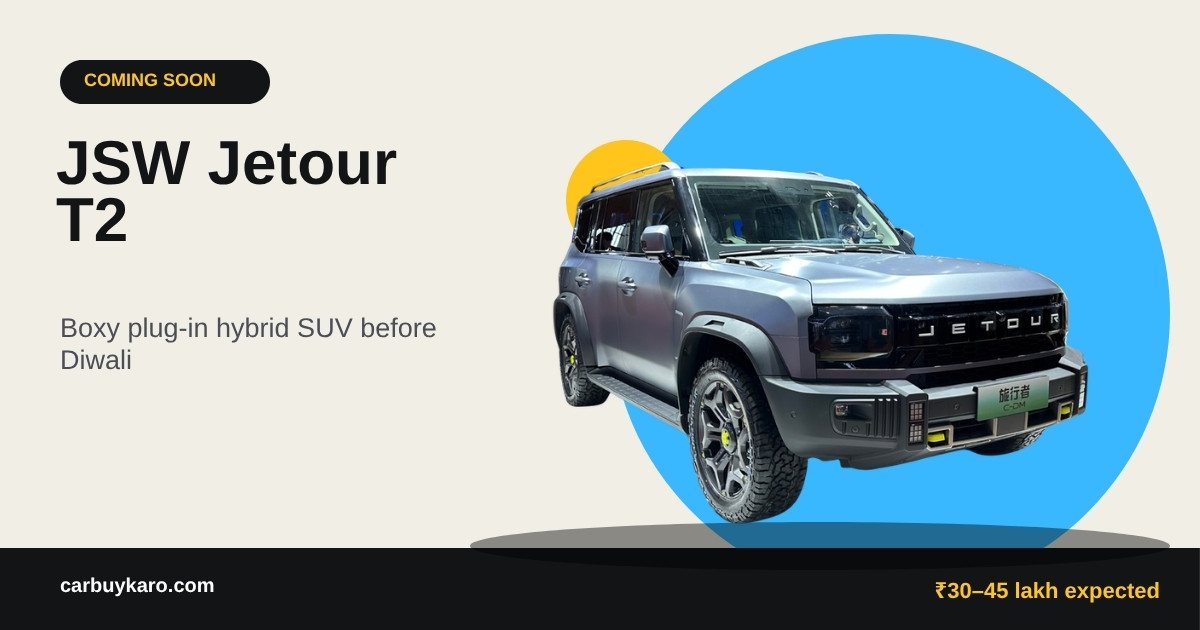
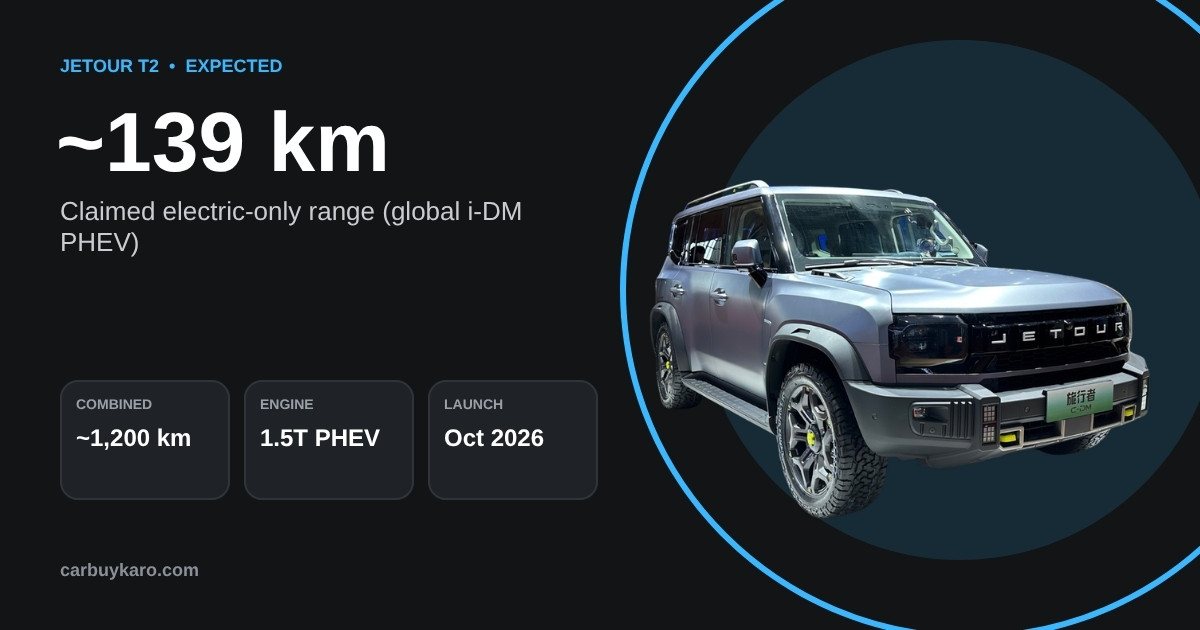
The JSW Jetour T2 India launch is expected before Diwali 2026, with listing sites pointing to late October. It will be the first SUV sold by JSW Motors, the automotive arm of the JSW Group, and is based on the Jetour T2 from China’s Chery group. The India-bound car is expected to use Jetour’s i-DM plug-in hybrid system, which pairs a 1.5-litre turbo-petrol engine with electric motors and a chargeable battery. Globally it claims around 139 km of electric-only range and about 1,200 km combined. Expected prices range widely, from about ₹30 lakh to ₹45 lakh (ex-showroom).
The T2 is a boxy, rugged-looking SUV in the style of the Land Rover Defender, at a far lower price. Here is what we know, how plug-in hybrids work, and who the T2 makes sense for.
JSW Jetour T2 at a glance
| Detail | What we know / expect |
|---|---|
| Brand | JSW Motors (JSW Group), with Chery’s Jetour |
| Body | Large, boxy five-seat SUV |
| Powertrain | 1.5 turbo-petrol plug-in hybrid (i-DM) |
| EV-only range | about 139 km (global claim) |
| Combined range | about 1,200 km (global claim) |
| Expected launch | Before Diwali 2026 |
| Expected price | ₹30–45 lakh (estimates vary) |
Who is JSW Motors?
JSW Group is one of India’s largest conglomerates, with interests in steel, energy, cement and infrastructure. It entered the car business through its joint venture with China’s SAIC, which sells MG cars in India as JSW MG Motor. JSW Motors is a separate venture that will sell cars under its own name, starting with Jetour-based models.
Jetour is a sub-brand of Chery, one of China’s biggest carmakers. Jetour specialises in SUVs, and the T2 has been one of its most popular models globally, thanks to its rugged design and plug-in hybrid option.
For Indian buyers, the key questions about any new brand are service network, spare parts, resale value and long-term support. JSW’s size and its experience with MG help, but a new brand always carries more uncertainty than an established one. We come back to this below.
Design
The T2 is unapologetically boxy: flat bonnet, upright windscreen, square wheel arches, a tailgate-mounted spare wheel on some versions and chunky bumpers. It looks like a serious off-roader. Inside, expect large screens, a modern layout and a long feature list, as is typical of Chinese SUVs in this class.
It is a big vehicle, close to 4.8 metres long in global form. That means a spacious cabin and boot, but also a car that needs planning in tight city lanes and older apartment parking.
How a plug-in hybrid works
A plug-in hybrid (PHEV) sits between a regular hybrid and a full EV.
- Like an EV, it has a battery you charge from a wall socket or charger, and it can drive on electricity alone for a meaningful distance.
- Like a petrol car, it has an engine and fuel tank, so long trips need no charging stops.
- Unlike a regular strong hybrid (such as the Grand Vitara or Hyryder), the battery is much bigger and is meant to be charged from the grid.
In daily use, a PHEV owner who charges at home every night can do most commutes on electricity. On a weekend trip of 500 km, the engine takes over after the battery runs low, and you refuel like a normal car.
The catch: a PHEV that is never charged behaves like a heavy petrol car, because it carries a big battery around without using it. PHEVs only make financial sense if you charge regularly. Our hybrid vs electric car guide explains all the types in detail.
Running cost: charged vs uncharged
Let us compare a T2 PHEV used in two ways by a buyer driving 1,500 km a month, of which 1,100 km is daily commuting and 400 km is a weekend trip.
Owner A charges every night at home.
- Commuting 1,100 km on electricity at roughly 5 km per unit and ₹9 per unit: about ₹2,000.
- Weekend 400 km on petrol at about 12 km/l and ₹100 per litre: about ₹3,300.
- Monthly total: about ₹5,300.
Owner B never charges.
- All 1,500 km on petrol in hybrid mode at about 13 km/l: about ₹11,500.
Same car, more than double the running cost. If you cannot charge at home, a PHEV is the wrong choice. Model your own case with our EV vs petrol calculator.
JSW Jetour T2 vs rivals
| JSW Jetour T2 | MG Hector Tomahawk PHEV | Toyota Fortuner | Mahindra Scorpio-N | |
|---|---|---|---|---|
| Powertrain | 1.5T PHEV | 1.5 PHEV | 2.8 diesel / 2.7 petrol | 2.2 diesel / 2.0 turbo |
| Seats | 5 | 7 | 7 | 7 |
| Style | Boxy, rugged | Family SUV | Classic body-on-frame | Tough, upright |
| Price band | ₹30–45 lakh (exp.) | ₹25.69 lakh | ₹35 lakh+ | ₹14–25 lakh |
The closest direct rival is the MG Hector Tomahawk PHEV, which JSW’s own MG joint venture sells. The Tomahawk is a seven-seat family SUV; the T2 is a five-seat lifestyle SUV with a rugged image. Among combustion SUVs, the Fortuner and Scorpio-N attract buyers who want a tough look, but neither offers the T2’s electric driving.
Should you consider the Jetour T2?
Consider it if:
- You love the boxy, off-roader look but do not need a body-on-frame vehicle.
- You can charge at home and want electric running for daily use.
- You take regular long trips to places without fast chargers, where a full EV would be stressful.
- You are comfortable being an early adopter of a new brand.
Look elsewhere if:
- You need seven seats.
- You cannot charge at home.
- Resale value and long-term service certainty matter most to you.
- You want serious off-road ability with low-range gearing and locking differentials; confirm the Indian T2’s hardware before assuming.
The new-brand question
Buying from a new brand in India comes with specific risks:
- Service network. Initially, dealers and workshops will be concentrated in big cities. Check how far your nearest service centre is.
- Parts availability. Body panels and specific parts may take longer to arrive after an accident. Ask about parts stocking policies.
- Resale value. Used-car buyers are cautious about new brands, so resale is harder to predict. Assume higher depreciation than an established brand for the first few years. Our resale value calculator gives a rough idea.
- Warranty. New brands often offer long warranties to build trust. Ask for battery and hybrid system warranty terms in writing, and check whether the warranty transfers to the next owner.
JSW’s scale and its existing relationship with MG’s dealer network may reduce some of these risks, but they will not disappear overnight.
Home charging for a PHEV
PHEV batteries are smaller than EV batteries, so charging is simpler. A standard 15-amp socket can often fully charge a PHEV overnight, and a 3.3 kW or 7 kW wallbox is faster. Before buying, check:
- Whether your parking spot has a nearby power point.
- Your housing society’s rules on installing chargers.
- Your home’s sanctioned electrical load.
Our home EV charger installation guide walks through the process, and the same steps apply to PHEVs.
Road tax and incentives
State EV policies usually treat pure EVs and hybrids differently. Many states offer road tax waivers for battery electric vehicles only. Some offer smaller concessions for strong hybrids or plug-in hybrids, and some offer none. Uttar Pradesh has at times waived registration charges on strong hybrids, and policies change often. Check your state’s current rules before assuming any saving; our EV road tax guide summarises the main states.
Test drive checklist once it launches
- Drive in EV mode in traffic and note how smoothly the engine starts when the battery runs low.
- Check the claimed electric range on the car’s display after a full charge.
- Test the ride on broken roads. Big, boxy SUVs can be firm.
- Park it in a tight spot to judge its size.
- Ask about service centres, parts and warranty in your city.
- Check the rear seat and boot with your family’s usual luggage.
Common mistakes PHEV buyers make
- Buying without home charging. The single biggest mistake. Without charging, you lose most of the benefit.
- Trusting the combined range figure. 1,200 km is a best-case number with a full battery and full tank.
- Ignoring the petrol engine’s servicing. A PHEV still needs regular engine oil and filter changes.
- Assuming EV tax benefits apply. Many state waivers cover only pure EVs.
PHEV maintenance: what to expect
A plug-in hybrid has two drivetrains, so it needs care for both. The petrol engine still needs oil and filter changes, spark plugs and coolant on schedule, although it runs less often than in a regular car, so wear is lower. The electric side needs very little routine maintenance: the battery and motors are sealed units monitored by software. Brake pads last longer because regenerative braking does much of the slowing.
One quirk to know: if you drive mostly on electricity, the petrol in the tank can sit for months. Many PHEVs automatically run the engine now and then to keep it healthy and to use up old fuel. Follow the maker’s guidance, and do not be surprised if the engine starts on its own occasionally even with charge in the battery.
Summary
The JSW Jetour T2 is expected before Diwali 2026 as JSW Motors’ first SUV: a boxy, rugged-looking plug-in hybrid with a 1.5 turbo-petrol, a claimed 139 km of electric range and a combined range around 1,200 km. Expected prices range from ₹30–45 lakh. It suits buyers who can charge at home, love the look and are comfortable with a new brand. See our list of upcoming cars in October 2026 for other launches this festive season.
Frequently asked questions
When will the JSW Jetour T2 launch in India?
JSW Motors plans to launch the Jetour T2 before Diwali 2026, with listing sites pointing to late October.
What is the expected price of the Jetour T2?
Estimates vary widely. Most listing sites suggest ₹30–45 lakh ex-showroom, while other reports mention figures around ₹38–40 lakh. JSW will confirm at launch.
Is the Jetour T2 an EV?
No. It is a plug-in hybrid (PHEV). It combines a 1.5-litre turbo-petrol engine with electric motors and a battery you can charge from a socket. It can run on electricity alone for short distances and use petrol for longer trips.
What is the range of the Jetour T2?
The global i-DM plug-in hybrid version claims around 139 km of electric-only range and a combined range of about 1,200 km with a full battery and full tank. Indian test-cycle figures may differ.
Prices are ex-showroom unless we say otherwise, and makers change them often. Confirm the latest price, offers and variant details with an authorised dealer before you book.


