On this page 16 sections
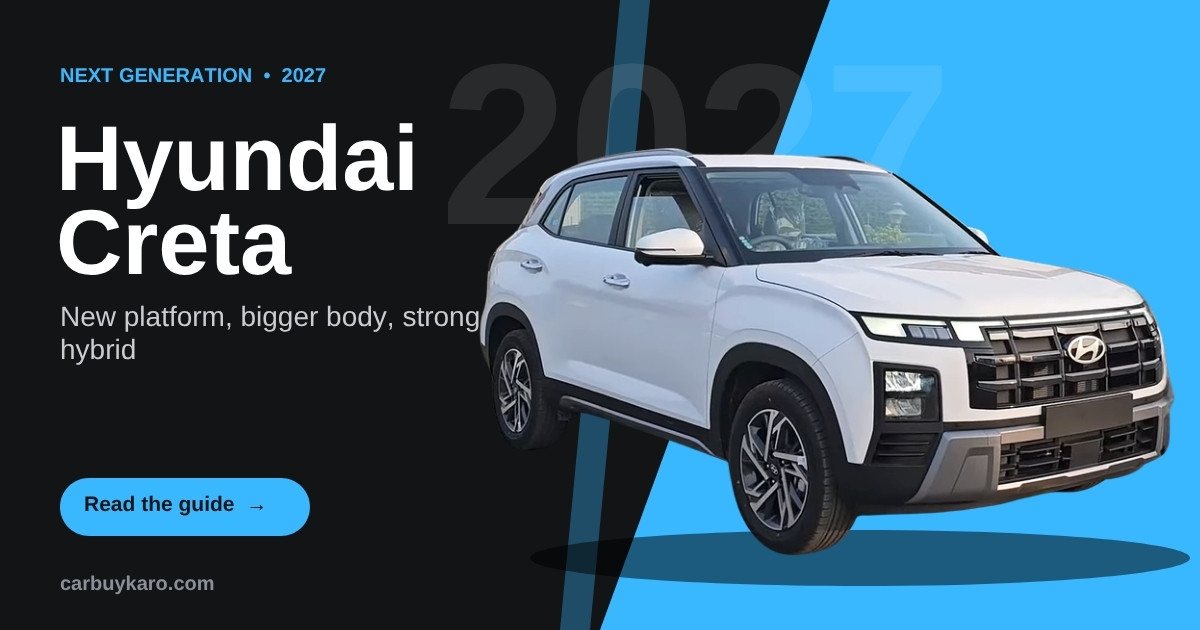
The next-gen Hyundai Creta is expected to launch in India in the first half of 2027. Hyundai has confirmed it, and test vehicles are already on Indian roads. The third-generation Creta moves to a newer platform (reported as K3), grows in size with a boxier, more upright look, and adds a petrol-hybrid option to a line-up of two petrol engines and a diesel. Expected prices are around ₹11–21.5 lakh (ex-showroom).
The Creta has been India’s best-selling midsize SUV for most of the past decade. A new generation is a big deal for the segment, and for anyone shopping for a Creta right now. This guide covers what we know, what to expect and whether you should wait.
What we know so far
| Detail | Status |
|---|---|
| India launch | Confirmed by Hyundai |
| Timing | First half of 2027 (expected) |
| Platform | New platform (reported as K3) |
| Engines | Two petrol, one diesel, one petrol hybrid |
| Size | Larger, boxier than current Creta |
| Expected price | ₹11–21.5 lakh |
Design: bigger and boxier
Camouflaged test mules show a more upright, squared-off shape. That follows a global trend and Indian buyers’ preference for SUVs that look like SUVs. A boxier body usually brings more headroom, a more upright rear seat and a squarer boot opening.
Expect entirely new styling front and rear, new lighting, redesigned bumpers, new alloy wheels and redesigned mirrors. Hyundai’s recent design language, seen on newer global models, uses bold horizontal lighting and clean surfaces.
Engines: four choices
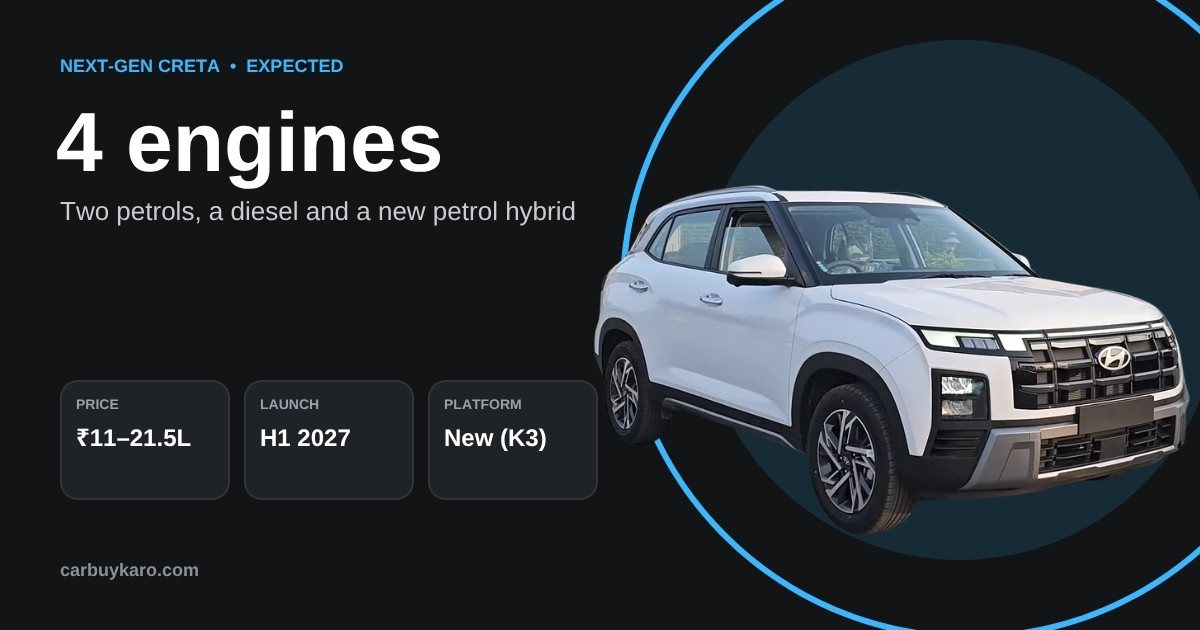
Reports point to four engine options:
- 1.5-litre naturally aspirated petrol (as today, about 115 PS). The volume engine, with manual and CVT.
- 1.5-litre turbo-petrol (as today, about 160 PS). For enthusiasts, likely with a DCT.
- 1.5-litre diesel (as today, about 116 PS). Still in demand for high-mileage buyers outside Delhi-NCR.
- Petrol strong hybrid. New. Likely built around the 1.5 NA petrol with two electric motors and a small battery.
The hybrid is the big story. It will take on the Maruti Grand Vitara and Toyota Hyryder hybrids, which have shown that Indian buyers will pay extra for 20+ km/l real-world economy in a midsize SUV. The Kia Seltos is expected to get a similar hybrid, since the two cars share much of their engineering.
Interior and features
Expect a completely new cabin:
- New dashboard with a curved screen setup combining instrument cluster and infotainment.
- New front seats, including a “boss mode” to move the front passenger seat forward from the rear, useful for chauffeur-driven owners.
- Fresh upholstery and materials.
- Updated Level 2 ADAS.
- The usual Hyundai feature list: panoramic sunroof, ventilated seats, 360-degree camera, premium audio and connected-car technology.
Expected rivals
When it arrives, the new Creta will compete with the Kia Seltos (and its hybrid), Maruti Grand Vitara, Toyota Hyryder, Honda Elevate, Tata Sierra, Mahindra’s midsize SUVs, Nissan Tekton, Skoda Kushaq and Volkswagen Taigun. That is the most crowded segment in India.
For the current generation’s head-to-head, read our Creta vs Seltos comparison.
Should you wait for the new Creta or buy now?
This is the question most readers ask. The answer depends on your timeline and what you value.
Buy the current Creta now if:
- You need a car in the next six months.
- You want a proven model with a long track record. First-year production of any all-new car can have teething issues.
- You can get a good discount. As the new generation approaches, dealers usually offer bigger deals on the outgoing model.
- You plan to keep the car for eight years or more, so resale timing matters less.
Wait for the new Creta if:
- You want the hybrid for low running costs.
- You sell cars every three to four years. An outgoing model loses value faster once the new one is out.
- You want the latest design and features.
- You can comfortably wait until mid-2027 or later.
A middle path: book a test drive of the Grand Vitara or Hyryder hybrid now. If you like how a strong hybrid drives, you will know whether the Creta hybrid is worth waiting for, or whether one of those is the better buy today. Our hybrid vs electric car guide explains how strong hybrids work.
How much could the hybrid save?
For a buyer driving 1,500 km a month in city traffic:
| Real-world economy | Monthly fuel cost | |
|---|---|---|
| 1.5 NA petrol CVT | 12 km/l | about ₹11,900 (petrol ₹95) |
| 1.5 diesel AT | 15 km/l | about ₹9,000 (diesel ₹90) |
| Strong hybrid (estimated) | 20 km/l | about ₹7,100 (petrol ₹95) |
A hybrid saving of around ₹4,800 a month over the NA petrol adds up to about ₹2.9 lakh over five years. If the hybrid carries a premium of ₹2–2.5 lakh, it pays for itself inside five years and then keeps saving. Use our fuel cost calculator to model your usage.
Resale value and the generation change
Midsize SUVs from popular brands hold value well in India, and the Creta has been among the best. But generation changes do affect resale. When a new model launches, the outgoing car’s used-market value typically drops a little, because buyers of nearly new used cars prefer the latest design.
If you buy a current Creta in late 2026, expect its resale in 2029–2030 to be slightly lower than a new-generation Creta bought in 2027 would be at the same age. For buyers who keep cars for a long time, this matters little. For those who upgrade every three years, it is a real cost. Our car resale value tips cover how to protect your car’s value whatever you buy.
Worked example: EMI on a new-gen Creta hybrid
Assume the hybrid costs about ₹19 lakh ex-showroom and ₹22.5 lakh on-road in Hyderabad.
- Down payment: ₹5 lakh.
- Loan: ₹17.5 lakh at 9% for five years.
- EMI: about ₹36,300 a month.
- Fuel at 1,500 km a month, 20 km/l: about ₹7,500 a month (petrol at ₹100).
Total: roughly ₹43,800 a month before insurance and service. Model other loan amounts in our car EMI calculator.
Things to watch as launch approaches
- Official specs and dimensions, especially rear legroom and boot space.
- Hybrid pricing. How big the premium is will decide whether it makes sense for average users.
- Bharat NCAP rating. Hyundai will likely aim for a strong result.
- Variant structure. Which features are limited to top trims.
- Waiting periods. New Cretas have historically had long waits in the first months.
Common mistakes Creta buyers make
- Buying the top trim for features you won’t use. Mid trims of the Creta are well equipped. Our guide to choosing a car variant helps you decide.
- Choosing diesel in Delhi-NCR. The 10-year diesel rule cuts resale sharply there.
- Ignoring the turbo’s fuel cost. The turbo-petrol is fun but thirstier, especially in traffic.
- Not comparing the Seltos. It shares a lot with the Creta, and often offers different features or pricing that suit some buyers better.
What about the current Creta’s reliability?
The second-generation Creta and its 2024 facelift have a good reliability record in India. The 1.5 NA petrol with CVT and the 1.5 diesel are the most proven combinations. The turbo-petrol with DCT has fewer complaints than early DCTs from some brands, but drivers in heavy traffic should still test it carefully. Hyundai’s service network is extensive, and parts are easy to find.
That track record is why the current Creta remains a safe buy right up until the new generation arrives.
Current Creta: which version is the best buy today?
If you decide not to wait, here is how we would pick a current Creta.
- City driving, under 1,200 km a month: the 1.5 NA petrol with the CVT. It is smooth, reliable and the easiest to live with in traffic.
- Highway-heavy use or 2,000 km a month outside Delhi-NCR: the 1.5 diesel automatic. It has strong mid-range torque and returns the best real-world economy of the current engines.
- Enthusiasts: the 1.5 turbo-petrol with the DCT. It is quick and fun, but costs more to buy and run.
Mid-level trims offer the best balance of price and features. The top trims add ADAS, ventilated seats and premium audio, which are nice but add a lot to the price.
How the Creta’s price has moved over the years
The first-generation Creta launched in 2015 at under ₹9 lakh for the base petrol. Today’s Creta starts around ₹11 lakh and tops out above ₹20 lakh. Some of that rise is inflation and some is regulation: six airbags, stricter emission norms and newer safety rules have added real cost to every car. The next generation will likely continue that trend, especially for the hybrid, which carries a battery, motors and power electronics. Expect the entry price to rise modestly and the top trims to climb more.
Booking tips for an all-new model
When the new Creta launches, demand will be high. Book early with one dealer if you are sure, confirm the refund terms in writing, and ask for an estimated delivery month for your exact variant and colour. Avoid paying extra “priority” charges that some dealers ask for during high demand; they are not official and you can report them to the manufacturer.
Summary
The next-gen Hyundai Creta is expected in the first half of 2027 on a new platform, with a bigger, boxier body, a new interior and four engine choices including a petrol strong hybrid. Expected prices are ₹11–21.5 lakh. Buy the current Creta if you need a car soon and can get a good deal; wait if you want the hybrid or change cars often. For other options at this budget, see our best SUVs under ₹15 lakh.
Frequently asked questions
When will the next-gen Hyundai Creta launch in India?
Hyundai has confirmed the next-generation Creta for India. The launch is expected in the first half of 2027, with testing already under way.
Will the new Creta have a hybrid?
Yes. Reports indicate a petrol-hybrid option alongside two petrol engines and a diesel, likely built around the existing 1.5-litre naturally aspirated petrol with electric motors and a small battery.
Should I buy the current Creta or wait for the new one?
If you need a car within the next few months, the current Creta is still a strong, proven choice. If you want the hybrid or can wait until mid-2027, waiting gets you a newer design that will hold its value longer.
Will the new Creta be bigger?
Test vehicles suggest the new Creta grows in size and adopts a more upright, boxier shape, which should improve cabin space.
Prices are ex-showroom unless we say otherwise, and makers change them often. Confirm the latest price, offers and variant details with an authorised dealer before you book.


