On this page 15 sections
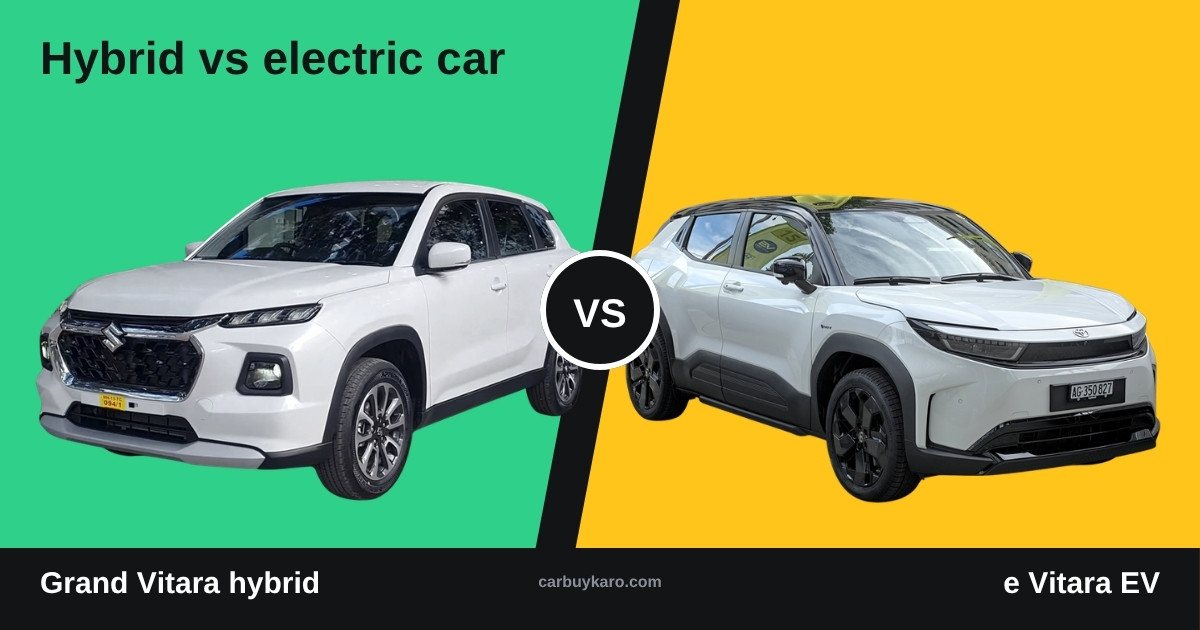
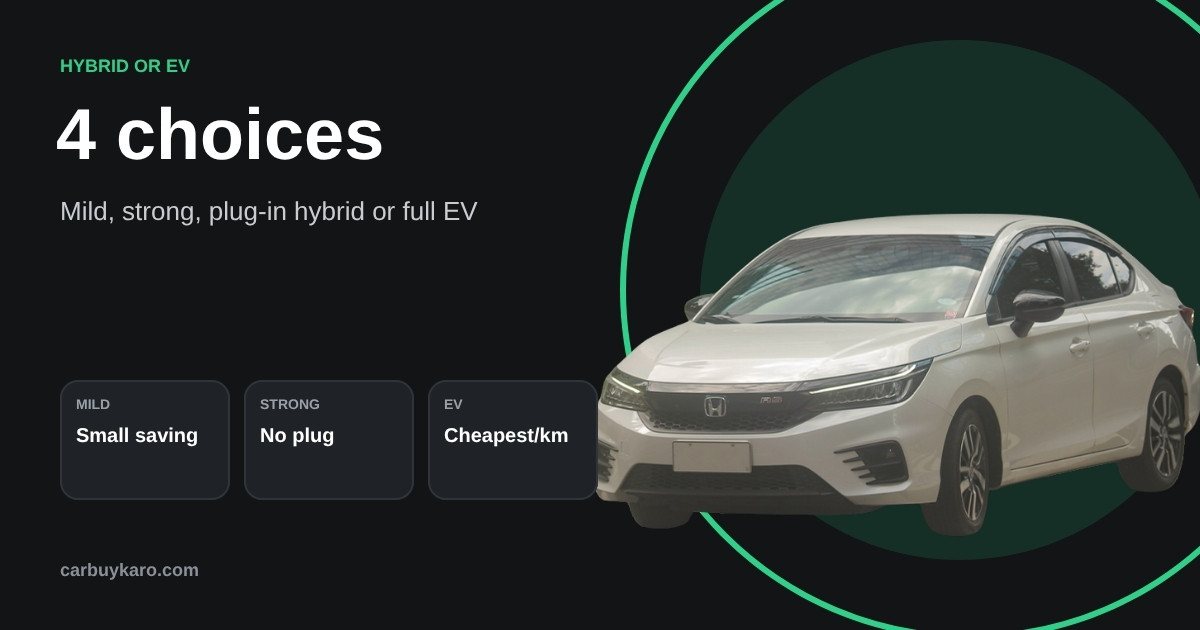
The hybrid vs electric car decision depends mostly on one question: can you charge at home? If you can, and your daily driving fits comfortably within an EV’s range, a full electric car is the cheapest to run, at about ₹1–1.5 per km. If you cannot charge at home, or you often drive long distances to places with few chargers, a strong hybrid is the better choice: it never needs plugging in and can cut fuel use in city traffic by 30–40%. Plug-in hybrids suit people who can charge at home but want a petrol backup for long trips. Mild hybrids offer only a small efficiency gain.
Here is how each type works and who it suits.
The four types, explained simply
Mild hybrid (MHEV)
A mild hybrid adds a small battery and a starter-generator to a normal petrol engine. It switches the engine off at stops and restarts it smoothly, recovers a little energy when you slow down, and gives a small boost when accelerating. It cannot drive the car on electricity alone.
Fuel saving: small, typically a few percent in city traffic.
Examples: the Maruti Brezza and Ertiga use mild-hybrid systems, and the BMW 740i combines one with its six-cylinder. See our Nexon vs Brezza comparison for how this plays out.
Strong hybrid (HEV)
A strong hybrid has a larger battery and one or more electric motors. At low speeds, in traffic and when pulling away, it can drive on electric power alone, with the engine off. The battery is charged by the engine and by regenerative braking. You never plug it in.
Fuel saving: large in city traffic, often 30–40% versus a similar petrol car. Smaller on steady highway runs.
Examples: Maruti Grand Vitara, Toyota Hyryder, Toyota Innova Hycross, Honda City e:HEV and Kia Sorento hybrid. See our Kia Sorento guide and City vs Verna comparison.
Plug-in hybrid (PHEV)
A plug-in hybrid has a much bigger battery that you charge from a socket, plus a petrol engine. It can drive a meaningful distance on electricity alone, often 50–140 km, and then switches to hybrid mode with the engine.
Fuel saving: very large if you charge daily and your commute fits within the electric range. Poor if you never charge.
Examples: the MG Hector Tomahawk PHEV and the upcoming JSW Jetour T2. See our Tomahawk guide and Jetour T2 guide.
Full electric (BEV / EV)
An EV runs entirely on a battery charged from the grid. There is no engine.
Running cost: lowest of all, about ₹1–1.5 per km with home charging.
Examples: Tata Nexon EV and Punch EV, MG Windsor EV, Hyundai Creta Electric, Maruti e Vitara, Mahindra BE 6. See our best electric cars in India.
Side-by-side comparison
| Mild hybrid | Strong hybrid | Plug-in hybrid | EV | |
|---|---|---|---|---|
| Needs charging | No | No | Yes, for full benefit | Yes |
| Electric-only driving | No | Short, low speed | 50–140 km typical | Always |
| City fuel saving vs petrol | Small | Large | Very large if charged | Largest |
| Price premium | Small | Medium–high | High | High |
| Long trips | Easy | Easy | Easy | Needs planning |
Running cost comparison
For a driver covering 1,500 km a month, mostly in the city, with petrol at ₹95 and home electricity at ₹8 per unit:
| Type | Example efficiency | Monthly cost |
|---|---|---|
| Petrol midsize SUV | 12 km/l | about ₹11,900 |
| Mild hybrid SUV | 13 km/l | about ₹11,000 |
| Strong hybrid SUV | 20 km/l | about ₹7,100 |
| Plug-in hybrid, charged daily (1,100 km electric) | mixed | about ₹4,000–5,000 |
| EV, home charging | 6.5 km/unit | about ₹1,850 |
The EV saves the most, but only with home charging. The strong hybrid saves a lot with zero change to how you refuel. Model your own situation with our EV vs petrol calculator.
Purchase price and taxes
- GST: EVs attract 5% GST. Hybrids fall under the normal car rates (18% or 40% depending on size and engine). Our GST on cars guide explains the structure.
- Road tax: many states reduce or waive road tax for EVs. A few states offer concessions for strong hybrids; rules change often. Check our EV road tax by state guide.
- Premium: strong hybrids typically cost ₹1.5–3 lakh more than equivalent petrol versions; EVs often more, although tax benefits narrow the gap.
Which one should you choose?
Choose an EV if:
- You can charge at home or at work every day.
- Your daily driving is predictable and within the car’s real range with a buffer.
- Your regular long trips are on routes with fast chargers.
- Your state offers EV road tax benefits.
Choose a strong hybrid if:
- You cannot charge at home.
- You drive a lot in city traffic.
- You often drive long distances to places with few chargers.
- You want low running costs without changing your habits.
Choose a plug-in hybrid if:
- You can charge at home, your commute fits within the electric range, but you take frequent long trips where charging is scarce.
A mild hybrid is fine if:
- You simply want a petrol car and appreciate a small efficiency boost and smoother start-stop.
Reliability and maintenance
Strong hybrids from Toyota and Honda have long, proven track records globally. Their batteries are designed to last the life of the car in normal use, and brake pads last longer thanks to regenerative braking.
EVs have far fewer moving parts: no engine oil, spark plugs, clutch or exhaust. Service costs are usually lower. Battery warranties are typically eight years; see our EV battery life and warranty guide.
PHEVs have both an engine and a large battery, so they need maintenance for both, but the engine often runs less.
Resale value
Strong hybrids from Toyota and Maruti hold value very well in India, helped by strong demand. EV resale is improving as ranges grow and warranties lengthen. PHEVs are new in India, so resale is less predictable. Mild hybrids resell like normal petrol cars.
Worked example: a Bengaluru commuter
A commuter drives 50 km a day in heavy traffic plus occasional weekend trips, about 1,400 km a month, and lives in an apartment with a parking spot.
- If the society allows a charger: an EV costs about ₹1,700 a month to run. Over five years, the saving versus petrol is around ₹5–6 lakh.
- If charging is impossible: a strong hybrid costs about ₹6,700 a month, saving around ₹2.5–3 lakh over five years versus petrol, with no charging hassle.
Both are good choices; the charging situation decides.
Common mistakes
- Buying a PHEV and never charging it. You carry a heavy battery for nothing.
- Expecting mild hybrids to deliver strong-hybrid savings. They do not.
- Buying an EV without solving home charging first. Public fast charging costs three times more.
- Ignoring state tax rules, which can swing the on-road price by lakhs.
How a strong hybrid feels to drive
People who drive a strong hybrid for the first time are often surprised. Pulling away from a signal is silent, with the car moving on electric power. In slow traffic, the engine switches on and off by itself, usually so smoothly that you only notice it on the display. On the highway, the engine runs most of the time and the car feels like a normal petrol car, just more efficient.
Braking feels slightly different too, because the motor recovers energy. After a few days, most drivers stop noticing. The overall effect is a calm, quiet car that uses remarkably little fuel in city conditions.
How an EV feels to drive
EVs deliver instant torque, so they feel quick off the line even in affordable models. There are no gear changes, and the cabin is quiet at city speeds. Most EVs offer adjustable regenerative braking; at the strongest setting, you can drive in traffic mostly with one pedal, lifting off the accelerator to slow down.
The main new habit is charging: plugging in at home in the evening becomes as routine as charging a phone.
Which type suits which city?
- Metro cities with heavy traffic (Mumbai, Bengaluru, Delhi, Pune): EVs and strong hybrids both excel. Choose based on home charging.
- Smaller cities with lighter traffic and longer distances: strong hybrids and efficient petrol or CNG cars make sense; EVs suit those with home charging and predictable routes.
- Hill regions: EVs recover energy on descents; strong hybrids help too. Check range carefully for long climbs.
- Highway-heavy users: diesel or strong hybrids, or EVs on routes with good fast charging.
Hybrid and EV myths
- “Hybrids need special fuel.” No, they use regular petrol.
- “You must plug in a strong hybrid.” No, only plug-in hybrids need charging.
- “EVs cannot handle Indian heat.” Modern EVs have thermal management; many are sold in the hottest parts of the country.
- “Hybrid batteries are expensive to replace every few years.” Hybrid batteries are designed to last many years and are covered by long warranties.
- “EVs are only for cities.” With fast chargers on major highways, intercity trips are practical with some planning.
The bottom line in one sentence
If you can plug in at home, go electric; if you cannot, go strong hybrid; and if you want a bit of both, a plug-in hybrid can work as long as you charge it every day.
Summary
In the hybrid vs electric car decision, home charging is the deciding factor. With home charging and predictable driving, an EV is cheapest to run. Without it, a strong hybrid gives big city savings with no plug. Plug-in hybrids suit home chargers who travel far, and mild hybrids add only a small gain. For more help, see our EV and CNG section.
Frequently asked questions
Which is better, hybrid or electric car?
An electric car is cheapest to run if you can charge at home and your daily driving fits its range. A strong hybrid is better if you cannot charge at home or often drive long distances to places with few chargers.
Do hybrid cars need charging?
Mild and strong hybrids do not need to be plugged in; they charge themselves through braking and the engine. Plug-in hybrids (PHEVs) have larger batteries and should be charged from a socket to get their full benefit.
What is the difference between mild and strong hybrid?
A mild hybrid uses a small battery and motor to assist the engine and enable start-stop; it cannot drive on electric power alone. A strong hybrid has a bigger battery and motor and can drive on electricity at low speeds, which saves much more fuel in city traffic.
Which strong hybrid cars are available in India?
Examples include the Maruti Grand Vitara, Toyota Hyryder, Toyota Innova Hycross, Honda City e:HEV and the Kia Sorento hybrid.
Prices are ex-showroom unless we say otherwise, and makers change them often. Confirm the latest price, offers and variant details with an authorised dealer before you book.


