On this page 18 sections
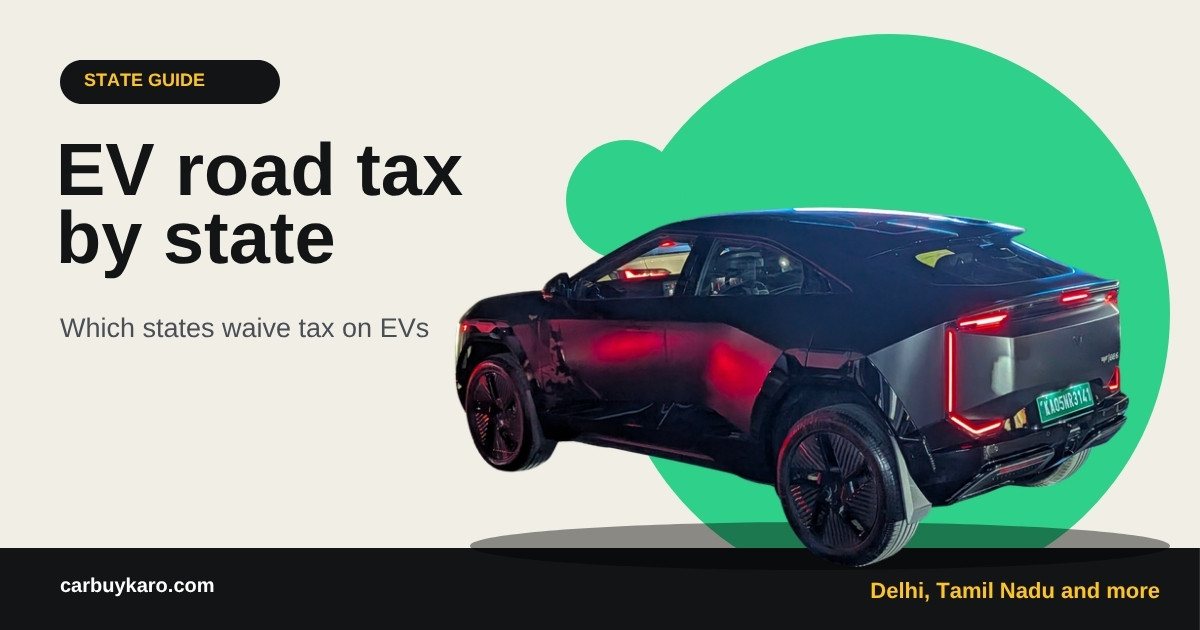
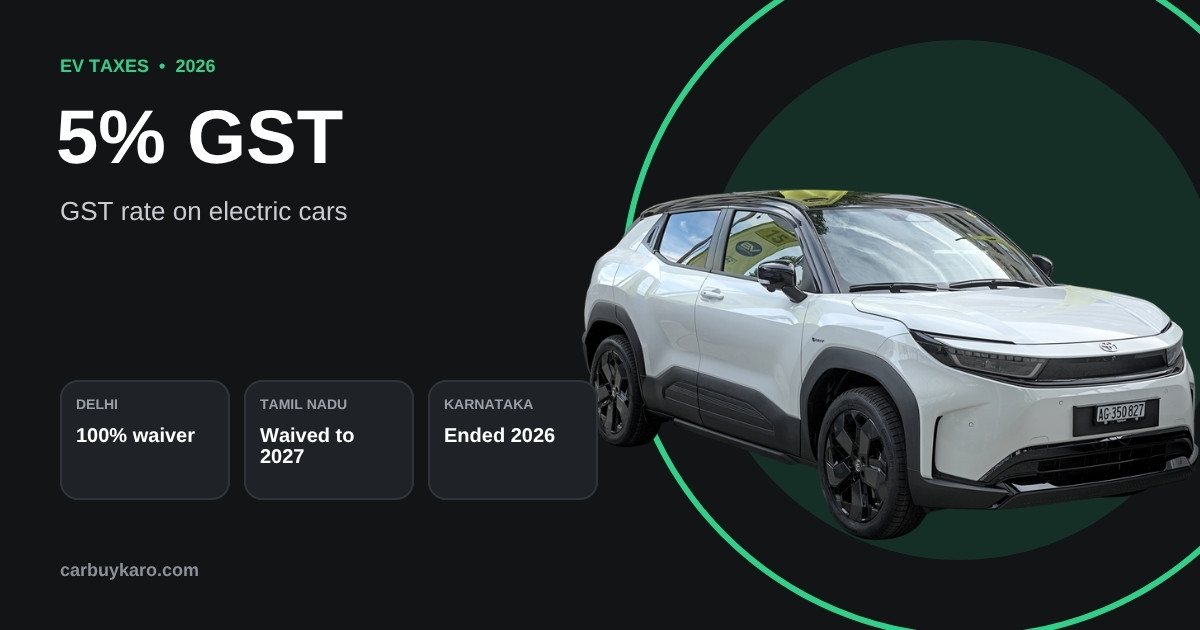
EV road tax and subsidy by state vary so much in India that the same electric car can cost ₹1.5–3.5 lakh more on-road in one state than in another. In 2026, Delhi waives road tax and registration fees on EVs priced up to ₹30 lakh (ex-showroom) until March 2030. Tamil Nadu offers a 100% road tax exemption until 31 December 2027. Karnataka ended its EV road tax exemption in 2026 and now charges 5–10% depending on price. Many other states still offer full or partial waivers. At the national level, EVs attract only 5% GST, but the PM E-DRIVE scheme does not subsidise private electric cars.
Here is how EV incentives work and where the main states stand.
Central incentives
GST at 5%
Electric cars attract 5% GST, far lower than the 18% on small petrol and diesel cars and 40% on larger ones under the structure effective from 22 September 2025. This lower tax is built into the ex-showroom price. Our GST on cars guide explains the full structure.
PM E-DRIVE: not for private cars
The PM E-DRIVE scheme, launched in October 2024, supports electric two-wheelers, three-wheelers, e-buses, e-trucks, e-ambulances and charging infrastructure. It does not offer purchase subsidies for private electric cars. The earlier FAME schemes had also largely shifted away from private cars.
Income tax benefit
Section 80EEB previously allowed a deduction on interest paid on loans for EVs sanctioned within a specific window. That window has closed for new loans, so check with a tax adviser whether any benefit applies to you.
State incentives: the big variable
States control road tax and registration fees, and most EV incentives come from them. Typical incentives include:
- Road tax exemption (full or partial).
- Registration fee waiver.
- Purchase incentives in some states, sometimes capped per vehicle or limited to early buyers.
- Scrappage or trade-in incentives when replacing an old petrol or diesel vehicle.
Key states in 2026
| State / UT | EV road tax status (2026) | Notes |
|---|---|---|
| Delhi | 100% road tax and registration waiver for EVs up to ₹30 lakh | Valid until 31 March 2030 under the 2026 EV policy |
| Tamil Nadu | 100% exemption | Valid from 1 January 2026 to 31 December 2027 |
| Maharashtra | Road tax exemption for EVs under state EV policy | Policy runs to 2030; check current terms |
| Karnataka | Exemption ended in 2026 | 5% up to ₹10 lakh, 8% for ₹10–25 lakh, 10% above ₹25 lakh |
| Uttar Pradesh | Among states offering 100% road tax exemption | Check eligibility window |
| Gujarat | Strong EV incentives historically | Check current terms |
Policies change frequently, sometimes mid-year. Always confirm with your local RTO or the state transport department website before buying.
How much does the exemption save?
Road tax on cars is usually a percentage of the ex-showroom price. For a ₹20 lakh car, road tax in many states is 10–15%, so ₹2–3 lakh. A full EV exemption saves that entire amount.
Example: a ₹20 lakh ex-showroom EV in Delhi (full waiver) versus the same EV in Karnataka (8% tax for ₹10–25 lakh).
- Delhi road tax: ₹0.
- Karnataka road tax: about ₹1.6 lakh.
- Difference: about ₹1.6 lakh on-road, before insurance and other charges.
Use our on-road price calculator to compare states, and see our road tax by state guide for petrol and diesel rates.
Registering an EV in another state
Some buyers consider registering an EV in a state with better incentives. Be careful: you generally must register a vehicle in the state where you live, with valid address proof. Registering elsewhere to avoid tax can create legal and insurance problems. If you move states later, you may need to re-register and pay the difference. For people who move often for work, the BH series registration is worth understanding; see our BH series number plate guide.
Hybrids and state incentives
Most state EV policies cover only battery electric vehicles. Strong hybrids and plug-in hybrids usually pay normal road tax, though a few states have offered concessions for strong hybrids at times. Check before assuming any saving. Our hybrid vs electric car guide explains the differences.
Other EV benefits
Beyond tax, EV owners in some cities get:
- Green number plates that may qualify for parking concessions in some places.
- Lower permit fees for commercial EVs.
- Special electricity tariffs for EV charging from some power companies. See our EV charging cost guide.
How incentives affect your decision
State incentives can tip the balance between an EV and a petrol car. In Delhi or Tamil Nadu, where the road tax waiver is generous, an EV’s on-road price can be close to an equivalent petrol car’s, and running costs are far lower. In a state without exemptions, the upfront gap is bigger, so the payback takes longer.
A quick way to decide:
- Get on-road quotes for the EV and a comparable petrol car in your city.
- Estimate monthly running costs for each with our EV vs petrol calculator.
- Divide the on-road price difference by the monthly saving to get the payback period.
If payback is under five years and you can charge at home, the EV is usually the smarter buy.
Worked example: Chennai buyer, 2026
A buyer in Chennai compares a compact EV at ₹15 lakh ex-showroom and a petrol compact SUV at ₹12 lakh.
- EV road tax in Tamil Nadu: exempt until end-2027.
- Petrol road tax: roughly 10–15% of ₹12 lakh, about ₹1.2–1.8 lakh.
- On-road gap shrinks from ₹3 lakh to around ₹1.5 lakh.
- Monthly running cost saving at 1,500 km: around ₹8,000.
- Payback: under two years.
This is why buying before an exemption expires can make a big difference.
Common mistakes
- Relying on old information. EV policies change often; check the current rules.
- Assuming hybrids get EV benefits. Usually they do not.
- Registering in another state to save tax. It can cause legal and insurance problems.
- Ignoring exemption deadlines. Buying just after an exemption ends can cost lakhs.
How to check your state’s current EV rules
Because EV policies change often, the most reliable approach is to check official sources before buying:
- State transport department website. Most publish road tax rates and EV exemptions, sometimes as a notification or circular.
- Your local RTO. A phone call or visit can confirm current rates and any exemption deadlines.
- The Parivahan portal. Useful for registration fees and procedures.
- Your dealer’s on-road quote. Ask for an itemised quote and check that the road tax line matches the official rate.
When a state announces the end of an exemption, dealers often see a rush of registrations before the deadline. If an exemption is due to expire, confirm whether the benefit depends on the invoice date, the registration date or the delivery date.
A note on older EV policies
Several states introduced EV policies around 2020–2022 with generous incentives for early buyers. Many had fixed end dates or caps on the number of vehicles that could claim benefits. Some have since been extended, revised or replaced. Articles and videos from a few years ago may describe incentives that no longer exist, so always rely on current official information.
Commercial vs private EVs
Most state policies treat commercial EVs, such as taxis and delivery vans, differently from private cars. Commercial EVs often get stronger incentives, including permit fee waivers. If you plan to use an EV for ride-hailing or a business, check the commercial incentives, which can be more valuable than the private ones.
Scrappage benefits
Some states offer additional road tax concessions if you scrap an old vehicle through an authorised scrapping facility and buy a new one, including an EV. Keep the certificate of deposit from the scrapping facility, as you will need it to claim the benefit.
Other states at a glance
Beyond the states in the table, many others offer some EV benefit, ranging from full road tax exemption to partial concessions or registration fee waivers. States including Telangana, Kerala, Rajasthan, Punjab, Haryana, West Bengal and Madhya Pradesh have introduced EV policies at various points, with different durations and caps. Because these change, the safest approach is to check the current rules with your RTO before buying. If your state’s benefit is about to expire, time your purchase and registration accordingly.
Insurance for EVs registered under exemptions
A road tax exemption does not affect your insurance. You still need valid comprehensive or third-party insurance from day one. EV insurance premiums are linked to the insured value, so ask for quotes that include battery and charger cover. Our zero depreciation insurance guide explains the add-ons worth considering.
Quick checklist before you buy an EV
- Confirm your state’s current road tax rule for EVs and any expiry date.
- Ask the dealer for an itemised on-road quote showing road tax and registration.
- Check whether registration fees are also waived.
- Ask about any state purchase incentive and how it is paid (at the dealer or later).
- Check whether a scrappage benefit applies if you are replacing an old car.
- Compare the on-road price with an equivalent petrol car and work out the payback period.
Keep a copy of every document, because you may need them at resale.
Summary
EV road tax and subsidy by state vary widely in 2026. Delhi and Tamil Nadu offer full road tax exemption, Maharashtra and several others provide strong incentives, and Karnataka has ended its exemption. Nationally, EVs benefit from 5% GST, but PM E-DRIVE does not subsidise private cars. Check your state’s current rules, compare on-road prices and work out the payback before you buy. For EV recommendations, see our best electric cars in India.
Frequently asked questions
Which states give road tax exemption on electric cars in 2026?
Several states and UTs still offer full road tax exemption on EVs. Delhi waives road tax and registration for EVs up to ₹30 lakh ex-showroom until March 2030, and Tamil Nadu offers a 100% exemption until 31 December 2027. Karnataka ended its exemption in 2026. Rules change often, so check your RTO.
Is there a central subsidy on electric cars in India?
No. The PM E-DRIVE scheme supports electric two-wheelers, three-wheelers, buses, trucks and charging infrastructure, not private electric cars. EVs do benefit from a lower 5% GST rate.
How much GST is charged on electric cars?
Electric cars attract 5% GST, compared with 18% for small petrol and diesel cars and 40% for larger ones under the structure effective from 22 September 2025.
How much can road tax exemption save on an EV?
Depending on the state and price, road tax on a ₹15–25 lakh car can be ₹1.5–3.5 lakh. A full exemption saves that amount on the on-road price.
Prices are ex-showroom unless we say otherwise, and makers change them often. Confirm the latest price, offers and variant details with an authorised dealer before you book.


