On this page 19 sections
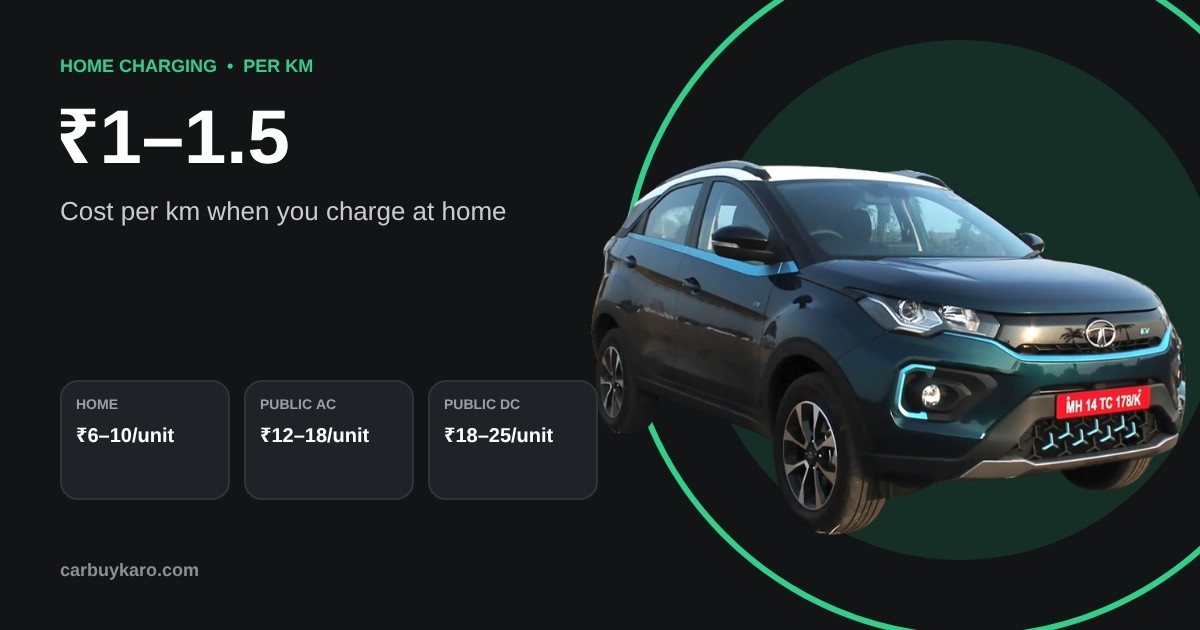
The EV charging cost in India depends mainly on where you charge. At home, electricity costs roughly ₹6–10 per unit, which works out to about ₹1–1.5 per km for most EVs. Public AC chargers typically cost ₹12–18 per unit, and public DC fast chargers ₹18–25 per unit plus GST, which works out to about ₹3–4 per km. Petrol cars, by comparison, cost ₹5–8 per km. Home charging is the single biggest factor in how much an EV saves you.
Below we break down the costs, show the maths for popular EVs, and explain how to cut your charging bill.
What a “unit” means
Electricity is sold in kilowatt-hours (kWh), commonly called units. An EV battery’s size is also measured in kWh. A 40 kWh battery holds 40 units of energy. Charging is not perfectly efficient; some energy is lost as heat. Expect to draw about 10–15% more from the wall than ends up in the battery for AC charging.
Home charging cost
Residential electricity tariffs vary by state and by slab. Many states use slabs, where the price per unit rises with monthly consumption. Adding an EV often pushes a household into higher slabs.
| Home tariff | Cost to add 40 kWh (with losses, ~45 units) |
|---|---|
| ₹6 per unit | about ₹270 |
| ₹8 per unit | about ₹360 |
| ₹10 per unit | about ₹450 |
Some power companies offer special EV tariffs or time-of-day rates that are cheaper late at night. Ask your distribution company whether a separate EV connection or tariff is available.
Public charging cost
Public AC chargers (7–22 kW) are usually found at malls, offices and hotels. They cost roughly ₹12–18 per unit. They are slower, so they suit places where you park for a few hours.
Public DC fast chargers (30–150 kW or more) are found on highways and in city hubs. They cost roughly ₹18–25 per unit plus GST. Some operators charge idle or parking fees if you stay connected after charging finishes.
Prices vary by operator, city and even time of day. Charging apps show the price before you start.
Cost per kilometre for popular EVs
Efficiency varies by car size and driving. As a guide, compact EVs manage about 7 km per unit in mixed driving, larger SUVs about 5–6 km per unit.
| EV type | Efficiency | Home (₹8/unit) | Public DC (₹22/unit) |
|---|---|---|---|
| Compact (Punch EV, Nexon EV) | ~7 km/unit | ~₹1.1/km | ~₹3.1/km |
| Midsize (Creta Electric, BE 6) | ~6 km/unit | ~₹1.3/km | ~₹3.7/km |
| Large / 7-seat (Tomahawk EV, Harrier EV) | ~5.5 km/unit | ~₹1.5/km | ~₹4.0/km |
For comparison, a petrol compact SUV at 14 km/l and ₹95 per litre costs about ₹6.8 per km.
Monthly cost examples
For 1,500 km a month:
| Scenario | Monthly cost |
|---|---|
| Compact EV, all home charging | about ₹1,700 |
| Compact EV, 80% home / 20% public DC | about ₹2,300 |
| Compact EV, all public DC | about ₹4,700 |
| Petrol compact SUV | about ₹10,200 |
Even owners who rely heavily on public charging save money compared with petrol, but home charging saves the most. Model your own mix with our EV vs petrol calculator.
How to reduce your charging bill
- Charge at home whenever possible. It is the cheapest option by far.
- Use time-of-day tariffs if your power company offers them. Schedule charging for late night.
- Charge to 80% for daily use. It is gentler on the battery and you rarely need 100% for daily trips.
- Use workplace charging if your office offers it, sometimes free.
- Drive smoothly. Gentle acceleration and strong regenerative braking add range.
- Keep tyres properly inflated. Low pressure costs range.
- Pre-cool the car while plugged in on hot days, using grid power rather than the battery.
- Compare charging apps on highways; prices vary between operators at the same location.
Solar and EVs
Homes with rooftop solar can charge EVs with very low marginal cost, especially if the car is at home during the day. With net metering, excess solar during the day offsets night-time charging. For bungalow owners who already plan solar, adding an EV makes the investment work even harder.
Hidden costs and fees
- Idle fees at some DC chargers if you stay plugged in after charging.
- GST on public charging (usually added on top of the per-unit price).
- Wallbox installation at home, typically ₹10,000–30,000 depending on wiring, although many carmakers include a charger. Our home EV charger installation guide explains what is involved.
- Sanctioned load increase fees if your home connection is too small.
Worked example: a Mumbai commuter
A commuter drives 60 km a day, 22 days a month, plus 300 km on weekends, total about 1,600 km a month, in a midsize EV at 6 km per unit.
- Energy needed: about 267 units a month.
- Home charging at ₹10 per unit (higher slab): about ₹2,700.
- If 20% is charged at public DC chargers at ₹24 per unit: the mix costs about ₹3,400.
- A petrol midsize SUV at 12 km/l and ₹104 per litre: about ₹13,900.
Monthly saving: roughly ₹10,500, or about ₹6.3 lakh over five years.
EV charging on road trips
Highway corridors like Mumbai–Pune, Delhi–Jaipur, Bengaluru–Mysuru and Chennai–Bengaluru now have plenty of DC fast chargers. Plan stops at 20–30% battery, charge to about 80%, and keep two or three charging apps installed with payment details saved. Our upcoming electric cars guide also covers range and charging tips.
Common mistakes
- Assuming public charging costs the same as home. It can cost three times more.
- Ignoring electricity slabs. Your EV may push your home bill into a higher slab.
- Charging to 100% every day. Unnecessary for most commutes.
- Not checking idle fees at public chargers.
Charging connectors in India
Most modern EVs in India use the CCS2 connector for DC fast charging and Type 2 for AC charging. Older and smaller EVs sometimes used different standards, so check your car’s compatibility with public chargers in your city. Charging apps usually filter stations by connector type.
How charging speed affects cost and time
- Portable charger on a 15-amp socket (about 3 kW): very slow, useful only as a backup or for small batteries overnight.
- Home wallbox (7.2 kW): adds about 35–45 km of range per hour. The most practical option for most homes.
- Home wallbox (11 kW): faster, if your car and electrical connection support it.
- Public DC fast charger (30–60 kW): adds 100–200 km in 30 minutes.
- High-power DC charger (100 kW+): 10% to 80% in around 25–35 minutes on compatible cars.
Faster charging costs more per unit but saves time on road trips. For daily use, slow home charging is cheapest and kindest to the battery.
Workplace and society charging
Many offices and housing societies now install shared chargers. Tariffs vary: some offer free charging as an employee perk, others charge a fixed rate per unit. In societies, a common arrangement is a separate meter for EV chargers with costs billed to each user. If your society has no charger, ask the committee; state rules in several places now require societies to allow EV charging installations.
Choosing an EV with charging costs in mind
If your home has a limited sanctioned load, or you rely on public charging, choose an efficient EV with a moderate battery rather than the biggest pack. A compact EV at 7 km per unit costs noticeably less to charge than a large SUV at 5 km per unit. Compare models in our best electric cars in India guide, and plan your home setup with our home EV charger installation guide.
Battery care and charging habits
Charging habits affect battery life. Daily charging to 80–90% and avoiding frequent fast charging to 100% helps batteries last longer. LFP batteries tolerate full charges better than other types. Our EV battery life and warranty guide explains how to protect your battery.
Home tariff tips by state
Electricity tariffs differ widely. Some states have low base tariffs but steep upper slabs; others have flatter rates. A few practical steps help:
- Look at your last few electricity bills to see which slab you are in.
- Estimate your EV’s monthly consumption (monthly kilometres divided by about 6–7 km per unit).
- Check whether adding that consumption pushes you into a higher slab.
- Ask your power company about separate EV meters or time-of-day tariffs.
In many cases, the extra cost of home charging still works out far cheaper than public charging, even in the top slab.
Charging cost vs total ownership cost
Charging is only one part of what an EV costs. The purchase price is usually higher than a comparable petrol car, insurance can be slightly higher, and resale is still settling. On the other side, service costs are lower and many states reduce road tax. For most buyers who drive 1,000 km or more a month and can charge at home, the energy saving alone recovers the price premium within four to six years. Beyond that, the EV keeps saving money every month. The higher your monthly distance, the faster the payback.
Keep a simple log of units charged and kilometres driven for the first two months. It will tell you your real cost per kilometre far more accurately than any estimate, and help you decide whether a wallbox upgrade or a special tariff is worth it.
Summary
The EV charging cost in India ranges from about ₹1–1.5 per km with home charging to ₹3–4 per km at public DC fast chargers, both cheaper than petrol at ₹5–8 per km. Home charging, time-of-day tariffs and smooth driving keep costs lowest. If you are choosing an EV, see our best electric cars in India list.
Frequently asked questions
How much does it cost to charge an EV at home in India?
Home electricity typically costs ₹6–10 per unit depending on your state and slab. A 40 kWh battery charged from 10% to 100% needs about 40 units including losses, so a full charge costs roughly ₹250–400.
What do public fast chargers cost in India?
DC fast chargers usually charge ₹18–25 per unit plus GST, depending on the operator and location. Some also charge a session or parking fee.
What is the cost per km of an electric car?
With home charging, most EVs cost about ₹1–1.5 per km. With public DC fast charging, it rises to about ₹3–4 per km.
Is charging an EV cheaper than petrol?
Yes. Even with public fast charging, most EVs are cheaper per km than petrol cars, which cost ₹5–8 per km. With home charging, the saving is dramatic.
Prices are ex-showroom unless we say otherwise, and makers change them often. Confirm the latest price, offers and variant details with an authorised dealer before you book.


