On this page 14 sections
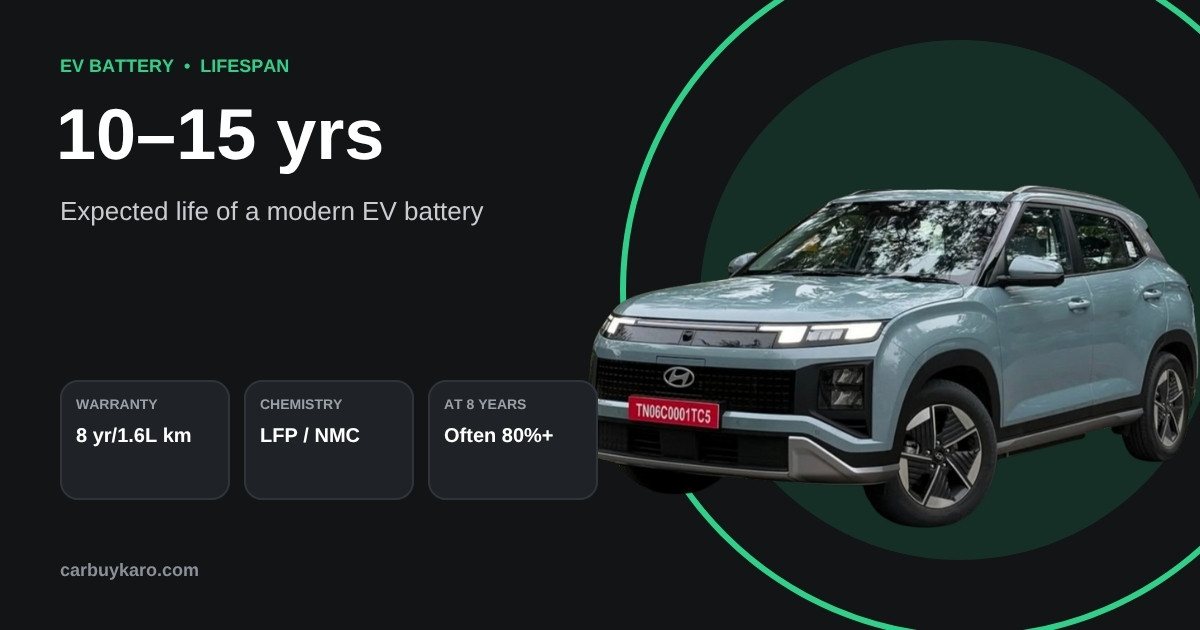
EV battery life and warranty are the two biggest worries for people considering an electric car in India. The short answer: modern EV batteries are built to last 10–15 years or well over 1.5 lakh km, losing capacity slowly rather than failing suddenly. Most carmakers in India offer battery warranties of around eight years and 1.6 lakh km, with some offering unlimited kilometres for the first owner, and they typically guarantee that the battery will retain a minimum capacity, often around 70%, during that period. Simple habits, like charging mostly at home and avoiding keeping the battery at 100% for long periods in extreme heat, help it last even longer.
Here is how EV batteries age, what warranties really cover, what replacement costs, and how to look after yours.
How EV batteries age
EV batteries are made of many lithium-ion cells grouped into modules. Over time, chemical reactions inside each cell slowly reduce how much energy it can store. This is called degradation. It happens in two ways:
- Calendar ageing: the battery ages simply with time, faster when kept at high temperature and high charge.
- Cycle ageing: each charge and discharge cycle causes a tiny amount of wear.
Degradation is usually faster in the first year or two, then slows to a gentle, steady decline. A battery that loses 5% in its first two years might lose only another 5–8% over the next six.
What this means in practice: an EV with 400 km of real range when new might have around 340–360 km after eight years. The car is still perfectly usable.
LFP vs NMC batteries
Two battery chemistries dominate Indian EVs.
LFP (lithium iron phosphate): very stable, tolerant of heat and of frequent charging to 100%, and very long cycle life. The trade-off is lower energy density, so the battery is heavier for the same range. Many Indian EVs, including the MG Hector Tomahawk EV, use LFP. See our Tomahawk EV guide.
NMC (nickel manganese cobalt): higher energy density, so more range for the weight. It is more sensitive to heat and to sitting at 100% charge for long periods. Makers usually recommend charging NMC batteries to 80–90% for daily use.
Neither is “better” overall. Check which chemistry your car uses and follow the maker’s charging advice.
What EV battery warranties cover in India
Warranty terms vary by brand and model, but most include:
- Duration: typically eight years, sometimes longer.
- Distance: typically 1.6 lakh km, sometimes unlimited for the first owner.
- Minimum capacity guarantee: often 70% state of health during the warranty period. If capacity falls below that, the maker repairs or replaces the battery.
- Defects: manufacturing faults in cells, modules or the battery management system.
What is usually not covered:
- Damage from accidents, flooding or misuse.
- Damage from unauthorised modifications or repairs.
- Normal, gradual capacity loss above the guaranteed minimum.
Transferability: some warranties transfer fully to the next owner, some offer reduced coverage, and some extended benefits apply only to the first owner. This matters for resale.
Always read the warranty document before buying and keep a copy.
What does a battery replacement cost?
A full battery pack replacement outside warranty can be expensive, often several lakh rupees depending on the battery size and model. But full replacements are rare for three reasons:
- Batteries age slowly. Most owners sell or keep using the car long before the battery becomes unusable.
- Module-level repairs. If one module fails, it can often be replaced without replacing the whole pack.
- Falling battery prices. Battery costs have dropped substantially over the past decade and are expected to keep falling.
Some makers also offer extended battery warranties or battery-as-a-service (BaaS) plans, where you rent the battery and the maker takes responsibility for it. Our BE 6 Sporteq guide explains how BaaS pricing works.
How to make your EV battery last longer
1. Charge mostly at home with AC
Home AC charging is gentle. Regular DC fast charging generates more heat, which speeds up ageing. Use fast chargers on road trips, not as your daily routine.
2. Avoid keeping the battery at 100% for long
For NMC batteries, set a daily charge limit of 80–90%. Charge to 100% only before a long trip. LFP batteries tolerate 100% better, and some makers recommend a full charge periodically to keep the battery management system calibrated. Follow your car’s manual.
3. Avoid running it very low
Try not to regularly drop below 10–15%. Deep discharges add stress.
4. Park in the shade
Heat is the enemy of batteries. In Indian summers, park in shade or covered parking where possible. Your car’s thermal management system will work less hard.
5. Do not leave the car unused for months at high or very low charge
If you are travelling for weeks, leave the battery around 50–60%.
6. Keep software updated
Makers improve battery management through software updates. Accept updates at service visits.
7. Drive smoothly
Hard acceleration and high speeds draw large currents and generate heat. Smooth driving helps range and battery health.
Checking battery health
Many EVs show a state of health (SoH) figure through the service centre’s diagnostic tools, and some apps display it too. When buying a used EV, ask for a battery health report from an authorised service centre. A car with 90% SoH after four years is in good shape.
Battery health and resale value
Used EV buyers look closely at battery condition. To protect resale value:
- Keep service records and any battery health reports.
- Mention the remaining warranty period when selling.
- Check whether your warranty transfers to the next owner.
Our car resale value tips cover more ways to get a good price.
Worked example: range after eight years
A buyer drives an EV with 420 km of real-world range when new, 1,500 km a month.
- After two years, battery health is around 94%: range about 395 km.
- After five years, around 88%: range about 370 km.
- After eight years, around 82%: range about 345 km.
At 1,500 km a month, that is about 1.44 lakh km over eight years, within a typical 1.6 lakh km warranty. The car still covers a 50–60 km daily commute several times over on a single charge.
Is battery worry a reason not to buy an EV?
For most buyers, no. Modern EV batteries have proven more durable than many people expected, warranties are long, and the savings on fuel and maintenance are large. If you drive a lot and can charge at home, the running-cost savings usually far outweigh any battery concerns. Our EV charging cost guide shows how much you can save.
That said, choose a car with a clear warranty, a good service network and, ideally, a transferable warranty. See our best electric cars in India for recommendations.
Battery safety
EV batteries are designed with multiple safety systems: cell-level monitoring, cooling, protection against overcharging and crash protection structures. Thermal events are rare. Good habits help:
- Use certified chargers and proper wiring at home.
- Do not charge a battery that has been visibly damaged.
- Avoid driving through deep water; follow the maker’s wading limits.
- If a warning light appears, get the car checked promptly.
Common myths
- “You will need a new battery after five years.” Most batteries last far longer.
- “Fast charging ruins batteries.” Occasional fast charging is fine; daily reliance is what adds wear.
- “You must always charge to 100%.” Not needed for daily use, especially with NMC batteries.
- “Batteries fail suddenly.” They usually lose capacity gradually, giving plenty of warning.
Questions to ask the dealer about the battery
Before you buy any EV, ask these questions and get the answers in writing:
- What is the battery warranty period in years and kilometres?
- What minimum state of health is guaranteed during the warranty?
- Does the warranty transfer fully to a second owner?
- Can the warranty be extended, and at what cost?
- Is the battery LFP or NMC, and what daily charge limit do you recommend?
- How is battery health checked at service visits, and will I get a report?
A dealer who answers clearly and puts it in writing is a good sign. Vague answers are a warning.
Battery recycling and second life
When an EV battery eventually drops below useful capacity for driving, it is not waste. Batteries with 70% or so of their capacity can be reused for stationary storage, such as backing up solar power. Beyond that, recycling recovers valuable materials like lithium, nickel and cobalt. India’s battery waste management rules place responsibility on producers for collection and recycling.
Summary
EV battery life and warranty in India are better than many buyers fear. Batteries typically last 10–15 years with gradual capacity loss, and warranties of around eight years and 1.6 lakh km, with minimum capacity guarantees, protect you against defects and excessive wear. Charge mostly at home, avoid heat and long periods at full charge, and keep records for resale. For more EV guidance, visit our EV and CNG section.
Frequently asked questions
How long does an EV battery last in India?
Most modern EV batteries are designed to last 10–15 years or well over 1.5 lakh km, losing capacity gradually. Many will still have around 80% of their original capacity after eight years of normal use.
What does an EV battery warranty cover?
Most EV battery warranties in India cover manufacturing defects and excessive capacity loss for around eight years and 1.6 lakh km, sometimes longer. The warranty usually guarantees a minimum capacity, often 70%, during that period.
How much does it cost to replace an EV battery in India?
A full battery replacement outside warranty can cost several lakh rupees depending on battery size. In practice, full replacements are rare; faulty modules can often be repaired or replaced individually.
Does fast charging damage the battery?
Occasional fast charging is fine. Relying on DC fast charging every day, especially to 100% in hot weather, can speed up battery ageing. Home AC charging is gentler.
Prices are ex-showroom unless we say otherwise, and makers change them often. Confirm the latest price, offers and variant details with an authorised dealer before you book.


