On this page 13 sections
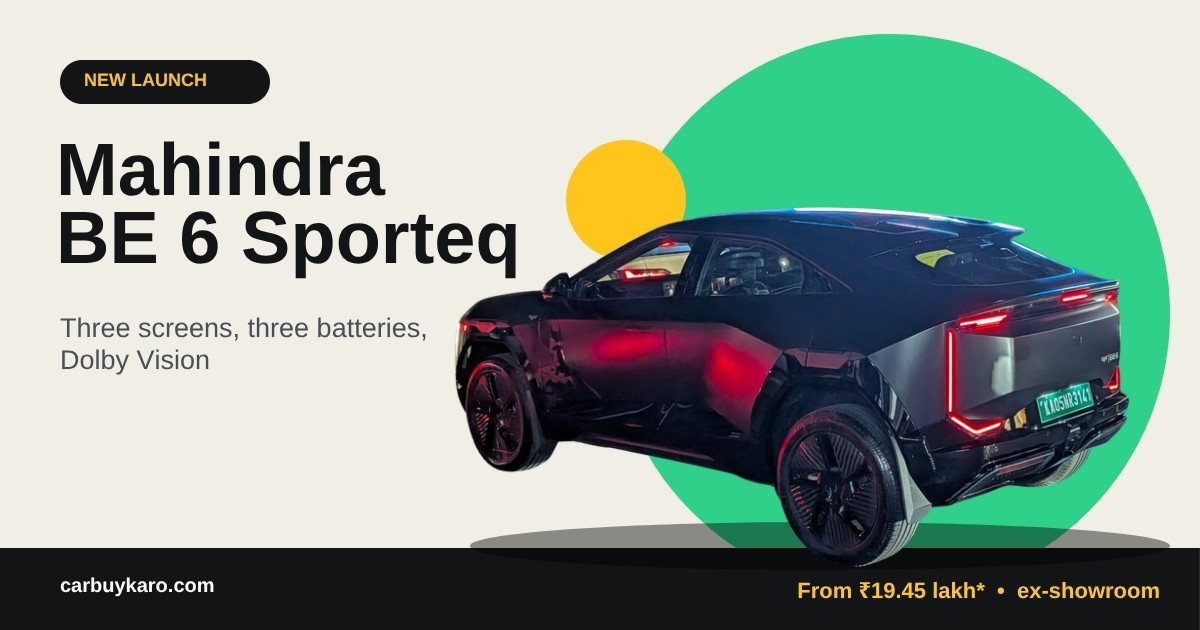
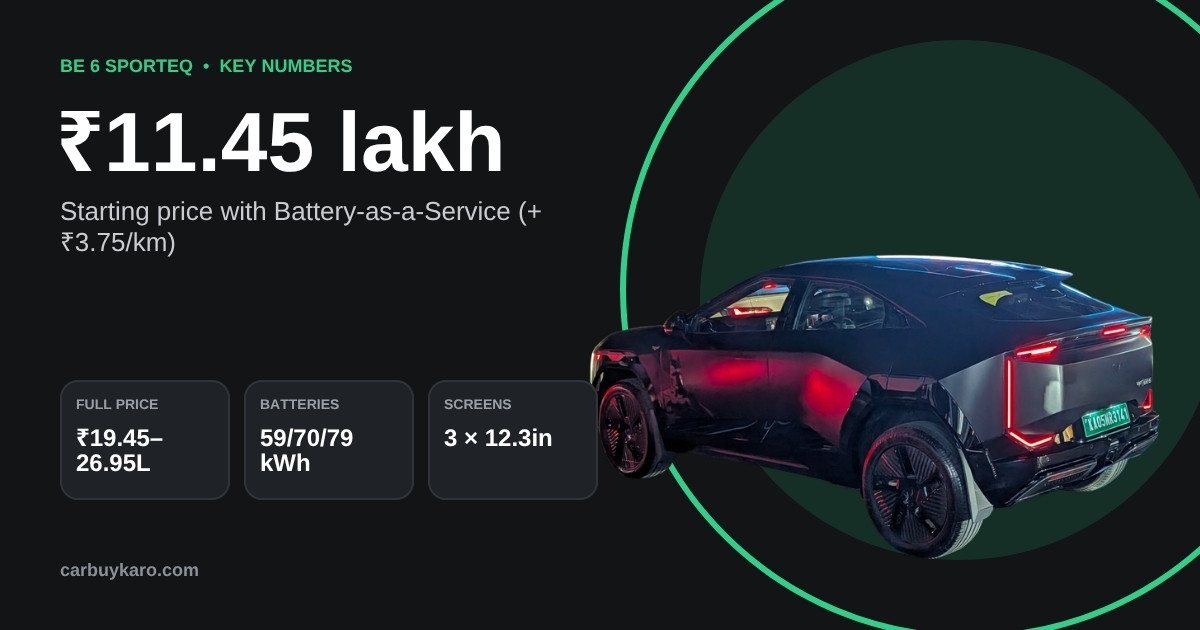
The Mahindra BE 6 Sporteq is an updated, sportier version of Mahindra’s coupe-styled electric SUV, launched on 15 August 2026. Prices run from ₹19.45 lakh to ₹26.95 lakh (ex-showroom), or from ₹11.45 lakh plus ₹3.75 per km with Battery-as-a-Service. It adds a third battery size (70 kWh), a new dashboard with three 12.3-inch screens, fresh software, a Dolby Vision and Atmos-certified 16-speaker Harman Kardon system, and new colours. Deliveries began on 26 August.
Here is what you get, how the batteries compare, and which version is worth your money.
BE 6 Sporteq prices and battery options
| Battery | What it suits | Price band (ex-showroom) |
|---|---|---|
| 59 kWh | City use, occasional highway | from ₹19.45 lakh |
| 70 kWh (new) | Mixed use, regular 250–300 km trips | mid-range |
| 79 kWh | Long highway runs, top features | up to ₹26.95 lakh |
The new 70 kWh option fills a real gap. Earlier, buyers had to choose between the smaller pack, which felt limiting for some highway users, and the big pack that came only with expensive trims. Mahindra says the top Launch Edition gets an exclusive matte Graphite Storm paint. Ruby Velvet is another new colour, and a Racing Tan interior theme joins the list.
What the Sporteq adds
Three screens
The dashboard now carries three 12.3-inch displays: a driver’s cluster, a central touchscreen and a separate screen for the front passenger. The passenger display is more than a gimmick on long trips; the navigator can manage music and navigation without reaching across.
TEQ software
Mahindra has rolled out new software features under the “TEQ” name: an AI voice assistant, driver profiles that remember seat, mirror and drive settings, and personalised tail-lamp animations. Software updates can arrive over the air.
Audio and video
The 16-speaker Harman Kardon system supports Dolby Atmos, and Mahindra claims the BE 6 Sporteq is the first EV in India with both Dolby Vision and Dolby Atmos. Useful while waiting at a fast charger, which is exactly when owners watch video.
Range and charging in the real world
Mahindra’s claimed MIDC ranges for the BE 6 are optimistic, as all MIDC figures are. As a rule of thumb, Indian EVs deliver 70–80% of their MIDC range in daily use. For the 59 kWh pack, plan on around 350–400 km of mixed driving. The 79 kWh pack should manage 450–520 km. On the highway at 100–110 km/h, knock off another 10–15%.
A full charge on the 79 kWh pack at home costs about ₹630–790 at ₹8–10 per unit. That works out to roughly ₹1.3–1.6 per km. At a public DC fast charger priced at ₹20–24 per unit, it rises to about ₹3.5–4 per km. That is still cheaper than petrol, but far less dramatic. Our EV charging cost guide has city-wise tariffs.
Is BaaS a good deal on the BE 6?
BaaS cuts the upfront price by ₹8 lakh (₹19.45 lakh to ₹11.45 lakh) and charges ₹3.75 per km. Over five years:
- At 1,000 km a month you pay ₹2.25 lakh in battery rental. You are ₹5.75 lakh ahead.
- At 2,000 km a month you pay ₹4.5 lakh. Still ₹3.5 lakh ahead.
- Break-even over five years is about 3,550 km a month, which very few private owners reach.
On these numbers, BaaS on the BE 6 is attractive for almost everyone who plans to keep the car for five years. The unknown is resale: some used-car buyers may hesitate over a car whose battery is on a subscription. Ask Mahindra exactly how BaaS transfers to a second owner before you sign. You can model your case with our EV vs petrol calculator.
BE 6 Sporteq vs its rivals
The BE 6 is a five-seat, coupe-style EV. Rivals include the Tata Curvv EV, Hyundai Creta Electric and MG ZS EV. The BE 6 is the most driver-focused of the group, with sharp steering and strong acceleration. The trade-off is rear headroom (the sloping roof eats into it) and a smaller rear window. Families who put tall adults in the back should sit there before booking.
If you are weighing up EVs in general, our list of the best electric cars in India compares the main choices by range and price.
Which BE 6 Sporteq should you buy?
- City commuter, 800–1,200 km a month, home charging: 59 kWh with BaaS. Lowest upfront cost, and the range is more than enough.
- Mixed use with weekend trips of 250–300 km: the new 70 kWh pack. This is our pick for most buyers.
- Frequent intercity trips and you want every feature: 79 kWh.
Before you book: a checklist
- Home charging. Confirm your building allows a 7.2 or 11 kW wallbox, and check your sanctioned electrical load. Our home EV charger installation guide walks you through it.
- Road tax. Many states waive road tax on EVs, which can save ₹1.5–3 lakh on a car in this price band. See the EV road tax guide.
- Battery warranty. Get the battery warranty terms in writing, including what capacity loss counts as a claim. See our EV battery warranty guide.
- Insurance. EV insurance premiums are based on the car’s value, and the battery is the most expensive part. Zero-dep cover matters more than on a petrol car.
- Rear seat test. Take the family along and sit in the back.
Common mistakes
- Picking the biggest battery “for safety” when you never drive more than 100 km a day. It adds cost and weight.
- Assuming fast charging is always available on your routes. Check the charger map for your regular trips before you buy.
- Forgetting that BaaS kilometres add up on road trips. A 1,000 km holiday adds ₹3,750 in battery rental.
How the BE 6 drives
The BE 6 is rear-wheel drive in its standard form, and it feels it. The steering is quick and the car turns in eagerly, which is unusual for an Indian-made SUV. Mahindra offers several drive modes; the sportiest one sharpens throttle response and adds weight to the steering. In the city, the comfort setting is the one you will use.
Regenerative braking has several levels. At the strongest, you can drive in traffic almost without touching the brake pedal. New EV owners often find this odd for a day or two. After a week, most prefer it, because it adds range and reduces brake wear.
The ride is firm at low speeds over sharp potholes, a trade-off for the car’s composed handling. It smooths out at highway speeds. If most of your driving is on badly broken roads, take a long test drive on your own route before deciding.
Practicality check
A coupe-style roofline always takes something away. In the BE 6, it is rear headroom and rear visibility. Passengers up to about 5 feet 10 inches sit comfortably. Taller adults may find their hair brushing the roof lining. The boot is a useful size for a family weekend, and there is a small storage space under the bonnet for charging cables.
The rear window is small and steeply raked, so you rely on the camera system when reversing. Mahindra’s surround-view camera is good, but check it at night in a dim basement, which is where most scrapes happen.
Charging on road trips: planning tips
EV road trips in India have become much easier since 2024, but a little preparation still saves time and stress.
- Plan charging stops at 20–30% battery, not 5%. DC chargers deliver their fastest speed at low-to-mid charge, and arriving with a buffer protects you if a charger is busy or broken.
- Charge to 80%, not 100%, on the road. Charging slows sharply after 80%. Two short stops are usually faster than one long one.
- Keep two apps on your phone. Different charging networks use different apps. Set them up and add payment details before you leave.
- Carry the portable charger. In an emergency, a regular 15-amp socket at a hotel or dhaba can add a few kilometres per hour, enough to reach the next fast charger.
- Watch your speed. Going from 100 to 120 km/h on the highway can cut range by 15–20%.
Ownership costs over five years
Let us compare a BE 6 with the 70 kWh pack against a petrol SUV of similar size for a buyer doing 1,500 km a month.
- Energy: home charging at ₹9 per unit and roughly 6.5 km per unit costs about ₹2,100 a month. The petrol SUV at 12 km/l and ₹95 a litre costs about ₹11,900.
- Service: EVs have far fewer moving parts. Expect service costs to be around half of a comparable petrol car.
- Road tax: in states that waive EV road tax, you save ₹1.5–2.5 lakh upfront.
Over five years, the fuel saving alone comes to roughly ₹5.9 lakh. That easily covers the EV’s price premium over a petrol SUV, which is why the BE 6 makes strong financial sense for high-mileage owners who can charge at home.
Summary
The Mahindra BE 6 Sporteq sharpens an already sporty EV with a new 70 kWh battery option, a triple-screen dashboard, better software and top-class audio, from ₹19.45 lakh or ₹11.45 lakh with BaaS. For most buyers, the 70 kWh version is the sweet spot, and BaaS pays off unless you drive huge distances. Browse our EV and CNG section for more electric car advice.
Frequently asked questions
What is the price of the Mahindra BE 6 Sporteq?
The BE 6 Sporteq costs ₹19.45 lakh to ₹26.95 lakh ex-showroom. With Mahindra's Battery-as-a-Service plan, it starts at ₹11.45 lakh plus ₹3.75 per km.
Which battery sizes does the BE 6 Sporteq offer?
Three: 59 kWh, 70 kWh and 79 kWh. The 70 kWh pack is new and sits between the two existing options.
What is new on the BE 6 Sporteq?
A redesigned dashboard with three 12.3-inch screens including one for the passenger, new TEQ software features like an AI voice assistant and driver profiles, a 16-speaker Harman Kardon system with Dolby Atmos and Dolby Vision, and new colours and interior themes.
When did BE 6 Sporteq deliveries begin?
Mahindra launched it on 15 August 2026 and deliveries started on 26 August 2026.
Prices are ex-showroom unless we say otherwise, and makers change them often. Confirm the latest price, offers and variant details with an authorised dealer before you book.


